Signature · about 4 hours, with the pork made the day before if you like · Serves 4
White corn arepa with rum-braised pork, avocado cream and pickled onion
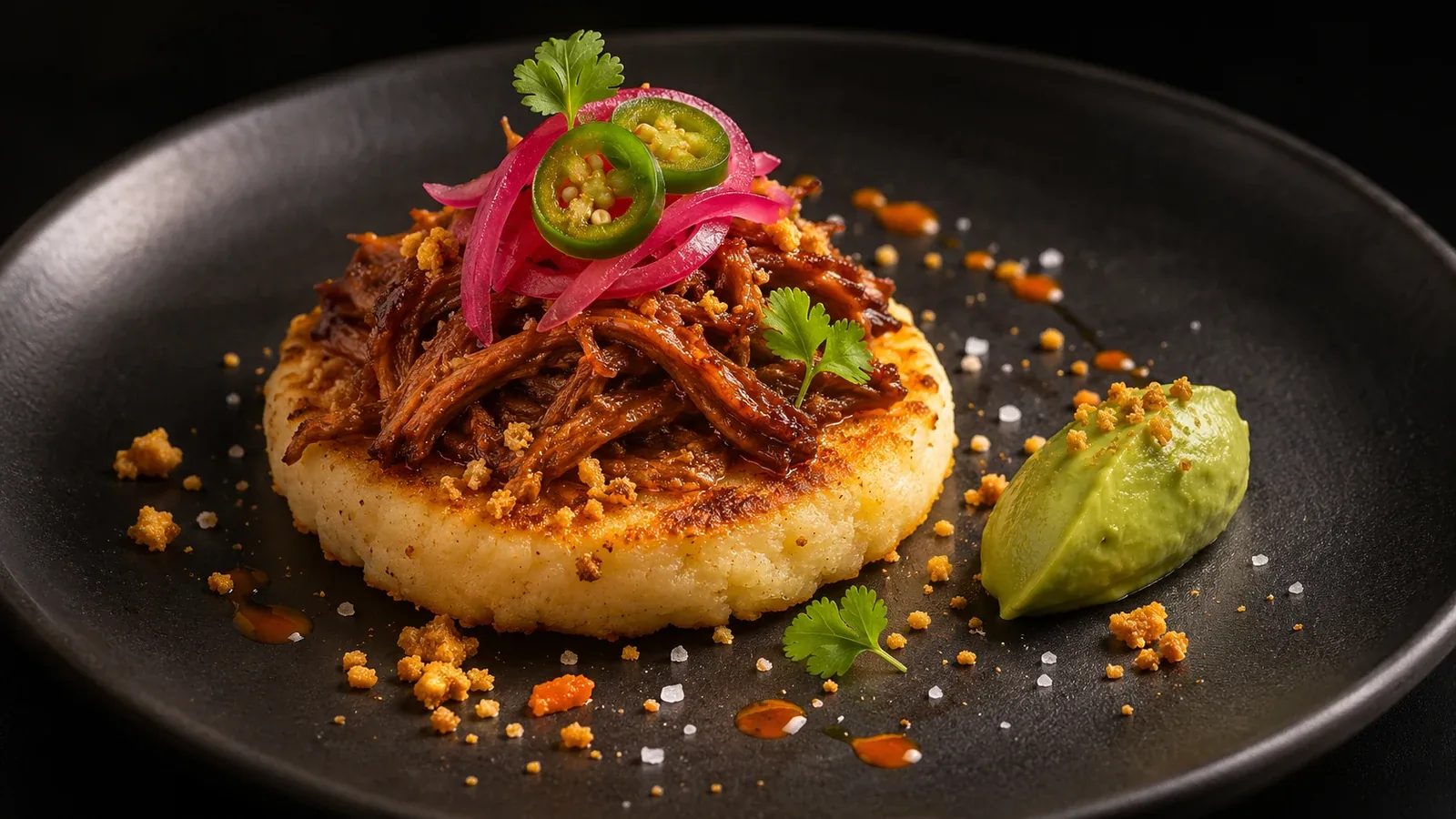
Illustrative image generated with AI, not a photo of the cooked dish.
Kitchen test pending
The Venezuelan arepa filled or topped with shredded meat and avocado, like the reina pepiada and the pernil. This version keeps the corn at the center in an individual arepa, golden and crisp outside and tender inside, as a starter or a tasting-menu dish.
The twist is to work with texture contrasts on top of the arepa. The pork is braised with aged rum and panela and shredded in a concentrated, glossy glaze with a touch of vinegar. An avocado and yogurt cream brings freshness and creaminess, a pickled red onion with jalapeño cuts through the fat with its acidity and a crumble of pork cracklings or panko adds crunch. Lime, cilantro and a chile oil lift the aromas at the end.
Special equipment: heavy pot or Dutch oven; cast-iron pan or griddle; hand blender
Ingredients
Rum and panela braised pork
- 600 g pork shoulder, collar or chuck, in 4–5 cm pieces
- Fine salt and freshly ground black pepper
- 20 ml neutral oil
- 150 g white onion, in brunoise
- 60 g carrot, in small cubes
- 40 g celery, in small cubes
- 3 garlic cloves, lightly crushed
- 80 g crushed tomatoes
- 80 ml aged rum
- 15 g panela, muscovado or brown sugar
- 2 bay leaves
- 2 sprigs fresh thyme
- 400–500 ml mild chicken or beef stock, hot
- 10 ml sherry or apple cider vinegar
Pickled red onion and jalapeño
- 100 g red onion, in very thin slices
- 1 fresh jalapeño, in thin rounds
- 80 ml rice or apple cider vinegar
- 40 ml water
- 15 g sugar
- 4 g salt
Crisp crumble
- 30 g very dry, crisp pork cracklings (chicharrón), or 20 g panko with 10 g clarified butter
- 1 pinch of smoked paprika
- ½ teaspoon finely grated lime zest
Avocado cream
- 200 g ripe avocado pulp
- 60 g plain Greek yogurt
- 15 ml lime or lemon juice
- 1 pinch of ground cumin
- ¼ fresh green chile, optional
- Fine salt
- 20 ml mild olive oil
White corn arepas
- 220 g fine-ground white corn flour, not pre-cooked
- 450 ml light chicken or vegetable stock, or water
- 15 g clarified butter or ghee
- 6 g fine salt
- 3 g sweet smoked paprika
- Neutral oil or ghee, for browning
Finishing
- Micro cilantro or cilantro sprouts
- Aji amarillo, chile or infused olive oil
- Lime zest, optional
- Flaky salt, optional
Method
Rum and panela braised pork
- Searing and sofrito. Dry the pork well and season it with salt and pepper. Heat a heavy pot over medium-high heat with the oil and sear the pork in batches, without crowding, 2–3 minutes per side; remove it. Lower to medium heat and cook the onion, carrot and celery 5–6 minutes, add the garlic for 1 minute and the tomato for 2–3 minutes, until just concentrated.
- Braising. Deglaze with the rum, scraping the bottom, and reduce by half. Return the pork with the panela, bay leaves and thyme, and add hot stock to cover three quarters of the meat. Bring to a gentle boil, cover leaving a gap and cook over very low heat for 1 h 45 min – 2 hours, or in the oven at 160 °C (320 °F) for 2–2½ hours, until the meat separates easily with a fork.
- Glaze. Remove the meat, let it rest for a few minutes and shred it, keeping some long fibers. Strain the liquid, discard the vegetables and herbs and reduce it over medium heat for 8–15 minutes, until concentrated, glossy, only slightly thick and able to cling to the meat. Add the vinegar and correct the salt, acidity and sweetness. Return the pork and mix until fully glazed. If prepared ahead, chill it quickly and reheat it slowly with a few spoonfuls of stock or water.
Pickled red onion and jalapeño
- Pickling. Put the onion and jalapeño —seedless and without membranes if you want less heat— in a heatproof container. Boil the vinegar with the water, sugar and salt and, once dissolved, pour it right away over the vegetables. Let stand at least 20 minutes; it is better with 1–24 hours in the refrigerator. Drain very well before plating.
Crisp crumble
- With cracklings. Crush them into small, irregular pieces and mix with the paprika and lime zest.
- With panko. Toast the panko in the clarified butter over medium-low heat, stirring constantly, to an even golden color; add the paprika and zest and let it cool completely before storing.
Avocado cream
- Emulsion. Process the avocado, yogurt, lime, salt, cumin and, if using, the chile to a completely smooth cream, and add the oil in a thin stream without stopping the processor. It should be creamy, smooth, light and firm enough for a quenelle. For a finer finish, pass it through a sieve. Cover with plastic film touching the surface and refrigerate. It is best made as close to serving as possible so it keeps its green color.
White corn arepas
- Toasting and cooking the dough. This non-pre-cooked flour must be fully cooked and hydrated. Toast it in a heavy-bottomed saucepan over low heat for 3–4 minutes, stirring, without browning it. Heat the stock with the salt, paprika and clarified butter and add it gradually to the flour, whisking so no lumps form. Cook over low heat for 8–10 minutes, stirring with a wooden spoon, until a heavy dough that partly pulls away from the sides, with no raw flour taste, no sandy feel and no dry center.
- Resting and texture. Transfer the dough to a tray, cover it with plastic film touching the surface and let it cool slightly for 15–20 minutes. Knead it for 1–2 minutes: it should be soft, pliable, moist, without cracks and not too sticky. If it is dry, add hot water 1 tablespoon at a time; if it is wet, a little flour, without overdoing it, because it makes the arepas tough.
- Shaping. Divide it into 4 portions, form compact balls and flatten them into discs 8–9 cm in diameter and 1.2–1.5 cm thick, smoothing the edges with wet fingers.
- Cooking. Brown them in a cast-iron pan or on a griddle over medium heat with a very thin film of oil or ghee, 5–6 minutes per side, to a golden, slightly crisp surface; over high heat they burn before the center heats through. Finish them in the oven at 180–190 °C (355–375 °F) for 8–10 minutes and rest them for 2 minutes.
Finishing
- At serving. Have the micro cilantro, chile oil, lime and flaky salt ready, and the avocado cream in a piping bag or with two spoons for quenelles.
The dish
Use matte black or dark ceramic plates, 24–26 cm. Place the arepa slightly off center and put 80–100 g of glazed pork on top, with a small ring if you want a more defined shape, without compacting it: the fibers should show. Add a small quenelle of avocado cream next to it and, on the pork, a small mound of pickled onion with 1–2 jalapeño rounds depending on the heat wanted. Scatter a little crumble around and over some spots of the arepa, without covering the plate, and finish with 2–3 micro cilantro leaves, 3–5 drops of chile oil and, if you like, a very fine grating of lime zest and a few flakes of salt. Final look: a golden arepa with the glossy, dark pork in fibers, the smooth green of the avocado, the fuchsia of the pickle and crisp dots.
Key points
- Fully cook and hydrate the non-pre-cooked flour: otherwise the arepa turns sandy and raw.
- Whisk when adding the liquid, to avoid lumps.
- Brown the arepas over medium heat and finish them in the oven.
- Reduce the glaze until it clings to the meat, and balance it with the vinegar.
- Make the avocado cream close to serving and drain the pickle well.
Pairing
An amber beer or a fruity IPA, or an aged rum on ice with orange peel, which echoes the rum in the braise. Without alcohol, papelón with lime or sparkling water with lime.
Notes
- Intended result: each bite combines corn, pork, fat, acidity, freshness and crunch. The arepa brings toastiness and texture; the pork, depth, sweetness and richness; the avocado, freshness; the pickle cuts the fat; the crumble adds a dry contrast, and the lime, cilantro and chile lift the aromas.
- Reheating the pork: if prepared ahead, bring it to 74 °C (165 °F) at the center before serving.