Essential · about 1 h 30 min of work, plus 4–12 hours of draining the ricotta · Serves 4
Traditional ricotta and spinach malfatti
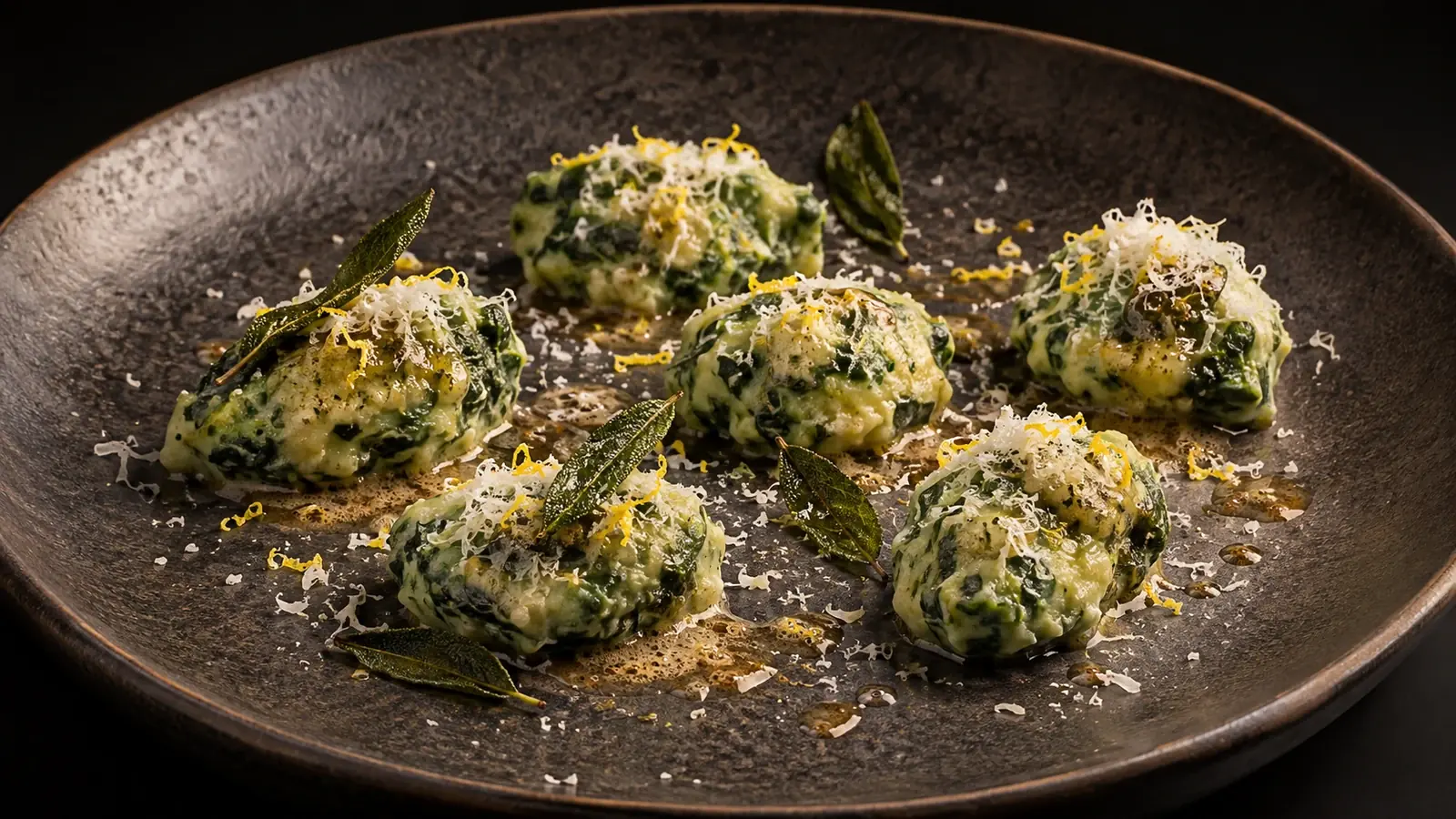
Illustrative image generated with AI, not a photo of the cooked dish.
Kitchen test pending
The malfatti, "badly made", of Tuscan and Lombard cooking: the filling of ricotta and spinach ravioli, without the pasta, formed by hand into irregular pieces. They do not seek a perfect structure or a firm dough: they should be soft, moist, light and slightly imperfect.
The recipe respects the traditional preparation —ricotta, spinach, Parmigiano Reggiano, egg, nutmeg and very little flour— and puts the care into controlling moisture. The ricotta is drained for hours and the spinach is cooked briefly, squeezed and dried in a pan, to need as little flour as possible; a test cook before forming the whole batch avoids surprises. Three sauces are proposed: brown butter with sage and lemon, a light pomodoro with confit garlic or a light mushroom cream.
Special equipment: fine sieve with cloth; kitchen thermometer recommended; slotted spoon
Ingredients
Malfatti
- 500 g whole fresh ricotta
- 500 g fresh spinach
- 80 g finely grated Parmigiano Reggiano
- 1 large egg
- 1 egg yolk
- 1 g freshly grated nutmeg
- 5 g fine salt
- Freshly ground white pepper
- 45–70 g 00 flour
- 20 g fine breadcrumbs, only if the mixture is too wet
- Semolina or flour, for the tray
Brown butter, sage and lemon sauce
- 100 g butter
- 12 fresh sage leaves
- 2–3 tablespoons of the malfatti cooking water
- 20 g grated Parmigiano Reggiano
- Finely grated zest of ½ lemon
- Freshly ground black pepper
Light pomodoro with confit garlic and basil
- 35 ml extra virgin olive oil, plus a drizzle to finish
- 2 whole garlic cloves
- 500 g peeled tomatoes, crushed by hand
- 8 fresh basil leaves
- Fine salt and, if the tomato is very acidic, a pinch of sugar
Light mushroom and Parmigiano cream
- 250 g fresh mushrooms: portobello, cremini or porcini
- 20 g butter
- 15 ml olive oil
- 1 small shallot, finely chopped
- 80 ml dry white wine
- 180 ml mild vegetable stock
- 80 ml heavy cream
- 25 g grated Parmigiano Reggiano
- Fresh thyme, salt and black pepper
Cooking
- Plenty of water and salt
- Finely grated Parmigiano Reggiano, to serve
Method
Malfatti
- Ricotta. Put the ricotta in a fine sieve covered with a cloth, gauze or thick paper, over a container that does not touch it, cover it and drain it in the refrigerator 4–12 hours. It should be firmer and creamier, without excess whey: when pressed with a spoon it releases no visible liquid, without being dry or grainy. If it stays wet, the mixture needs more flour and the malfatti lose lightness.
- Spinach. Wash it and remove thick stems. Cook it in a wide pot, only with the water left from washing, covered over medium heat 2 minutes; uncover, stir and continue 1 minute, until the leaves collapse. Cool it right away on a tray or over ice water, drain it, wrap it in a cloth and squeeze hard. Chop it fine and dry it in a pan without fat over medium-low heat 2–4 minutes, stirring, until it stops releasing steam. It should be moist inside but not watery, tender and not fibrous: about 140–160 g.
- Mixing. Mix with a spatula the ricotta, spinach, Parmigiano, egg, yolk, nutmeg, salt and pepper, without overbeating or kneading. Add 45 g of flour and mix just barely: the mixture should be soft, moist and somewhat sticky, but able to hold an irregular shape. Cover and refrigerate 20 minutes.
- Test. Heat salted water to 85–90 °C (185–194 °F), with gentle movement and no boil. Cook a small portion of the mixture and, when it rises, wait 45 seconds and remove it. If it opens or falls apart, add 10–15 g more flour and rest 5 minutes; if still too wet, add 10–20 g of fine breadcrumbs, only as a final adjustment.
- Forming. With two slightly wet spoons, form rustic quenelles of about 25 g, or oval, irregular pieces with floured hands: the imperfection is part of the dish. Arrange them on a tray with semolina and refrigerate 15 minutes.
Brown butter, sage and lemon sauce
- Browning. Heat the butter in a wide pan over medium heat until it foams and the solids take on a golden color with a nutty aroma. Add the sage 30–45 seconds, until crisp, and remove from the heat for a moment so the butter does not burn.
- Emulsion. Add the cooking water and move the pan for a light emulsion. Coat the malfatti in it 1 minute and finish with the Parmigiano, zest and pepper.
Light pomodoro with confit garlic and basil
- Sauce. Cook the oil with the garlic over low heat 6 minutes, without browning. Add the tomatoes and cook uncovered over medium-low heat 18–22 minutes, to a light, glossy, fresh sauce. Remove the garlic, add the basil and correct the salt, and the sugar if needed. Heat the malfatti in the sauce 45 seconds, moving the pan gently.
Light mushroom and Parmigiano cream
- Mushrooms. Clean them with a damp cloth, cut into slices or quarters and sauté over high heat with the butter and oil 5–6 minutes, until they brown and lose part of their water. Reserve a few browned ones for finishing.
- Cream. Add the shallot 2 minutes, deglaze with the wine and reduce almost completely. Add the stock and cook 5 minutes; add the cream and reduce gently 3 minutes, to a fluid sauce. Off the heat, emulsify the Parmigiano with circular movements and add the thyme, salt and pepper. Coat the malfatti delicately.
Cooking
- Final cooking. Bring plenty of salted water to 88–92 °C (190–198 °F), without a hard boil, and cook the malfatti in small batches so they do not knock into each other. When they rise, continue 60–90 seconds. Lift them out with a slotted spoon and take them straight to the sauce: never drain them in a colander, because they break.
The dish
Use wide plates of artisanal ceramic or stoneware, with a dark or neutral base. Put a very thin base of the chosen sauce and arrange 5 or 6 malfatti per serving, with space between them so their irregular shape shows, coated only in part: the malfatti are the protagonists and the sauce accompanies. With butter and sage, finish with the crisp sage leaves, finely grated Parmigiano, lemon zest and a few drops of brown butter around; with pomodoro, small basil leaves, Parmigiano and a drizzle of olive oil; with mushrooms, the reserved browned mushrooms, Parmigiano, pepper and small thyme leaves. Final look: soft, irregular green pieces on a barely visible sauce, with the cheese and herbs as the only finish.
Key points
- Drain the ricotta well: it is what avoids adding too much flour.
- Cook the spinach briefly, squeeze it thoroughly and dry it briefly in a pan, without toasting it.
- Add the flour little by little, without kneading, and always do a test cook.
- Cook in hot water but without a violent boil, and handle the malfatti with a slotted spoon.
- If they turn out firm, there was too much flour; if they fall apart, the mixture needed more draining or resting.
Pairing
With butter and sage, a Soave Classico or a Chardonnay without excess oak; with pomodoro, a young Chianti, a Barbera or a dry rosé with good acidity; with mushrooms, a Pinot Noir, a young Nebbiolo or a Chardonnay with moderate aging. Without alcohol, non-alcoholic white vermouth or sparkling water with lemon.