Essential · 4–5½ hours; about 90 minutes of active work; the ragù can be made a day ahead · Serves 4
Traditional lasagna with finely minced ragù, béchamel and Pecorino Romano
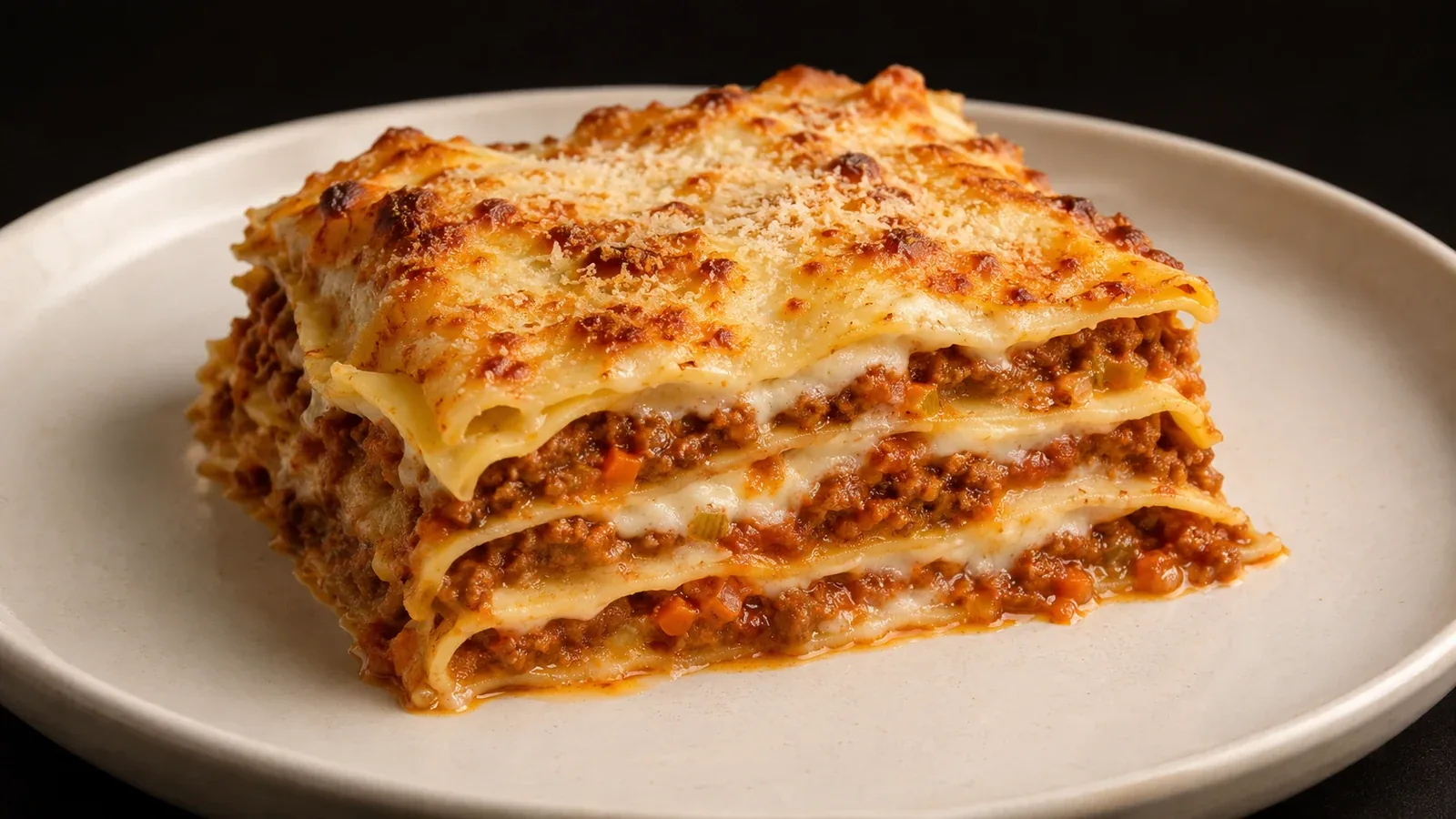
Illustrative image generated with AI, not a photo of the cooked dish.
Concept: the author's lasagna retains its ragù of very finely minced celery, carrot, onion and meat, with red wine and tomatoes. It is assembled with homemade egg pasta, briefly boiled and cooled, classic béchamel with nutmeg and Pecorino Romano between the layers. The aim is a tender, creamy result with pasta present in every bite.
Twist: the improvements focus on execution of that same recipe: cook the soffritto and brown the meat separately, reduce the wine before the tomatoes, adjust the ragù's water content and dry the pasta after cooling. Keep the béchamel fluid to form thin layers and distribute the pecorino in measured amounts for a more even cut without changing the flavor profile the author wants to preserve.
Special equipment: meat grinder with a fine plate; pasta machine or rolling pin; baking dish measuring about 20 × 20 cm inside and at least 6 cm deep; probe thermometer if storing components
Ingredients
Finely minced ragù
- 500 g beef for mincing, such as boneless chuck with some intramuscular fat, trimmed of tough tendons.
- 100 g peeled onion.
- 80 g peeled carrot.
- 60 g trimmed celery.
- 150 ml dry red wine.
- 350 g crushed tomatoes.
- 250 ml hot water, plus more as needed to sustain cooking.
- 30 ml olive oil, divided into 10 ml for the vegetables and 20 ml for the meat.
- Fine salt and black pepper, to taste.
Homemade egg pasta
- 200 g 00 flour.
- 100 g egg without the shell, approximately 2 medium eggs, beaten for weighing.
- Up to 10 g additional 00 flour for rolling and resting the sheets.
- 30 g coarse salt for 3 l cooking water.
Traditional béchamel
- 650 ml whole milk.
- 45 g butter.
- 45 g 00 flour.
- Freshly grated nutmeg, a pinch or to taste, without masking the milky flavor.
- Fine salt, to taste.
Assembly and browning
- 80 g Pecorino Romano, finely grated, divided into 60 g for the layers and 20 g for the top.
- 5 g butter for the baking dish.
Method
Finely minced ragù
- Mince. First pass the onion, carrot and celery through the grinder with a fine plate of about 3–4 mm, in a single pass; keep any juices released. Grind the meat separately with the same plate, keeping it thoroughly chilled. The texture should be fine and recognizable, without becoming a paste through repeated grinding. Clean the raw-meat area before proceeding with cooked food.
- Soffritto. Heat the 10 ml oil in a heavy-bottomed casserole and cook the vegetables with their juices over medium-low heat for 12–15 minutes, stirring. First they release water, then soften and begin to fry gently; aim for sweetness and very light browning. Transfer to a container to make room for browning the meat.
- Meat and wine. Add the remaining 20 ml oil and brown the meat in 2 batches of 6–8 minutes, breaking up lumps with a spoon and allowing short intervals without stirring so it colors. Return all the meat and soffritto to the casserole, add the wine and scrape up the fond. Reduce for 5–8 minutes, until little free liquid remains and the aroma of raw wine has softened.
- Slow cooking. Add the tomatoes and the 250 ml hot water. Bring to a gentle simmer and cook over very low heat, partially covered, for 2–3 hours, stirring occasionally and adding hot water a little at a time if the bottom dries before the meat is tender. The ragù is ready when the meat is finely grained and tender, the vegetables have integrated and the sauce is reddish-brown. Drawing a spoon through should leave a channel that closes slowly, without a ring of water or abundant fat around it. If too watery, finish uncovered for a few minutes; if stiff, adjust with a little hot water. Check the salt and pepper. Weigh the ragù and divide into 4 equal parts for assembly; keep hot, above 60 °C (140 °F), while finishing the pasta and béchamel.
Homemade egg pasta
- Knead and rest. Mix the 200 g flour with the 100 g egg and knead for 8–10 minutes, until firm and smooth. It may seem dry initially: press and knead before adding liquid. If it still will not come together, adjust with water a teaspoon at a time; if sticky, take a small part of the additional 10 g flour. Wrap and rest for 30–45 minutes in a cool place; if hot, rest in the refrigerator and roll once flexible again.
- Roll and cut. Roll progressively with a machine or rolling pin to 0.8–1 mm, flexible and evenly thick. Cut 5 sheets of about 20 × 20 cm, adjusted to the dish's actual interior; a layer can also be completed with two pieces side by side, without thick overlaps. Gather trimmings only once, allow to relax for a few minutes and roll again if more pieces are needed. Do not thicken the pasta to use all the dough: keep spare trimmings.
- Brief boiling and cooling. Bring the 3 l water with the 30 g coarse salt to a boil. Cook one or two sheets at a time for 30–45 seconds after the water returns to a gentle boil, until flexible but still firm. Transfer to clean cold water for 10–15 seconds, drain and spread in a single layer on clean lint-free cloths. Blot surface droplets with another cloth; the sheets should remain flexible without accumulated water. Use during immediate assembly and avoid stacking them wet or letting them harden through drying.
Traditional béchamel
- Roux. Heat the milk without a hard boil. Melt the butter in another saucepan, add the flour and cook over medium-low heat for 2–3 minutes, stirring, until bubbling and no longer smelling of raw flour. Keep it pale.
- Milk and consistency. Add the hot milk in several additions, whisking each smooth. Cook at a gentle simmer for 6–8 minutes, stirring the bottom, until the sauce coats a spoon and falls in a broad, continuous ribbon. Season with freshly grated nutmeg and moderate salt: the pecorino will complete the seasoning. Aim for a fluid béchamel that spreads thinly; if it thickens while waiting, add a little hot pasta cooking water and smooth it out. Keep hot and covered in contact until assembly. Reserve about 150 g for the top, use 2 tablespoons for the base and divide the rest into 4 parts for the layers.
Assembly and browning
- Traditional sequence. Heat the oven to 180 °C (355 °F) and grease the dish measuring about 20 × 20 cm and at least 6 cm deep with the 5 g butter. Spread the 2 tablespoons béchamel on the base and place the first sheet. Distribute one-quarter of the ragù, 15 g pecorino and one part béchamel. Repeat that sequence with another three sheets: pasta, ragù, pecorino and béchamel. Finish with the fifth sheet, the reserved 150 g béchamel and the 20 g pecorino for the top. Smooth gently, keep space below the rim and avoid pressing until sauces are squeezed out.
- Bake and brown. Cover the dish loosely with foil, with baking parchment underneath if it might touch the food. Bake at 180 °C (355 °F) for 30–40 minutes, until the center is hot and the edges bubble. Remove the cover and increase to 220 °C (430 °F) for 8–12 minutes, until the surface is golden with toasted spots. If refrigerated ragù was used, check at least 74 °C (165 °F) in the center before uncovering and continue the covered stage if needed. Browning adds color and does not replace heating the center.
- Rest. Remove and allow to settle for 15 minutes, uncovered. This rest allows the pasta and sauces to settle and helps portions lift out. Cut into 4 portions with a wide spatula, supporting the base when serving.
The dish
Bring the baking dish to the table on a trivet after the 15-minute rest, with the whole browned top visible. Mark four equivalent portions and lift each with a spatula that supports the base. Serve on warmed, wide rimmed plates, orienting a cut face toward the diner so the thin pasta, finely grained ragù and pale béchamel are recognizable. Keep the golden top facing up and collect sauce clinging to the bottom with the spatula to accompany its portion. Present with the ingredients of the layers themselves, retaining a creamy, generous appearance, and serve immediately so the pasta is tender and the center stays hot. The finished palette combines the golden top, reddish-brown ragù and pale lines of pasta and béchamel.
Key points
- Retain the finely minced texture of the author's recipe, processing vegetables and meat separately and avoiding repeated grinding into a paste.
- Allow the soffritto to lose its water and give the meat room to brown before adding the red wine.
- Cook the ragù until tender and bound; adjust water at the end to form moist layers that do not swim in sauce.
- Drain and blot the sheets after cooling, keeping them flexible.
- Salt the béchamel moderately, distribute the pecorino and allow the full rest before cutting.
Pairing
A Sangiovese with fresh acidity and moderate tannins complements the meat, tomato and pecorino. Without alcohol, sparkling water with a strip of orange peel, unsweetened.
Notes
- Storage: if making the ragù ahead, spread in a shallow metal container and cool immediately over ice. Check with a probe that it falls from cooking temperature to 60 °C (140 °F) in less than 30 minutes, from 60 to 21 °C within 2 hours and from 21 to 5 °C within another 2 hours. Store covered at 5 °C or below, preferably until the next day and within 48 hours of cooking as a prudent quality window. Reheat to at least 74 °C (165 °F) before assembly. These are the guidelines in ANMAT's 2024 manual, pp. 49–50; do not store if the curve is not verified. If previously refrigerated and reheated ragù was used, serve all the lasagna at that baking and do not plan another reheating of those leftovers.
- Leftovers from the same-day route: if all components were made that day and had no previous chilling and reheating cycle, divide leftovers into shallow containers, cool using the same curve and keep at 5 °C or below. Preferably use the next day, within 48 hours of cooking. Reheat only once, covered at 170 °C (340 °F), to 74 °C (165 °F) in the center, starting to check from 25 minutes; uncover at the end to restore browning. Do not restart the storage window when reheating.
- Dough trimmings: keep raw trimmings in a sealed freezer bag for another meal; they are not counted as part of the five assembled sheets.
- Developed formula: the author described the method and ingredients without quantities. This base for 4 portions uses beef as a development choice; it retains red wine, the grinder, boiled and cooled pasta, béchamel with nutmeg and Pecorino Romano.
- First cooking trial pending: confirm ragù yield, flour absorption, pasta thickness, béchamel fluidity and actual oven time in the dish used. No physical cooking trial of this formulation has been recorded.