Signature · about 8 hours spread over 2 days, plus 12–24 hours of resting the noodles and 12 hours of marinating the eggs · Serves 4
Tori paitan ramen with 64 °C chicken chashu, kombu and shiitake shio tare, miso ajitama and mayu
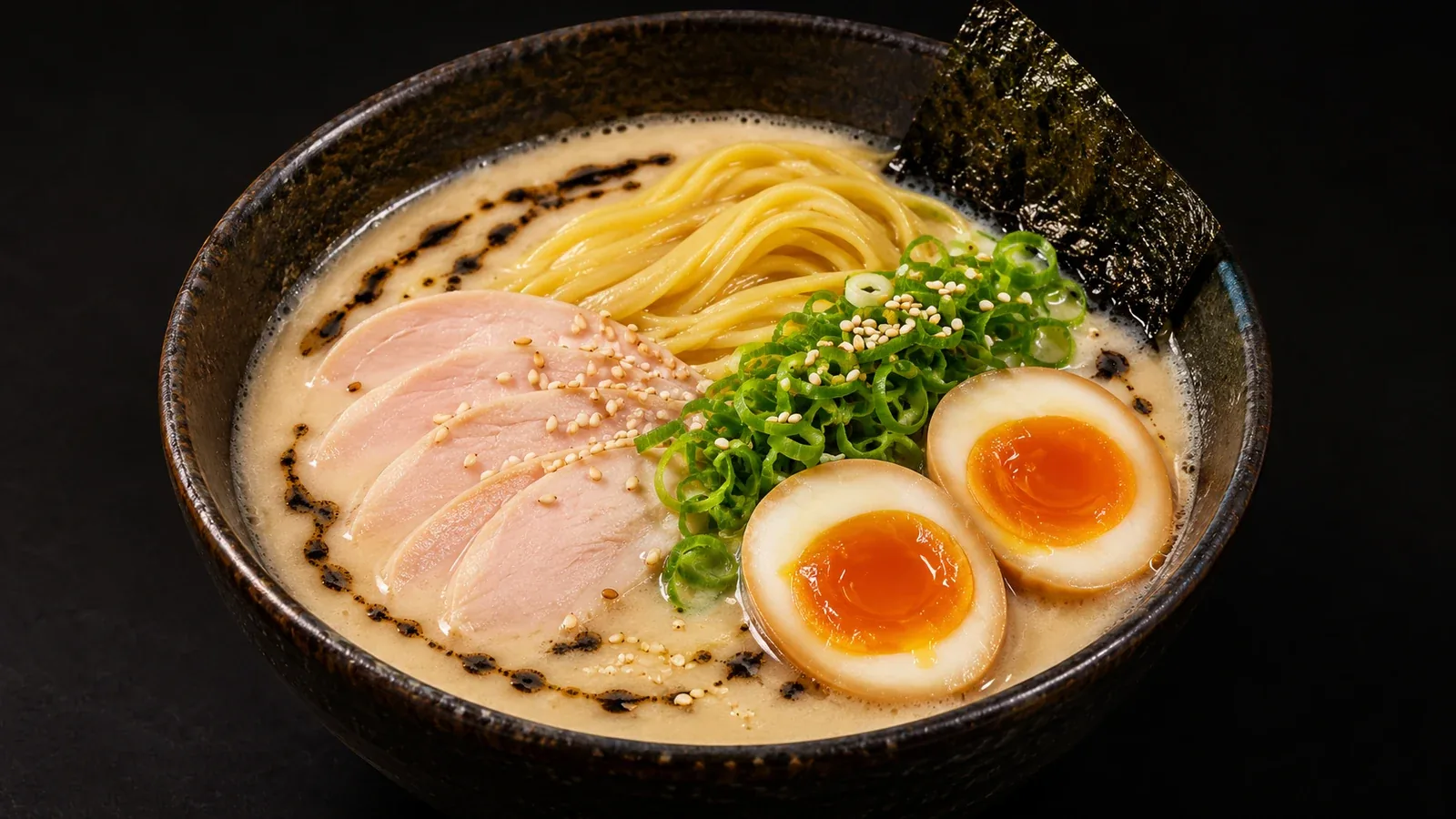
The root is the shoyu ramen of the family, built in layers: chicken broth, tare, aromatic fat, homemade alkaline noodles, chashu, marinated egg and scallion. This version keeps that architecture and swaps each layer for its counterpart: a white, creamy broth instead of a clear one, a salt tare instead of soy and a dark burnt-garlic oil instead of the scallion one.
The twist is the tori paitan. The chicken carcasses, wings and feet boil hard for hours, without lowering the heat, until the collagen and fat emulsify into an opaque, dense, unctuous broth, which is blended at the end to finish binding it. Since the broth is intense, the tare goes to salt, with kombu and shiitake for umami, and the chashu is breast cooked at 64 °C (147 °F), which gives a tender, clean meat. The egg is marinated in miso, and a few drops of mayu, garlic oil cooked until black, bring a toasted bitterness that contrasts with the cream of the broth.
Special equipment: 8-liter pot; sous vide circulator and vacuum bags; pasta machine with cutter; powerful blender; fine sieve; precision scale for the kansui
Ingredients
Tori paitan broth
- 1.5 kg chicken carcasses
- 500 g chicken wings
- 500 g chicken feet, cleaned and with nails removed
- 4 liters cold water, plus hot water to replenish
- 1 onion, in quarters
- 4 garlic cloves
- 30 g ginger, in slices
- The green part of 2 scallions
Kombu and shiitake shio tare
- 300 ml water
- 10 g kombu
- 3 dried shiitake
- 30 ml sake
- 20 ml hon-mirin
- 32 g fine salt
- 5 g sugar
64 °C chicken chashu
- 2 skinless chicken breasts, 220–250 g
- 30 ml soy sauce
- 15 ml hon-mirin
- 5 g ginger, in slices
Miso ajitama
- 4 large eggs
- 60 g white miso
- 30 ml hon-mirin
- 30 ml sake
- 20 ml water
Mayu
- 80 ml neutral oil
- 10 garlic cloves, finely chopped
- 10 ml toasted sesame oil
Ramen noodles
- 280 g bread flour (12–13% protein)
- 120 g weaker flour (9–10% protein)
- 144 g water
- 7 g fine salt
- 5 g kansui powder
- Potato starch or cornstarch, for dusting
Toppings and assembly
- 2 scallions, green part only
- 1 sheet of nori
- 4 teaspoons toasted white sesame seeds
- Finely grated lime zest
Method
Tori paitan broth
- Blanching. Cover the carcasses, wings and feet with cold water, bring to a boil and boil 5 minutes. Discard the water, wash the bones removing coagulated blood and wash the pot.
- Hard boil. Return the bones to the pot with the 4 liters of cold water and bring to a hard boil, with large, constant bubbles. Skim only during the first half hour. Hold that boil 5–6 hours, half covered, stirring every 30 minutes and scraping the bottom, and replenishing hot water so the level does not drop below the bones. Unlike the shoyu, here the boil is wanted: it agitates the fat and collagen until they emulsify. At 3 hours, crush the bones with a wooden spoon so they release more.
- Aromatics. During the last hour, add the onion, garlic, ginger and scallion.
- Straining and blending. Strain through a coarse sieve pressing the solids, and then through a fine one. About 1.4–1.6 liters should remain of an opaque, ivory-colored broth that leaves a film on the spoon. Blend it at maximum speed 1 minute, in batches and with the lid ajar covered by a kitchen towel: it turns whiter and creamier. If stored, chill it quickly in an ice bath; when reheating, blend it again, because the emulsion separates when cold.
Kombu and shiitake shio tare
- Cold and warm infusion. Soak the kombu and shiitake in the water 1 hour. Heat to 60–65 °C (140–149 °F) and hold 30 minutes; remove the kombu, bring almost to a boil and turn off the heat.
- Seasoning. Strain, add the sake and mirin, boil 1 minute to evaporate the alcohol and dissolve the salt and sugar. It yields about 250 ml; 30 ml per bowl are used. It is very salty: it is meant to be.
64 °C chicken chashu
- Cooking. Vacuum-seal the breasts with the soy, mirin and ginger and cook them in the bath at 64 °C (147 °F) for 1 h 30 min. Move the bag to ice water 20 minutes and keep it in the refrigerator until slicing.
- Slicing. At serving, cut into 3–4 mm slices. They are served at room temperature: the broth warms them.
Miso ajitama
- Cooking. Lower the eggs into boiling water and cook 6 min 30 s, moving them the first few seconds. Move them to ice water 10 minutes and peel them.
- Marinating. Mix the miso with the mirin, sake and water until smooth. Put the eggs in a bag with the marinade, remove the air and marinate in the refrigerator 12 hours, turning once. At serving, wipe off the excess miso and cut them in half with a thread or a wet knife.
Mayu
- Controlled burning. Put the oil and garlic in a cold pan and bring to medium-low heat, stirring constantly. At 8–10 minutes the garlic will be golden; continue 4–6 minutes more, stirring, until black and smelling of intense toastiness, not acrid burnt. Turn off the heat at once and pour into a heatproof bowl.
- Blending. Add the sesame oil, let cool and blend to a dark, fluid paste. It is used in drops: 4–5 ml per bowl.
Ramen noodles
- Mixing. Completely dissolve the salt and kansui in the water and pour it little by little over the two flours while mixing. The mixture stays dry and sandy: do not add water. Cover and rest 30 minutes.
- Sheeting. Press the dough into a block and divide it in two. Pass it through the thickest opening of the machine, fold it and pass it again 5–6 times, until it comes together and softens. Leave the sheets in a bag 20–30 minutes.
- Cutting and resting. Gradually lower to 1.3–1.5 mm, cut at 1.6–1.8 mm and dust with starch. Form portions of 135–140 g and leave them in the refrigerator 12–24 hours.
Toppings and assembly
- Scallion and nori. Cut the scallion in a very fine diagonal, submerge it 5–10 minutes in ice water and dry it thoroughly. Cut the nori in quarters and keep it dry.
- Bowl broth. Heat the broth until it boils, blend it again 30 seconds and keep it very hot: 300 ml per bowl are used.
- Noodles. Cook each portion in plenty of water at a hard boil, unsalted, about 90 seconds, until they keep a bite at the center. Drain very well.
The dish
Use deep, hot ramen bowls of dark ceramic. Put in each bowl 30 ml of shio tare, add the 300 ml of very hot tori paitan broth and mix. Add the drained noodles and fold them with chopsticks into an orderly wave. Fan out on top 4–5 slices of chashu to one side and, next to them, the ajitama cut in half with the yolk up. Add a small mound of scallion in the center and stand the quarter of nori upright against the rim. Last, let the mayu fall in a thin spiral thread on the surface of the broth and sprinkle the sesame and a minimal grating of lime zest over the scallion. Serve at once. Final look: a white, opaque, velvety broth with a black stroke of mayu, the orderly yellow noodles, the pale pink fan of chashu, the orange yolk, the green of the scallion and the dark nori.
Key points
- Keep the hard, constant boil, replenishing water: if it drops, the broth does not emulsify.
- Blend the broth before serving, also when reheating it.
- Measure the tare: the broth has no salt, all the salt in the bowl comes from there.
- Burn the mayu garlic slowly and stirring, and remove it as soon as it is black.
- Cook the noodles in unsalted water and drain them thoroughly.
Pairing
A cold junmai ginjo sake or a dry lager. Without alcohol, cold roasted barley tea (mugicha).
Notes
- 64 °C chicken: the chashu is safely cooked if the time for breasts up to 3.5 cm thick is respected.
- Liquid yolk: the ajitama has a barely set yolk. For pregnant women, small children, the elderly or the immunocompromised, cook it until the yolk is firm.
- Kansui: it is an alkaline powder. Measure it with a precision scale and do not touch it with wet hands.
- Storage: the broth is chilled in an ice bath and kept up to 3 days at 5 °C (41 °F) or below, or 3 months frozen.