Signature · 2.5 hours of work, 1 hour of baking and cooling, and a night in the refrigerator · Serves 4
Toasted milk and dulce de leche flan with yerba mate caramel
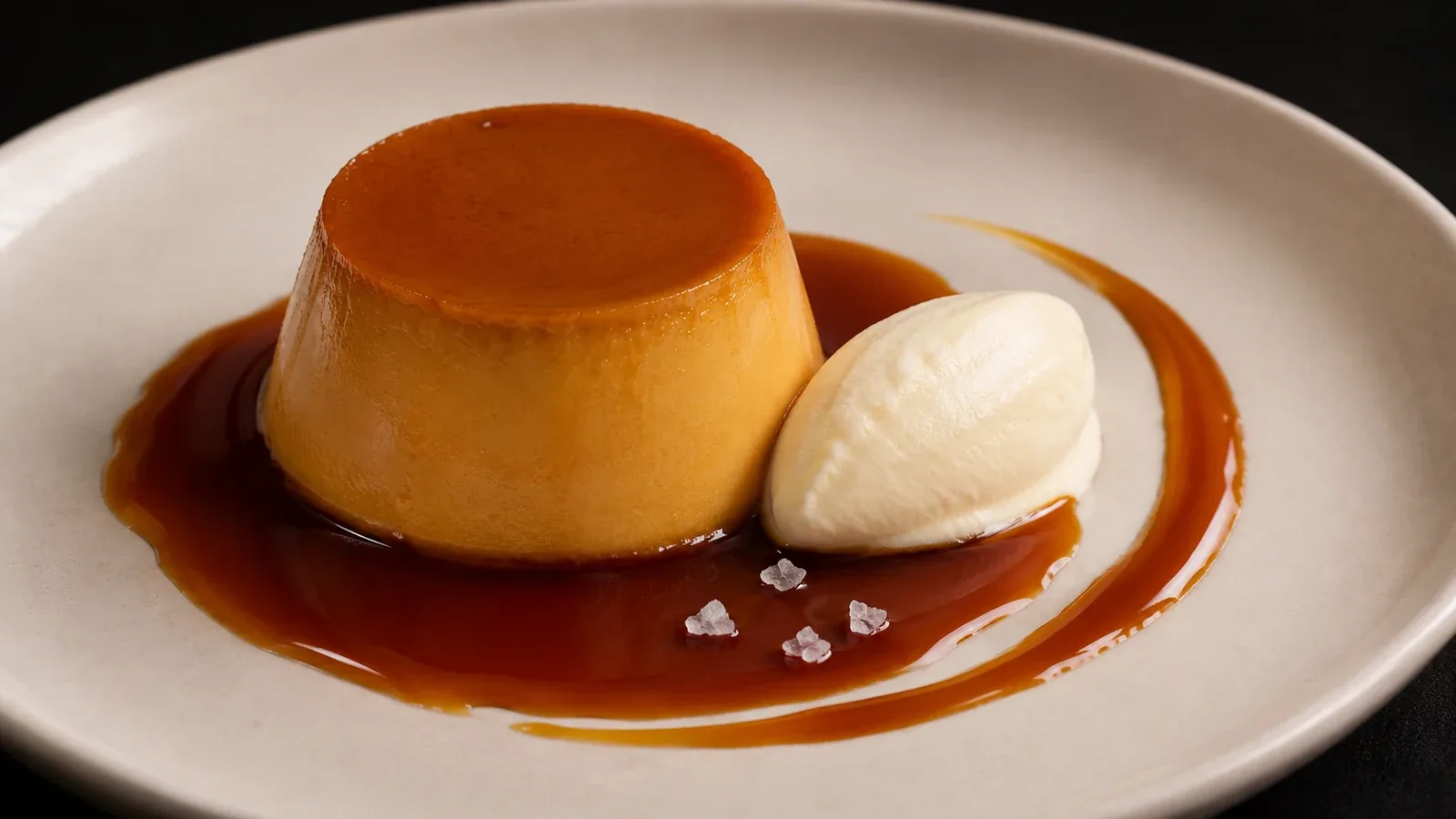
Illustrative image generated with AI, not a photo of the cooked dish.
A fine toasted milk and dulce de leche flan, trembling and tight-crumbed, unmolded over a dark amber caramel. Each spoonful starts in the deep sweetness of cookies and dulce de leche and ends in a dry, herbal bitterness, while a cold mascarpone cream refreshes and a flake of salt wakes up the caramel.
The tannic bitterness of yerba mate comes in through the caramel: it is infused in hot water and that infusion loosens the dark caramel off the heat, so the herbal flavor reaches the sauce without burning in the pan. Toasted milk powder raises the cookie and dulce de leche notes without adding sugar, and the yolks make it silkier than a whole-egg flan. The whipped mascarpone, cold and barely sweet, tones down the intensity and leaves the palate clean for the next spoonful.
Special equipment: four 180 ml individual molds; probe thermometer
Ingredients
Yerba mate caramel
- 8 g yerba mate with stems, traditional grind.
- 90 g water at 75 °C (167 °F) for the infusion.
- 100 g sugar.
- 25 g water for the caramel.
- 0.5 g flaky salt, to finish.
Toasted milk and dulce de leche flan
- 30 g whole milk powder.
- 270 g whole milk.
- 60 g heavy cream.
- ½ vanilla bean, split lengthwise and scraped.
- 100 g thick dulce de leche (pastry-grade).
- 100 g beaten egg without shell, about 2 medium eggs.
- 36 g egg yolks, about 2 yolks.
- 1 g fine salt.
- About 1 l freshly boiled water for the water bath.
Mascarpone cream
- 80 g cold mascarpone.
- 60 g heavy cream for whipping, very cold.
- 8 g sugar.
- 1 pinch fine salt.
Method
Yerba mate caramel
- Infuse the yerba. Heat the 90 g of water to 75 °C (167 °F), with small bubbles at the bottom and without boiling: boiling water extracts a harsh bitterness. Pour over the yerba, leave for 4 minutes and strain through a fine sieve. Weigh 50 g of infusion (if short, top up with hot water) and keep it hot.
- Cook the caramel. Put the sugar and the 25 g of water in a small, light-bottomed saucepan. Bring to medium heat without stirring, only swirling the pan, to a dark amber, like strong tea, at 175–180 °C (345–355 °F), smelling of toasted sugar and without sour smoke. Remove from the heat and, with an extended arm and a long spoon, add the hot infusion in 3 additions: it bubbles and splatters hard. Stir until homogeneous; if hard caramel remains at the bottom, return to low heat for 1 minute, stirring, until it melts. It yields about 140 g of a fluid, thick caramel with an herbal, toasty smell.
- Line the molds. With the caramel now warm, pour 12 g into the bottom of each mold, tilting to coat the base and barely the wall. Reserve the rest, about 80–90 g, in a covered jar at room temperature for serving. Place the molds on a tray, without stacking.
Toasted milk and dulce de leche flan
- Toast the milk powder. Spread the 30 g in a thin layer on a small dish. Bake at 140 °C (285 °F), without fan, for 12–20 minutes as a guide, stirring every 3–4 minutes and breaking up the lumps. Remove when beige-golden and it smells of cookies; the color matters more than the time. Move at once to a cold plate. If dark brown spots or a burnt smell appear, start over: the bitterness carries into the flan.
- Infuse. Heat the milk, cream and vanilla bean with its seeds to 70–75 °C (158–167 °F), without boiling. Remove from the heat, add the toasted milk powder and the dulce de leche and whisk by hand until no lumps or strands of dulce de leche remain. Cover for 15 minutes. Remove the bean and strain through a fine sieve. The mixture should be at 60 °C (140 °F) or less, so it does not cook the eggs.
- Combine and strain. Break up the eggs and the yolks with the salt with a hand whisk, without incorporating air. Pour the warm mixture over in a thin stream, stirring. Strain into a pitcher, skim off the foam with a spoon and let it rest for 10 minutes; remove any that has risen. The surface should be smooth.
- Bake in a water bath. Heat the oven to 150 °C (300 °F), without fan, with the rack in the center. Place a folded kitchen towel on the bottom of a deep baking dish, arrange the lined molds on top and fill them to 1 cm below the rim, about 152 g each, pouring over the back of a spoon so the mixture does not break through the caramel. Pour freshly boiled water to two-thirds of the height of the molds and cover the dish loosely with aluminum foil. Bake 45–55 minutes. They are ready when the edge is firm for 1 cm and the center trembles as a single mass; with a thin probe in the center of one mold, 78–80 °C (172–176 °F). The yolks make it more tender than a whole-egg flan: if the center ripples like liquid, add 5 minutes; bubbles in the bath water or tiny holes on the surface mean the oven is too hot, and the flan turns porous.
- Cool quickly and rest. Remove the molds with tongs and leave them 10 minutes on a rack. Move them to a container with ice water to two-thirds of their height, renewing the ice, for 40–60 minutes, until they are at 21 °C (70 °F) or less. Cover with plastic wrap, without stacking, and refrigerate at 5 °C (41 °F) or less for at least 8 hours and up to 48. In that time the caramel layer loosens and blends into the lower edge.
- Unmold. At serving time, run a thin knife around the edge and set the mold briefly in warm water at about 50 °C (122 °F) if it resists. Turn it over onto the plate with a quick motion: the caramel should run around the base.
Mascarpone cream
- Whip. With a cold bowl and whisk, mix the mascarpone with the sugar and salt with a spatula until smooth. Add the cold cream and whip at low speed for 1–2 minutes, to soft peaks that hold their shape. Stop before it looks grainy: if overwhipped, mascarpone splits. Keep in the refrigerator until serving.
The dish
Use four flat, light-colored dessert plates, chilled in the refrigerator. Unmold each flan slightly off-center and let the caramel run and form an amber pool. Complete the pool with about 20 g of the reserved caramel, drawn in a semicircle with the back of a spoon and without covering the flan, so the dark, glossy edge reads against the smooth beige of the flan. With two spoons shape a quenelle of about 30 g of mascarpone cream and set it alongside, barely touching the caramel. Scatter 3 or 4 flakes of salt over the caramel and not on the flan, and serve at once: glossy dark amber, a smooth flan that trembles when the plate is set down, and a white, matte cream.
Key points
- Infuse the yerba at 75 °C (167 °F) and add the infusion off the heat: boiling water or yerba burned in the caramel gives a harsh bitterness.
- Toast the milk powder to beige-golden; if it turns brown, start over.
- Strain and skim the foam: the smooth surface depends on it.
- Remove the flan with the center still trembling (78–80 °C / 172–176 °F): overbaking makes it porous.
- Whip the mascarpone only to soft peaks; it splits easily.
Pairing
Dry amontillado, chilled, in a small glass: its nutty notes and dryness cut through the dulce de leche. Non-alcoholic: hot unsweetened mate, which extends the bitterness of the caramel.
Notes
- Storage: flans covered in the refrigerator at 5 °C (41 °F) or less, up to 48 hours, unmolding only at serving time. The serving caramel keeps in a covered jar at room temperature until the next day. The cream is made on the day of serving. Do not freeze.
- Molds: use individual molds; a large one takes too long to cool inside and bakes unevenly.
- Yerba: a yerba with stems and a coarse grind gives a gentler infusion; a very fine or dusty yerba makes it cloudy and more bitter.
- Scaling: multiply by molds, no more than 8 per dish. The oven and time are governed by the doneness and the probe, not by the clock.