Signature · 1 hour 20 minutes · Serves 4
Spaghetti with three-tomato filetto, green basil oil and olive crumble
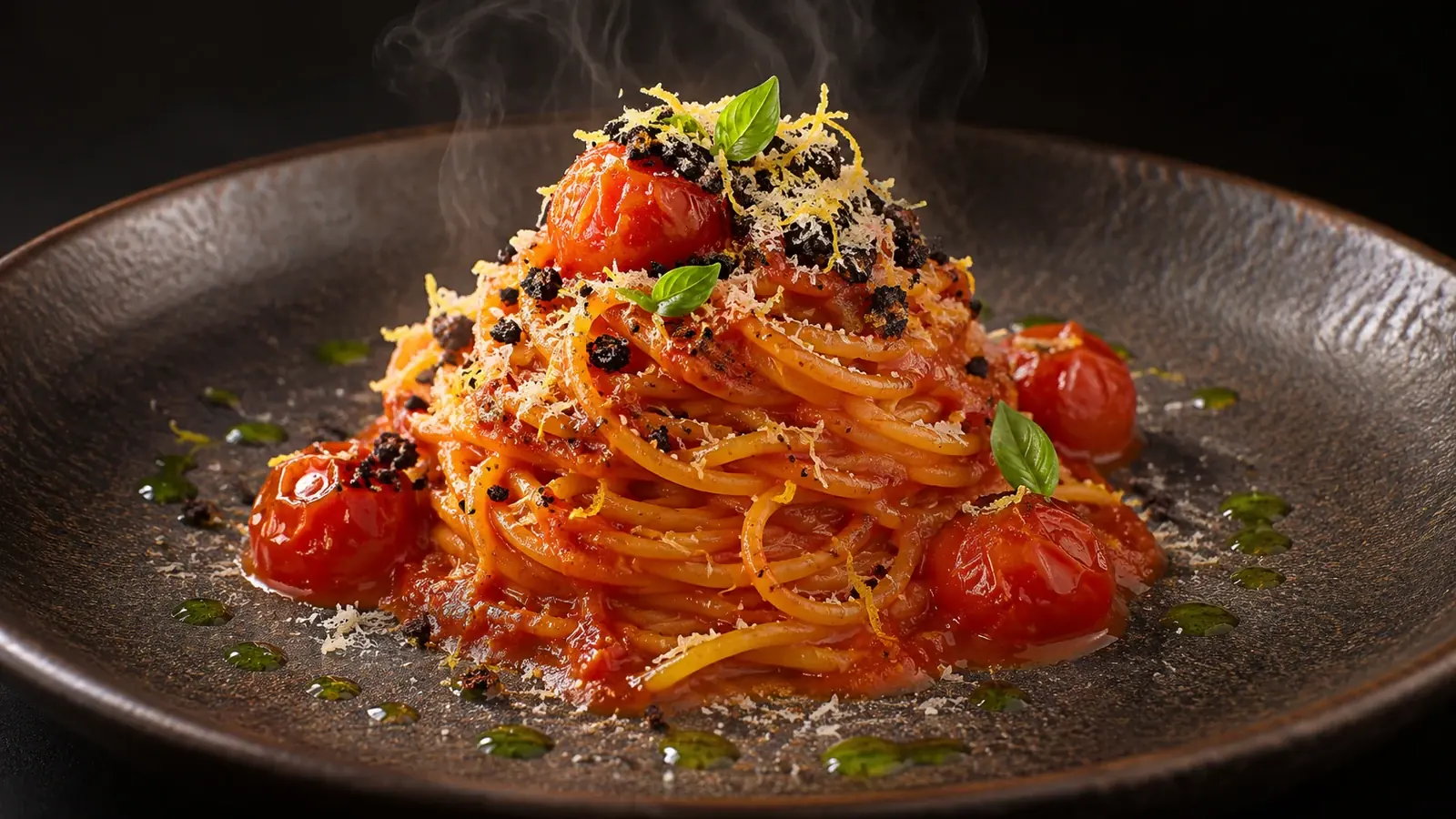
The pasta with filetto of the Buenos Aires and Italian table: dried pasta finished in a tomato sauce with garlic, basil and butter, glossy and clinging to the noodle. The dish keeps that familiar bite and brings it to a more precise reading, with the pasta cooked inside the sauce so the starch binds it.
The twist is to treat the tomato in three ways with different functions: cooked San Marzano for body and umami, confit cherry tomatoes for sweetness and concentration, and a fresh, almost raw concassé for acidity and freshness. The green basil oil adds lively herbal notes, the black olive crumble brings saltiness and crunch, and the Parmigiano and lemon zest close the dish.
Special equipment: hand blender or blender
Ingredients
Confit cherry tomatoes
- 400 g cherry tomatoes
- 60 ml extra virgin olive oil
- 2 garlic cloves, lightly crushed
- 2 thyme sprigs
- 2 pinches of salt
- 2 pinches of sugar
Green basil oil
- 50 g fresh basil leaves
- 120 ml extra virgin olive oil
- 2 pinches of salt
Fresh tomato concassé
- 2 ripe plum tomatoes, about 200 g
- Fine salt, as needed
Black olive crumble
- 80 g pitted black olives
- 40 g panko or coarse breadcrumbs
- 1 teaspoon finely grated lemon zest
- 2 teaspoons extra virgin olive oil
- Fine salt, only if needed
Filetto sauce
- 700 g peeled San Marzano tomatoes, lightly crushed
- 60 g shallot, in very fine brunoise
- 4 garlic cloves, sliced
- 80 ml dry white wine
- 40 g cold butter
- 80 ml extra virgin olive oil
- 6 to 8 fresh basil stems
- Fine salt and freshly ground black pepper, as needed
- 2 pinches of crushed chili flakes, optional
Pasta
- 400 g spaghettini, spaghetti or other bronze-cut dried pasta
- Plenty of water
- Coarse or fine salt: 10 g per liter of water
Finishing
- 40 to 60 g Parmigiano Reggiano
- Small fresh basil leaves
- Finely grated lemon zest
- Extra virgin olive oil
- Freshly ground black pepper
Method
Confit cherry tomatoes
- Confit. Preheat the oven to 110 °C (230 °F). Wash and dry the tomatoes and arrange them close together in a small dish with the oil, garlic, thyme, salt and sugar, mixing gently to coat them in oil. Bake 35–45 minutes, until barely wrinkled, glossy and concentrated, but whole. Let them cool in their oil. They can be prepared 1 or 2 days ahead and kept covered in the refrigerator; bring them to room temperature before using.
Green basil oil
- Blanching. Separate the leaves from the stems and set the stems aside for the sauce. Blanch the leaves 10 seconds in boiling water, move them to water with plenty of ice, drain and dry them very well. The blanching partly sets the chlorophyll's green and gives a more intense oil.
- Blending. Heat the oil to 60–70 °C (140–158 °F), without smoking. Process it with the leaves and salt for 1 minute, to an intense green, and pass it through a fine sieve. Keep it covered in the refrigerator and use it, ideally, within 24 hours.
Fresh tomato concassé
- Peeling and cutting. Cut a cross in the base of the tomatoes, submerge them 15–20 seconds in boiling water and move them to ice water. Peel them, cut them into quarters, remove seeds and excess liquid, and cut the flesh into 5 mm cubes. Keep in the refrigerator until the pasta is done: it brings acidity, freshness and a texture different from the cooked sauce.
Black olive crumble
- Drying. Preheat the oven to 110 °C (230 °F). Drain and dry the olives well, spread them on a tray and bake them 30–40 minutes. Let them cool and chop finely.
- Toasting. In a small pan over medium heat, toast the panko with the oil, stirring constantly, to an even gold. Off the heat, mix with the olives and zest. Taste before salting, because olives usually bring enough salt. Keep in a dry place until plating.
Filetto sauce
- Base. In a wide pan, about 30 cm, where the pasta will later be finished, heat the oil and cook the shallot over medium-low heat 3–4 minutes, until translucent and tender, without browning. Add the garlic and, if using, the chili, and cook 30 seconds: the garlic should perfume the oil without toasting.
- Reduction. Add the wine, raise the heat slightly and reduce until almost no liquid remains. Add the San Marzano and the basil stems and cook gently 12–15 minutes: the sauce concentrates but stays fluid, because it still has to finish cooking the pasta. Remove the stems, season and keep over very low heat.
Pasta
- Cooking. Boil plenty of water with 10 g of salt per liter and cook the pasta until 2 minutes before the doneness the manufacturer indicates. Reserve cooking water.
- Finishing with the sauce. Bring the sauce to medium heat, move the pasta directly into the pan and add about 120 ml of cooking water. Stir vigorously or keep moving the pan for 1–2 minutes, adding more water little by little if needed, until the sauce clings to the pasta without being heavy.
- Three tomatoes. With the pasta almost done, add half of the confit cherry tomatoes, a spoonful of their oil and the concassé, and mix gently: the fresh tomato should get very little cooking to keep its acidity and texture.
- Mounting. Turn off the heat and add the cold butter and 1 tablespoon of green oil, mixing vigorously. Off the heat, the butter leaves the sauce glossy and keeps the emulsion from splitting. It should be glossy, emulsified, silky and clinging to the pasta. Adjust the salt, pepper and acidity; if it thickened too much, loosen with a few spoonfuls of cooking water.
Finishing
- At serving. Grate the Parmigiano very finely at the moment and have at hand the small basil leaves, lemon zest, olive oil and pepper.
The dish
Use wide plates, preferably dark, so the red of the tomato and the green of the basil contrast. Take each portion with long tongs, twirl it inside a ladle to form a nest and place it in the center of the plate, with some height. Distribute a little sauce around and arrange 3 to 5 confit cherry tomatoes around or partly resting on the pasta. Add small drops of green oil, a shower of olive crumble over the top and very finely grated Parmigiano. Finish with small basil leaves, very fine lemon zest, a few drops of olive oil and freshly ground pepper. Final look: a glossy red nest, the wrinkled, lustrous cherry tomatoes, the intense green of the oil in drops and the dark, crunchy crumble on top.
Key points
- Do not toast the garlic: overdone garlic brings bitterness and dominates the sauce.
- Do not over-reduce the tomato: the sauce must keep moisture to finish cooking the pasta.
- Reserve the cooking water: the starch is what gives a stable emulsion when finishing.
- Add the butter off the heat, so the sauce is glossy and does not split.
- Add the concassé at the end, so it keeps freshness and texture.
Pairing
Reds with good acidity and moderate tannins, which go with the natural acidity of the tomato: a young Chianti Classico, a Barbera d'Asti or a Patagonian Pinot Noir. Without alcohol, very cold soda with orange peel, ice and a few drops of white balsamic vinegar.
Notes
- The original recipe was designed for 2 servings; this version doubles all the quantities. For 2 servings, use half of each ingredient and a 26–28 cm pan.