Essential · 1 hour and 15 minutes, with overlapping tasks · Serves 4
Sous vide trout with smashed potatoes, lemon butter and capers
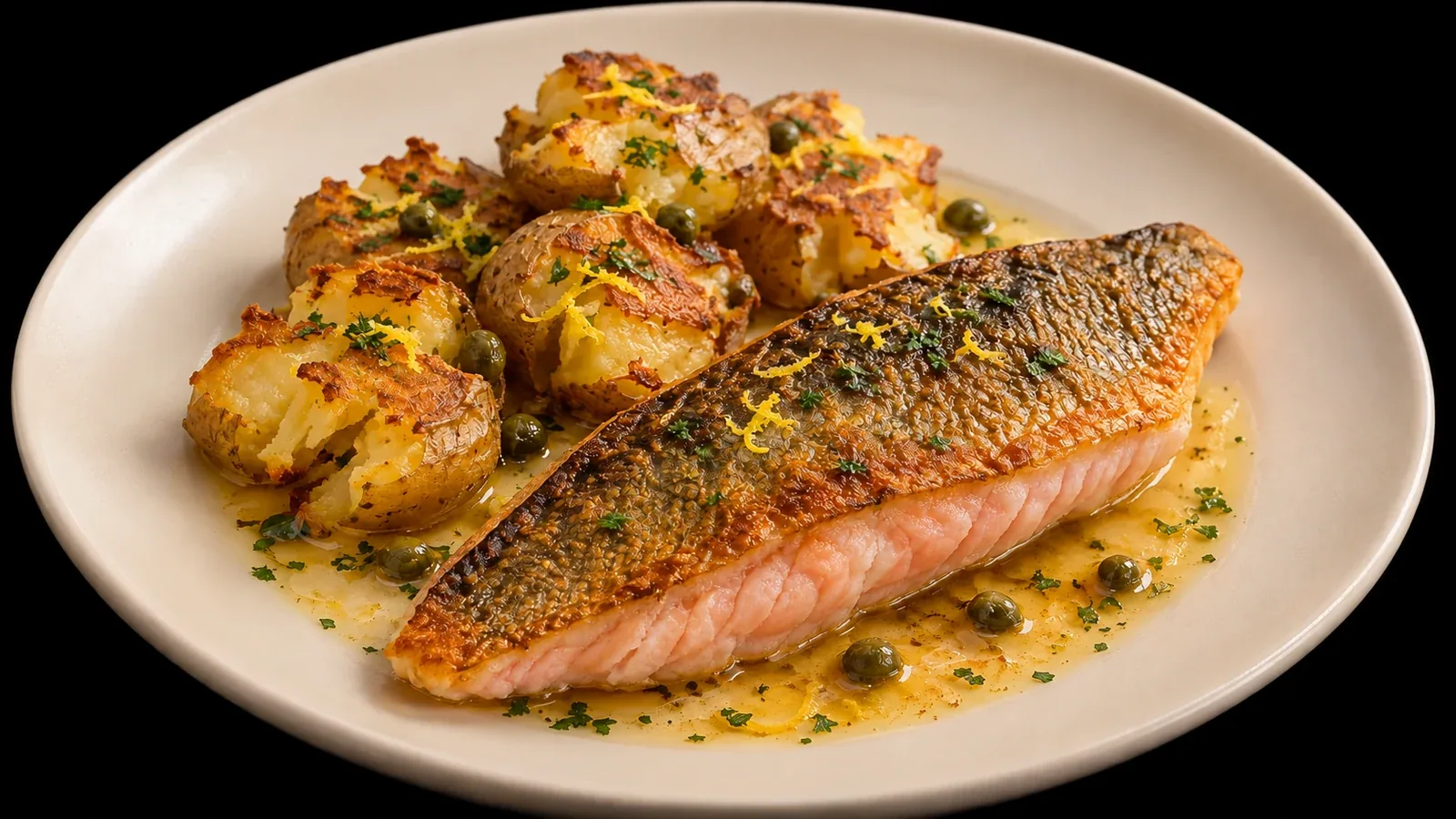
Illustrative image generated with AI, not a photo of the cooked dish.
Kitchen test pending
Concept: golden-skinned trout with smashed baby potatoes and a quick sauce of brown butter, fresh lemon and capers. The fish stays at the center of the dish and the potatoes provide crisp edges, with acidity that balances the butter.
Twist: cooking the fish at 52 °C (126 °F) is separated from browning the skin, and the potatoes finish in the oven to free up the stovetop. The butter is browned to hazelnut-gold and the lemon is added off the heat: a direct approach that concentrates the contrast between toasted, fresh and saline flavors.
Special equipment: sous vide circulator; 10–12 l container; cooking-safe bags; fine-probe thermometer; oven and large baking tray; two 28 cm nonstick frying pans
Ingredients
Sous vide trout
- 800 g skin-on trout fillets, in 4 portions of about 200 g, scaled and pin-boned, with a maximum thickness of 15–20 mm.
- 10 ml neutral oil for the bags.
- 15 ml neutral oil for searing.
- 5 g fine salt, as a starting point.
- Black pepper to taste.
Smashed baby potatoes
- 800 g baby potatoes, 3–4 cm across and evenly sized.
- 35 ml olive oil.
- Enough water to cover.
- Salt for the water and finishing, to taste.
Lemon butter and capers
- 100 g unsalted butter.
- 30 g capers in brine, drained weight.
- 20–30 ml freshly squeezed lemon juice, starting with 20 ml.
- Finely grated zest of 1 lemon, without white pith.
- 20 ml hot water.
- 8 g parsley leaves, chopped.
- Fine salt to taste, only after tasting.
Method
Sous vide trout
- Confirm the product and doneness. At the user's request, this version is served mi-cuit with a 52 °C (126 °F) bath: it is not pasteurized. Use trout from a reliable supplier with confirmed parasite control for raw or undercooked consumption and a carefully maintained cold chain; farmed origin alone is not enough. The user confirmed farmed origin and freezing specified by the supplier for that use. If that condition is absent or a vulnerable person is eating, follow the fully cooked alternative in Notes.
- Prepare. Bring the bath to 52 °C (126 °F) and check its temperature with an independent thermometer. Use fully thawed, refrigerator-cold fish at 5 °C or below, scaled and pin-boned. Measure the thickest part: this development covers fillets of 15–20 mm; do not apply its time to thicker, folded or frozen pieces. If the fish comes frozen in vacuum packaging, follow the label's directions on opening before thawing in the refrigerator.
- Bag. Distribute the salt, pepper and 10 ml oil. Put one portion per cooking-safe bag in a single layer; remove air by water displacement or gentle vacuum without crushing the flesh. Keep the mouth above water if the closure requires it. The fish must stay submerged with water circulating around it and no air pockets against the flesh. Do not add lemon juice: reserve it for the sauce. Cook immediately after bagging.
- Cook to the chosen doneness. Introduce the separated bags and allow about 30 minutes from when the bath returns to 52 °C (126 °F). This is a culinary heating reference for the stated thickness, not a pathogen-destruction time or pasteurization. Aim for moist, tender, slightly opalescent flesh with delicate flakes and possible translucency at the center; do not expect the completely opaque appearance of cooking to 63 °C (145 °F). The 52 °C (126 °F) refers to the water: the center approaches that temperature during the bath and searing may raise it afterward. Neither appearance nor a single temperature reading establishes safety.
- Coordinate removal. Have the sauce, potatoes and plates ready before the bath ends. Do not extend cooking to wait for guests or to attempt pasteurization at that temperature; it can worsen texture and does not turn this into a validated process. If the bath lost temperature control or the pieces do not meet the stated thickness, do not improvise a longer mi-cuit cook: switch to the fully cooked alternative.
- Sear the skin and serve. Lift the portions out with a wide spatula and dry the skin very well with paper without compressing the flesh. Heat the frying pans over medium-high heat with the 15 ml oil divided between them. Place the skin facing down and press gently for the first 10 seconds to ensure contact. Sear for about 45–90 seconds until it colors and releases without force. In such a thin fillet, searing also raises the flesh's doneness: prioritize brief, even contact and do not turn onto the flesh side. Remove without stacking, plate and eat immediately. Searing provides texture; it does not pasteurize the center.
Smashed baby potatoes
- Boil. Start before putting the fish in the bath. Preheat a conventional oven to 220 °C (428 °F). Cover the potatoes with cold water, salt and cook at a gentle boil for about 15–20 minutes from boiling. They are ready when a fine knife reaches the center without resistance and they still hold their shape.
- Smash. Drain and let the steam escape for about 5 minutes. Smash with the base of a glass to about 15 mm thick; keep the skin attached and the flesh in chunks without making a purée.
- Brown. Divide the olive oil between the tray and both sides of the potatoes, arrange them apart and roast for 25–35 minutes. Turn about halfway through and remove when the edges are well browned and dry. Salt when they come out. They can wait for up to 10 minutes for quality in the oven at 100 °C (212 °F), uncovered and without stacking, while finishing the fish skin.
Lemon butter and capers
- Organize the finish. Zest the lemon before squeezing and measure the juice. Drain the capers; if very salty, rinse briefly and drain again. Dry them to reduce splattering. Reserve half the parsley and zest for finishing the plates.
- Brown the butter. Heat the butter in a small light-colored saucepan over medium heat. After melting and foaming, the solids brown and smell nutty; this usually takes 3–5 minutes, depending on the heat. Move the pan to observe the color and remove as soon as it reaches hazelnut-gold. Add the capers during the last 20–30 seconds without letting the solids turn black.
- Add acidity. Off the heat and taking care with splattering, first add the 20 ml hot water, then 20 ml juice. Stir with a whisk to distribute; this sauce stays fluid with visible butter and does not need a stable emulsion. Taste and add up to 10 ml more juice if needed; adjust salt only then. Add half the parsley and zest.
- Coordinate with the fish. Have the sauce finished just before searing the skin. Keep it warm off the heat during those 2–3 minutes; stir before dividing so each portion receives butter, juice and capers. If the butter starts to set, warm briefly without boiling the lemon again.
The dish
Use four warm, dry dinner plates. Group the potatoes on one side with their crisp edges visible and place a portion of trout beside them, skin-side up, leaving room to cut without breaking it apart. Stir the sauce and spoon it over some of the potatoes and around the flesh, distributing the capers among the four plates. Avoid wetting the skin or covering all the potato edges. Finish with the reserved parsley and zest, clean any excess from the rim and serve immediately: golden-skinned fish, rustic potatoes and glossy butter with green accents.
Key points
- Bath at 52 °C (126 °F) for about 30 minutes for thawed, cold fillets of 15–20 mm: unpasteurized mi-cuit doneness, only with the specified product and immediate service.
- Lift the fish with a wide spatula; well-dried skin and even contact allow a short sear.
- The potatoes must be tender before smashing and spaced apart in the oven to brown.
- Remove the butter when the solids are hazelnut-gold, before they turn black; add water and lemon off the heat.
- Taste the sauce before salting: capers contribute variable salinity.
Pairing
Chilled Sauvignon blanc, with enough acidity for the butter and lemon. Without alcohol, sparkling water with a strip of lemon peel, unsweetened.
Notes
- For the requested fillet: skin-on and slightly under 2 cm thick, use the 1-serving scale in Planning ahead. Keep 52 °C (126 °F) and about 30 minutes; the weight of a more generous portion does not replace checking thickness or require increasing the time.
- Why the change from 65 to 52 °C (149 to 126 °F): the original 65 °C (149 °F) bath was chosen to reach and verify 63 °C (145 °F) at the center for 15 seconds, a fully cooked endpoint. It was not the optimum temperature for maximum tenderness. After the user confirmed farmed origin, supplier freezing for raw or undercooked consumption and their texture preference, 52 °C (126 °F) was chosen for mi-cuit doneness: more tender and juicy, with a little more structure than at 50 °C (122 °F). This is a culinary choice, not a temperature that is safe on its own; the recipe has not yet been physically tested.
- What freezing provides: appropriate parasite treatment controls parasites but does not eliminate all microorganisms. Do not treat “farmed,” “was frozen” and supplier confirmation for raw or undercooked consumption as equivalent. The confirmation reported by the user was not independently verified. A 52 °C (126 °F) bath for about 30 minutes and searing the skin do not constitute pasteurization; arbitrarily extending time does not demonstrate it either. Pregnant people, children, older adults and immunocompromised people should choose fully cooked fish.
- Fully cooked alternative: use the same thawed 15–20 mm portions in a 65 °C (149 °F) bath for about 35–45 minutes from temperature recovery. Open each bag and measure with a clean fine probe, entering horizontally from the edge to the center of the thickest part: reach at least 63 °C (145 °F) and hold for 15 seconds. If a portion has not reached it, put it unseared in a new cooking-safe bag, close and return to the 65 °C (149 °F) bath in 3–5 minute intervals, repeating the check. Clean and sanitize the probe between uses according to its manufacturer. Dry and sear as the recipe directs. This time is approximate; the center check takes priority and the result is firmer.
- Preparing potatoes ahead: they can be boiled up to 24 hours ahead only with verified rapid cooling in one layer: pre-cool to 60 °C in under 30 minutes, reduce from 60 to 21 °C within 2 hours and from 21 to 5 °C within another 2 hours, at most. Cover once cold and store at 5 °C or below. Before browning and serving, reheat to at least 74 °C (165 °F) at the center; they may need longer in the oven than freshly boiled potatoes.
- Fish storage: this mi-cuit version is for immediate consumption; cooling, storing or reheating leftover fish, inside or outside its bag, is not planned. Prepare only the portions that will be served. Prior freezing does not change that instruction. Sauce may be stored only if cooled using the curve specified for the potatoes, kept at 5 °C or below and reheated to 74 °C (165 °F); preferably use the next day, with loss of emulsion quality and aroma. If cooling and refrigeration were not verified, do not assign storage. Do not freeze the assembled dish.