Signature · about 2 hours of work, plus 12–24 hours of rub and 10–12 hours of sous vide · Serves 4
Sous vide tri-tip lacquered with dark barbecue sauce
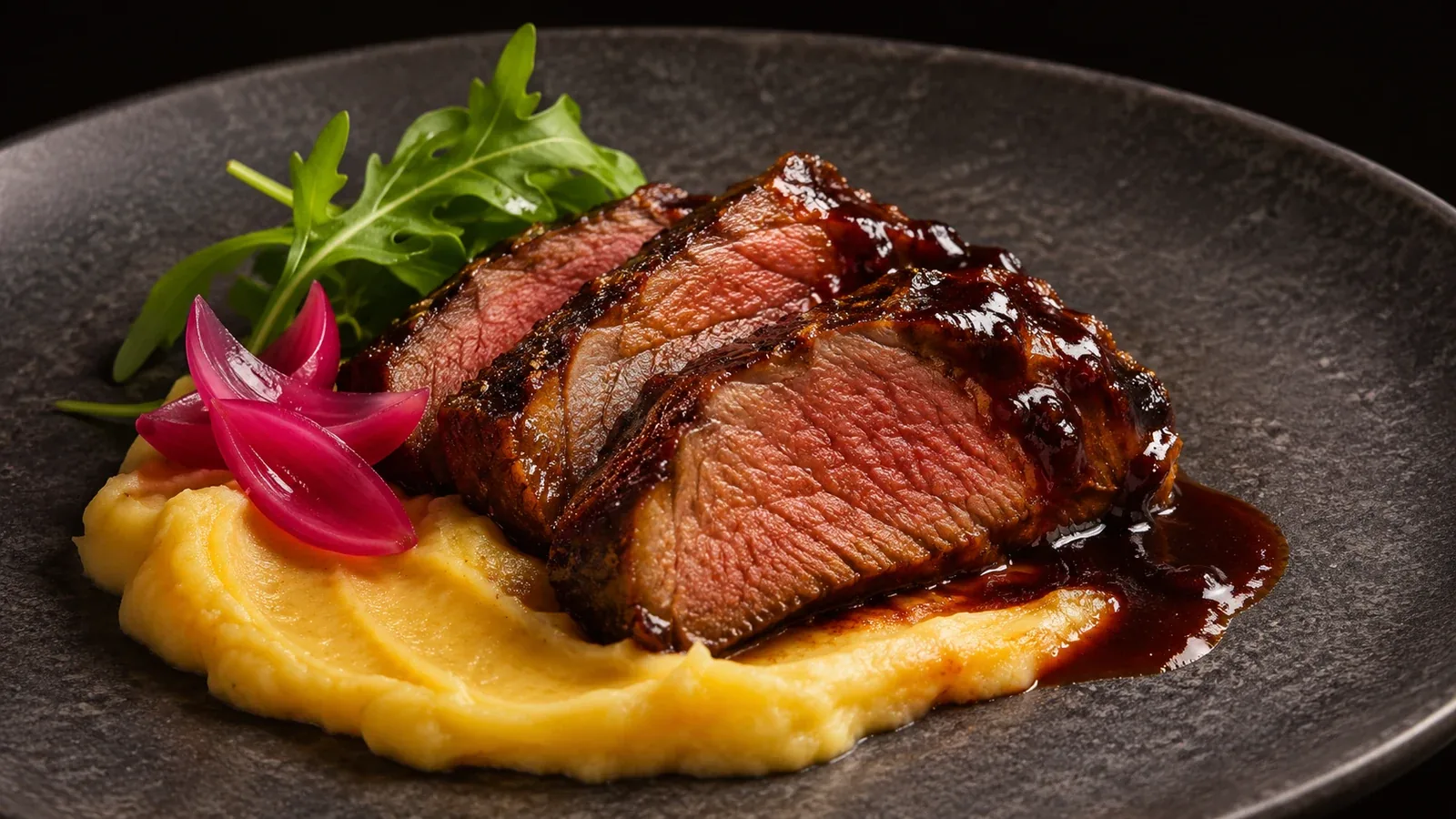
The colita de cuadril, a very Argentine cut, here with the flavors of North American barbecue: spice rub, long cooking and a dark sauce that lacquers it. The aim is a meat that can be cut into thick slices but yields easily to the fork, with a dark, glossy, caramelized exterior and the barbecue present without covering the meat.
The twist is the combination of techniques. The meat is rubbed with Dijon and a spice rub, rests like a dry brine and is cooked sous vide at 68 °C (154 °F) for 10–12 hours with butter, soy, Worcestershire and miso, until the connective tissue transforms. The juices in the bag are not discarded: they are reduced with the BBQ sauce, dark beer, espresso and vinegar into a dark barbecue sauce with deep toastiness and bitterness. At the end, a hard sear and a lacquer give the crust; a brown butter mashed potato, a pickled onion and some greens balance the richness.
Special equipment: sous vide circulator and vacuum sealer; cast-iron pan or griddle; potato ricer or food mill
Ingredients
Meat and rub
- 1 whole tri-tip (colita de cuadril), 1.2–1.6 kg
- 15–20 g Dijon mustard
- 25 g fine salt (for 1.4 kg of meat)
- 8 g light brown or muscovado sugar
- 5 g freshly ground black pepper
- 3 g smoked paprika
- 3 g garlic powder
- 2 g onion powder, 0.5–1 g cumin and 0.5–1 g crushed chili flakes, optional
Sous vide
- 30–40 g butter
- 20 g soy sauce
- 10 g Worcestershire sauce
- 15 g miso paste
- 2 sprigs fresh thyme
- 1 bay leaf
- 3–5 g chipotle or adobo, optional
Pickled onion
- 1 small red onion or 2 shallots, cut very thin
- 80 ml apple cider or wine vinegar
- 80 ml water
- 25 g sugar
- 2 g salt
Dark barbecue sauce
- 120 ml porter or stout dark beer
- 250 g BBQ sauce
- 15–20 g molasses, dark honey or muscovado sugar
- 20–30 ml espresso
- 20–30 ml apple cider vinegar
- All the juice from the bag
- 30 g cold butter, in cubes
- Worcestershire, soy or chipotle, optional to adjust
Brown butter mashed potatoes
- 900 g starchy potatoes
- 180–220 g butter: about 90–100 g for the brown butter and the rest regular
- 120–180 ml hot whole milk
- Fine salt and a minimal amount of nutmeg, optional
Searing and lacquering
- Neutral oil, a thin film
Finishing
- A green of your choice: baby arugula, radish sprouts, small watercress leaves, chives, tender parsley or baby mustard leaves
- A few drops of mild olive oil, salt and a few drops of lemon juice or vinegar
Method
Meat and rub
- Trimming. Remove only the significant excess of fat or silver skin, without removing all the outer fat, which protects and adds flavor. Dry the surface completely.
- Dijon and rub. Coat all the meat with a very thin film of Dijon, which acts as an adhesive. Mix the salt, sugar, pepper, paprika, garlic and optional spices and spread them evenly, pressing with your hands. The order is meat, Dijon and rub, never Dijon on top. The rub should add flavor without competing with the barbecue.
- Resting. Refrigerate on a rack, uncovered or with a cover that lets air circulate, for 12–24 hours: the salt penetrates like a dry brine.
Sous vide
- Optional pre-sear. For maximum complexity, brown the meat on a griddle or cast-iron pan at maximum heat, with a minimal film of oil, 45–60 seconds per side and on the edges. The crust softens in the bag, so it still has to be seared afterward; the simplest option is not to sear beforehand.
- Cooking. Vacuum-seal the meat with the butter, soy, Worcestershire, miso, thyme, bay leaf and, if using, the chipotle, without adding much liquid or BBQ sauce, which works better as a lacquer. Cook at 68 °C (154 °F) for 10–12 hours: at 10 it is very tender but structured; at 12, softer and close to falling apart. For this dish 11–12 hours are recommended. It is not a braised meat, but it gives juicy slices that yield to the fork.
- Juices and drying. Carefully take out the meat and strain all the liquid from the bag, which holds juices, gelatin, fat and the aromas of the cooking; remove some of the fat if there is a lot. Dry the meat thoroughly and leave it 5–10 minutes uncovered in the refrigerator so the surface dries more: wet, it gives off steam and takes longer to brown.
Pickled onion
- Pickling. Boil the vinegar with the water, sugar and salt, pour it hot over the onion, let cool and refrigerate. It is good after 20–30 minutes but improves after a few hours.
Dark barbecue sauce
- Reduction. In a saucepan, combine the beer, BBQ sauce, molasses, espresso, vinegar and the strained juice from the bag, bring to a gentle boil and reduce 8–15 minutes, until it coats a spoon. The coffee should not taste like coffee: it adds toastiness, bitterness and depth.
- Adjusting. Look for a balance among sweet, acid, salty, smoky, umami and toasty. If too sweet, add vinegar or Worcestershire; if too acidic, honey, molasses or muscovado; if it lacks umami, a little miso, soy or Worcestershire; if too intense, a little water or unsalted stock. Taste before salting: the rub and miso already bring salt.
- Mounting. Turn off the heat and whisk in the cold butter in cubes, for shine and to bind the sauce. Do not boil it hard afterward. Set aside part for lacquering and part for serving.
Brown butter mashed potatoes
- Potatoes. Cook the potatoes whole and unpeeled from cold salted water, at a gentle boil, for 25–40 minutes depending on size, until completely tender. Peel them hot and pass them right away through a potato ricer, food mill or sieve.
- Brown butter. Heat the 90–100 g of butter over medium heat until it foams, the solids toast and a hazelnut aroma appears; remove it at an intense hazelnut color, without burning it, strained or with its solids.
- Finishing. Dry the potato in a saucepan over very low heat for 1–2 minutes, stirring. Gradually add the regular butter and the brown butter and then the hot milk, to a smooth, glossy, silky purée soft enough to spread on the plate. Salt and, if you like, add a minimal pinch of nutmeg. Keep it hot without boiling.
Searing and lacquering
- Searing. Heat a heavy pan, griddle or iron pan until very hot, with a thin film of oil, and sear the very dry meat 45–60 seconds per side, browning the edges too.
- Lacquering. Lower the heat a little, brush the meat with a thin coat of reduced sauce and caramelize it quickly; repeat once or twice, in the pan, on the griddle, under the oven broiler or with a torch. It should end up glossy, sticky, dark and caramelized, without leaving it too long on the strong heat, because it burns quickly.
- Slicing. Let it rest a few minutes and always slice against the grain, in slices 1.5–2.5 cm thick: thick ones keep the juiciness and the feeling of meat that yields.
Finishing
- Greens. Right before plating, dress the chosen green very lightly with a few drops of oil, salt and lemon or vinegar.
The dish
Use wide dark, gray, stone or neutral ceramic plates. Put a generous portion of mashed potato and spread it with a spoon into an irregular base or a swipe, and lay on top 2–3 thick slices, slightly overlapping. Coat the meat only partly with the sauce, so the lacquer still shows, and add a little sauce around or next to the purée. Add a few petals or rings of pickled onion, without excess, and finish with the chosen green. Final look: slices with a dark, glossy edge and the juicy interior in view, the golden, silky purée, the almost black sauce and fuchsia and green dots.
Key points
- Do not overdo the salt: the rub, miso, soy and Worcestershire already season.
- Dry the meat thoroughly after the bath before searing.
- Always sear at the end, even if it was seared before the sous vide.
- Lacquer in thin coats and do not leave the meat too long over strong heat.
- Do not forget acidity: the pickled onion and the vinegar in the sauce keep the dish from feeling heavy.
Pairing
An oaked Malbec or a Cabernet Sauvignon, with structure for the lacquer and the smokiness, or a porter, like the one in the sauce. Without alcohol, a non-alcoholic dark beer or sparkling water with lemon.
Notes
- Intended result: dark, glossy exterior, toasty and smoky aromas, very juicy interior, tender fibers that yield, deep meat and umami flavor, and the barbecue present without covering the meat.
- The meat is seared, lacquered and served the same day it is cooked.