Signature · about 4 hours of production, with the skin drying and the pickle made the day before · Serves 4
Sous vide teriyaki chicken with gochujang baby carrots, onsen egg and crisp skin
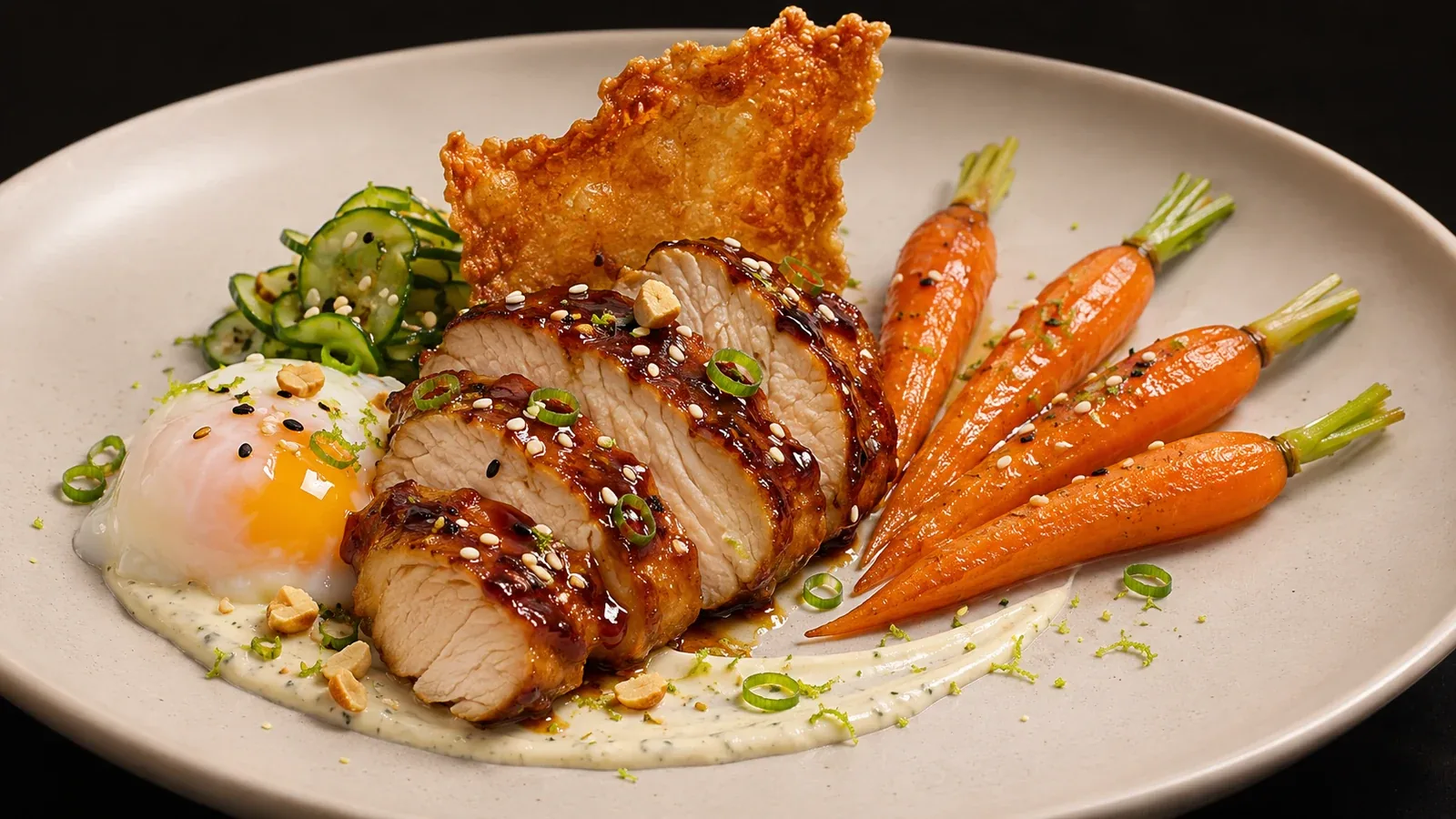
Japanese teriyaki chicken, glazed with soy, mirin and sugar until glossy, built into a complete dish with Korean accents. The aim is a very juicy breast with a shiny lacquer, surrounded by components that bring acidity, heat and crunch.
The twist is the cooking and the balance. The breast is cooked sous vide at 64 °C (147 °F), very juicy but firm, and only seared at the end; the liquid from its bag is reduced into the teriyaki glaze. The baby carrots are cooked in a vacuum bag and lacquered with honey and gochujang; an onsen egg made in the same bath is broken over the chicken, and the skin is separated and baked into a crisp tuile. So that not everything is sweet, a yogurt, lime and tahini cream, the heat and a quick pickle balance the teriyaki and the honey.
Special equipment: sous vide circulator and vacuum bags; griddle or heavy pan; food processor for homemade tahini
Ingredients
Quick pickle
- ½ small cucumber or ½ red onion, cut very thin, optional
- 40 ml rice vinegar
- 40 ml water
- 1 teaspoon sugar
- ½ teaspoon salt
Crisp skin
- The skin from the 4 breasts
- Fine salt
- The barest pinch of cornstarch, optional
Yogurt, lime and tahini cream
- 120 g plain unsweetened Greek yogurt
- 1 tablespoon tahini, store-bought or homemade (100 g lightly toasted sesame seeds, 1–2 tablespoons neutral or plain sesame oil and a pinch of salt)
- 1–2 teaspoons lime juice
- 1 pinch of salt
- 1 teaspoon water, only if needed to loosen
Gochujang baby carrots
- 16 baby carrots, about 4 per person
- 20 g butter
- 1 pinch of salt
- Finely grated zest of ½ orange or lime
- 2 teaspoons honey
- 1 teaspoon soy sauce
- 1 teaspoon gochujang
- 1 teaspoon rice vinegar or lime juice
Teriyaki chicken
- 4 skin-on chicken breasts, 180–220 g each and no more than 3.5 cm thick
- 60 ml soy sauce, plus 20–30 ml to reinforce the glaze if needed
- 30 ml mirin
- 20 g honey or muscovado sugar, plus 10–15 g honey for the glaze
- 1 garlic clove, finely grated
- 10 g fresh ginger, finely grated
- Finely grated zest of ½ lime and 1 teaspoon of its juice
- 1 teaspoon plain sesame oil
- 1 tablespoon neutral oil, for searing
- 10 g cold butter
- Black pepper, optional
Onsen egg
- 4 eggs
Finishing
- 2 scallions (spring onions), cut very thin
- 2 tablespoons sesame seeds
- 30 g unsalted roasted peanuts, coarsely chopped, optional
- 1 lime
- A few drops of soy sauce
- Cilantro, optional
Method
Quick pickle
- Pickling. Mix the vinegar, water, sugar and salt, add the vegetable and keep it covered in the refrigerator. It is good after 30 minutes but improves after a few hours.
Crisp skin
- Drying. Carefully remove the skin from the breasts, in pieces as whole as possible, pat it dry with paper towels and leave it in the refrigerator on a rack, uncovered or barely covered, from the day before: the drying is what gives the crunch.
- Baking. Place the well-dried skin between two sheets of parchment paper with a pinch of salt, and put a tray on top to keep it flat. Bake at 200 °C (390 °F) for 20–25 minutes; remove the top tray, raise to 220–230 °C (430–445 °F) and continue for 3–8 minutes, watching closely, until deeply golden and crisp. Leave it on a rack. Never brush it with teriyaki: the moisture and sugar soften it.
Yogurt, lime and tahini cream
- Homemade tahini. If not using store-bought, process the toasted seeds with the oil and salt to a smooth, fluid paste and keep it in a jar in the refrigerator.
- Cream. Mix the yogurt, tahini, lime and salt, and add a few drops of water only if it is too thick: it should hold a spoonful or a brushstroke without spreading. Keep it cold.
Gochujang baby carrots
- Sous vide. Bag the carrots with the butter, salt and zest and cook them at 85 °C (185 °F) for 45–60 minutes, until tender but whole. Since the chicken cooks at a lower temperature, it is best to do the carrots first and then lower the bath; they can wait several hours in their bag in the refrigerator.
- Lacquering. At serving, take them out of the bag, reserving a little of their liquid. In a hot pan, mix the honey, soy, gochujang and 1–2 tablespoons of that liquid into an even glaze, add the carrots and keep them moving until lacquered and glossy. Turn off the heat and add the vinegar or lime.
Teriyaki chicken
- Marinade. Mix the 60 ml of soy with the mirin, the 20 g of honey, the garlic, ginger, lime zest and sesame oil.
- Sous vide. Bag the breasts in a single layer, with 1–2 tablespoons of marinade each. Cook them at 64 °C (147 °F) for 1 h 30 min, up to 1 h 45 min if thick: they come out very juicy and tender, but firm enough to slice and sear. The safe time depends on the thickness and on how long the center takes to reach the bath temperature: do not shorten it with thick pieces.
- Glaze. Take out the breasts and dry them thoroughly with paper towels: moisture prevents browning. Strain the liquid from the bags into a small saucepan, bring it to a boil and reduce over medium heat until just syrupy; boiling is necessary because it was in contact with raw chicken. Correct with soy, honey or lime juice, and off the heat whisk in the cold butter. It should be glossy and fluid enough to coat.
- Searing. Heat a griddle or heavy pan very hot with a film of neutral oil, or half neutral and half sesame, without letting it smoke too much. Sear the breasts 30–60 seconds per side, only until a crust forms: the aim is not to cook the inside again. Brush immediately with a thin coat of glaze and, for more lacquer, return them to the griddle for a few seconds and brush again. Do not pour much teriyaki into the hot pan, because the sugar burns.
Onsen egg
- Cooking. Put the whole eggs, in their shells, in the bath at 64 °C (147 °F) for 45–60 minutes: the white is very tender and the yolk thick and creamy. At serving, crack them carefully into a small bowl before moving them to the plate. For a slightly firmer white, give them a very brief dip in boiling water, before or after the sous vide.
Finishing
- Toppings. Lightly toast the sesame if it is not already toasted, cut the scallions very thin, coarsely chop the peanuts and break the crisp skin into irregular fragments, leaving a few large pieces for height. Cut the lime.
The dish
Use wide, flat plates. Put a spoonful or a brushstroke of yogurt, tahini and lime cream, slice each breast into 3–5 thick diagonal pieces and arrange them partly overlapping, coated with a little glaze. Place 4 lacquered carrots alongside and the onsen egg where it can be broken over the chicken while eating, with a few drops of soy and lime. Add a little pickle if using and a piece of crisp skin standing upright, for texture and height. Finish with sesame, scallions, peanuts and a very fine grating of lime zest, and cilantro if desired. Final look: lacquered, glossy pieces of chicken, deep orange carrots, the white and golden egg, the pale cream and the crisp skin standing tall.
Key points
- Balance the sweetness: the lime, yogurt, heat and pickle offset the teriyaki and honey.
- Respect the sous vide time according to thickness; do not shorten it with thick breasts.
- Dry the chicken thoroughly before searing and sear it very briefly, only for the crust.
- Boil the liquid from the bags before using it as a glaze.
- Do not brush the skin with teriyaki: it softens.
Pairing
A dry Riesling or a dry Gewürztraminer, with acidity and aromas that go with the ginger, teriyaki and heat. Without alcohol, cold green tea with lime.
Notes
- Onsen egg: at 64 °C (147 °F) the yolk is creamy and only lightly set. For pregnant women, small children, the elderly or the immunocompromised, use pasteurized eggs or cook them until the yolk is firm.
- No mirin: replace the 30 ml with 20 ml of sake and 10 g of sugar, or with 20 ml of rice vinegar, 10 ml of water and 1 teaspoon of sugar.
- Heat: with 8 carrots, halve the lacquer and use ½ teaspoon of gochujang for medium heat.