Signature · about 4 hours of work, with the pavé and the gel the day before · Serves 4
Sous vide tenderloin medallions with mushroom and sherry cream, potato pavé, sherry gel and portobello textures
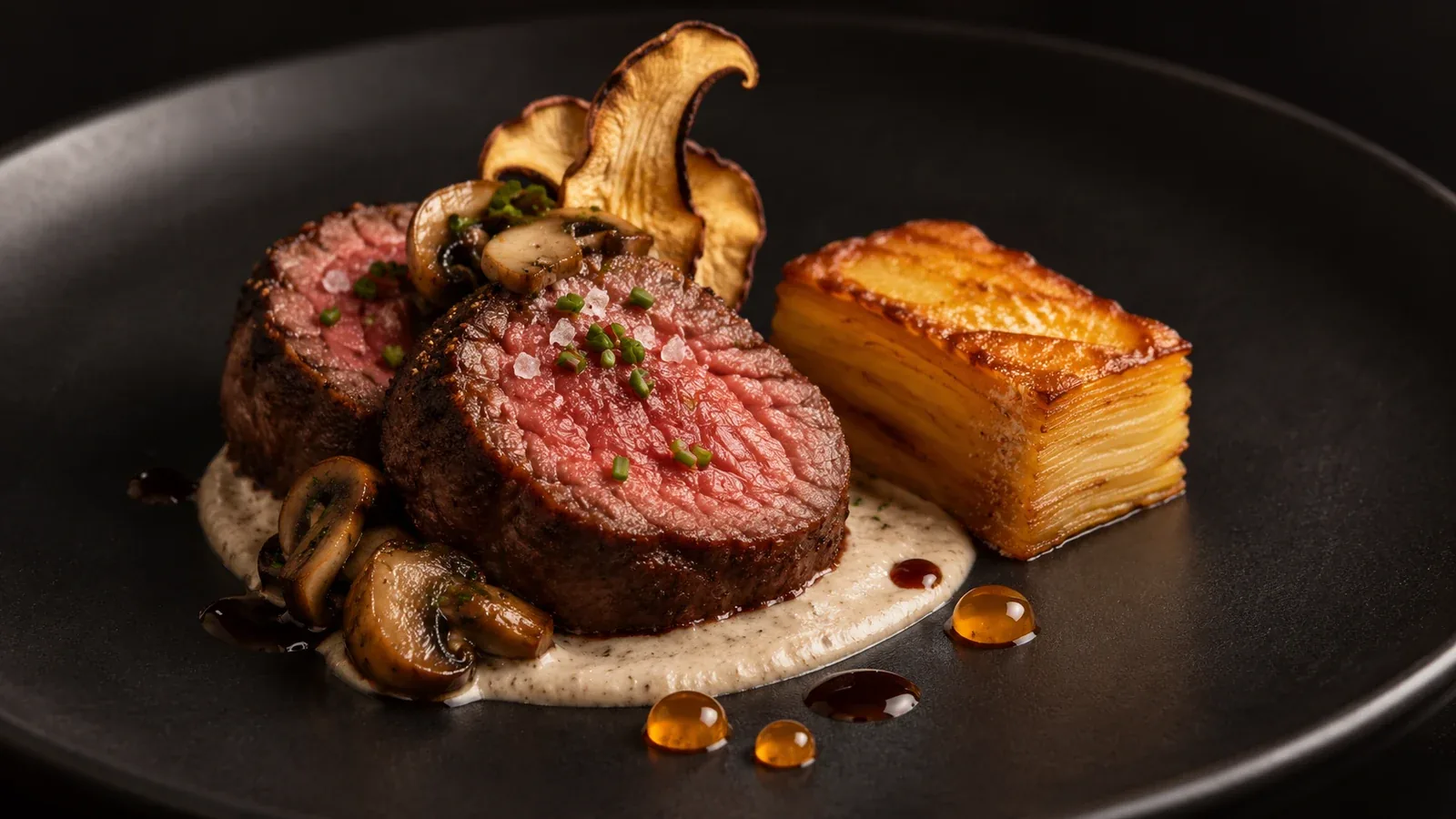
The classic of meat, mushrooms and potatoes from French bistro cooking: seared tenderloin, a creamy mushroom sauce with sherry and gratinéed potatoes. The dish keeps that combination and seeks five contrasts: juicy meat with a deeply caramelized exterior, an unctuous but not heavy sauce, creamy and crisp potato, the acidity of sherry and mushrooms in three textures.
The twist is the precision of each part. The tenderloin is cooked sous vide at 53 °C (127 °F), pink from edge to edge, and only seared at the end for the Maillard reaction. The potatoes become a sliced pavé, pressed and browned in a pan. The sherry appears in the sauce, in a reduced jus and in a gel that brings acidity to cut the fat. The mushrooms repeat in the cream, in a concentrated powder and in dry, crisp chips, with aromatic continuity without repeating texture.
Special equipment: sous vide circulator and vacuum sealer; mandoline; rectangular mold; spice grinder; squeeze bottle
Ingredients
Potato pavé
- 1.2 kg firm-fleshed potatoes
- 350 ml heavy cream
- 120 ml whole milk
- 2 garlic cloves
- 8 g salt
- 2 g white pepper
- Nutmeg
- 60 g melted butter
- 40 g finely grated Parmesan, optional
- Clarified butter or oil, for browning
Sherry gel
- 150 ml dry sherry
- 50 ml water or clear stock
- 8 ml sherry vinegar
- 6 g sugar
- 1 g salt
- 2 g agar-agar, or 4–5 g unflavored gelatin
Mushroom powder
- 20 g dried porcini
- 15 g dried shiitake
- 10 g dried button mushrooms
- 3 g fine salt
- A pinch of black pepper and, if you like, a minimal pinch of dried thyme
Portobello chips
- 2–3 large portobello mushrooms
- 10–15 ml mild or neutral olive oil
- Fine salt
Cauliflower cream
- 300 g cauliflower, optional
- 150 ml milk
- 20 g butter
- 20–30 ml heavy cream
- Salt, white pepper, nutmeg and a few drops of lemon
Mushroom and sherry cream
- 180 g button mushrooms
- 100 g portobello mushrooms
- 70 g oyster or shiitake mushrooms
- 15 ml mild olive oil
- 30 g butter
- 2 medium shallots, finely chopped
- 1 garlic clove, chopped
- 80 ml dry sherry
- 120 ml dark beef stock
- 180 ml heavy cream
- 1 teaspoon Dijon mustard
- 1 teaspoon Worcestershire sauce, optional
- Fresh thyme, salt, black pepper and a few drops of lemon juice
Reduced jus
- 150 ml dark beef stock
- 30 ml dry sherry
- 10 g cold butter
Sous vide tenderloin
- 8 tenderloin medallions of 90–100 g, 3–4 cm tall
- 12 g fine salt
- 4 g freshly ground black pepper
- 20 ml neutral oil
- 25 g butter
- 2 garlic cloves, crushed
- 2 sprigs fresh thyme
Finishing
- Chives
- Microgreens, optional
- Flaky salt
- Herb oil, optional
Method
Potato pavé
- Infusion. Heat the cream with the milk, garlic, salt, white pepper and a pinch of nutmeg for 5 minutes over low heat, without a hard boil. Remove the garlic.
- Slicing and layering. Peel the potatoes and slice them on a mandoline at 1.5–2 mm, without rinsing them: the starch binds the layers. Line a rectangular mold with parchment paper and build even layers of potato, spreading between each a little of the mixture of cream, melted butter and, if using, Parmesan.
- Cooking and pressing. Cover with parchment paper and then foil and bake at 160 °C (320 °F) for 60–75 minutes, until a knife passes through all the layers without resistance. Cover, put an even weight on top, cool and refrigerate at least 6 hours, ideally overnight.
- Portioning and browning. Unmold cold and cut pieces of 8 × 3 cm or squares of 5 × 5 cm. At serving, brown them in a pan with clarified butter or oil 2–3 minutes per side, to a golden, crisp crust with a creamy interior. Keep them hot, uncovered.
Sherry gel
- Gelling. Cold-mix all the ingredients with a whisk, bring to a boil and hold 1 minute. Pour into a shallow container and refrigerate 20–30 minutes. Once firm, cut it and process to a completely smooth gel; if too stiff, add a few drops of water or sherry. Pass it through a fine sieve into a squeeze bottle. With gelatin instead of agar the gel is possible, but the agar keeps the dots more defined at serving temperature.
Mushroom powder
- Drying and grinding. Dry the mushrooms in the oven at 80–90 °C (175–195 °F) for 20–25 minutes and cool them completely. Grind them to a powder, sift it fine and mix with the salt, pepper and, if using, the thyme. Store airtight and away from moisture. 0.5–1 g per plate is used.
Portobello chips
- Baking. Clean the portobellos without submerging them, slice them 1–2 mm thick and pat dry between paper towels. Lightly brush with oil, salt very little and spread without overlapping on a silicone sheet or parchment paper. Bake at 95 °C (205 °F) about 50–60 minutes, checking from 40, and turn them if needed. Turn off the oven and leave them 10–15 minutes more with the door ajar. As they cool they finish hardening: they should be dry, light, slightly curved and very crisp.
Cauliflower cream
- Cooking and processing. Cook small florets in the milk, gently, until tender, without overdoing it: overcooking intensifies sulfurous notes. Drain keeping part of the milk and process hot with the butter, cream, salt, pepper and a minimal pinch of nutmeg, adding only the liquid needed for a silky cream. Sieve fine and finish with a few drops of lemon. It is a discreet side, not a second sauce.
Mushroom and sherry cream
- Mushrooms. Cut the button mushrooms into quarters, the portobellos into thick slices and the oyster or shiitake into irregular pieces. Heat a wide pan very hot with the oil and half the butter and sauté them in batches, without crowding, 8–10 minutes in total: first they release water and then they brown. Reserve some good-looking ones for finishing.
- Sauce. Add to the pan the rest of the butter and the shallot and cook 2–3 minutes; add the garlic 30 seconds. Return the mushrooms, deglaze with the sherry and reduce 3–4 minutes, until almost no liquid remains. Add the stock and reduce by half. Add the cream, Dijon and, if using, Worcestershire, and cook over low heat 5–7 minutes. Finish with thyme, salt, pepper and a few drops of lemon if it needs tension. It should be coating, not thick. For a more bound base, process a third of the sauce and mix it back in: it keeps visible pieces of mushroom.
Reduced jus
- Reduction. Slowly reduce the stock with the sherry to a barely syrupy texture. Remove from the heat and emulsify the cold butter by moving the pan. Do not boil it again. Keep hot.
Sous vide tenderloin
- Bagging. Dry the medallions, season moderately and vacuum-seal them one at a time or with space between pieces. Do not put much butter in the bag: its flavor is better used in the searing.
- Cooking. Cook at 53 °C (127 °F): for medallions of 3–4 cm, 45–60 minutes; of 4–5 cm, 60–90 minutes. The practical recommendation is 1 hour; it can be extended to about 2 hours if the service requires, but in such a tender cut long times give a texture that is too soft. At 53 °C (127 °F) the tenderloin is juicy, evenly pink and with structure: 50–51 °C (122–124 °F) gives a very red doneness; 54–55 °C (129–131 °F), pink and somewhat firmer; 56–57 °C (133–135 °F), medium.
- Searing. Take the medallions out of the bag and dry them very well with paper towels. Heat a heavy pan very hot with the oil and sear them 45–60 seconds per side. Add the butter, garlic and thyme, tilt the pan and baste them with the foaming butter 30–45 seconds. The goal is only the Maillard reaction, without raising the interior temperature further.
Finishing
- At serving. Chop the chives and have at hand the reserved mushrooms, flaky salt and, if used, microgreens and herb oil.
The dish
Use black, graphite, dark stone or matte ceramic plates, with free space. Put a measured spoonful of mushroom cream just off center, without making a pool, and set on top one or two medallions, slightly overlapping for height. Place the pavé at the side, with the layered structure and golden surface in view; if using, put a small teardrop of cauliflower cream next to one of its ends, leaving at least 70% of the crust exposed. Distribute 3–5 small dots of sherry gel near the meat and the mushroom cream, and a few drops or a short stroke of reduced jus around the tenderloin, without covering the crust. Add a minimal amount of mushroom powder on one side of the pavé, and 1–3 portobello chips standing upright, behind the medallion or resting on the pavé. Finish with a few sautéed mushrooms, chives, very few microgreens and flaky salt on the tenderloin. Final look: medallions with a dark crust and pink center on an ivory mushroom sauce, the golden, layered pavé, amber dots of gel and the chips standing high.
Key points
- Dry the tenderloin thoroughly after the bath and sear in a very hot pan and for a short time, so as not to overcook the interior.
- Let the mushrooms lose their water before browning them, working in batches.
- Press the pavé cold for at least 6 hours: it is what allows clean cuts and a crisp crust.
- Keep the mushroom cream coating and the cauliflower one discreet: the dish should not feel heavy.
- Use the powder and chips sparingly and add them at the end, so they keep their texture.
Pairing
An elegant Pinot Noir, with red fruit, good acidity and moderate oak, or a fresh-profile Merlot, avoiding very ripe or high-alcohol examples. In white, a Chardonnay with good acidity and discreet aging goes especially well with the mushrooms, pavé and butter.
Notes
- Doneness safety: cooking at 53 °C (127 °F) is appropriate for a whole, intact cut of tenderloin, not ground or tenderized with needles, and seared and served right away. Do not chill or store the tenderloin after the bath to reheat it.