Signature · 1 hour and 15 minutes · Serves 4
Sole with Roquefort and whisky, fennel and walnut crisp
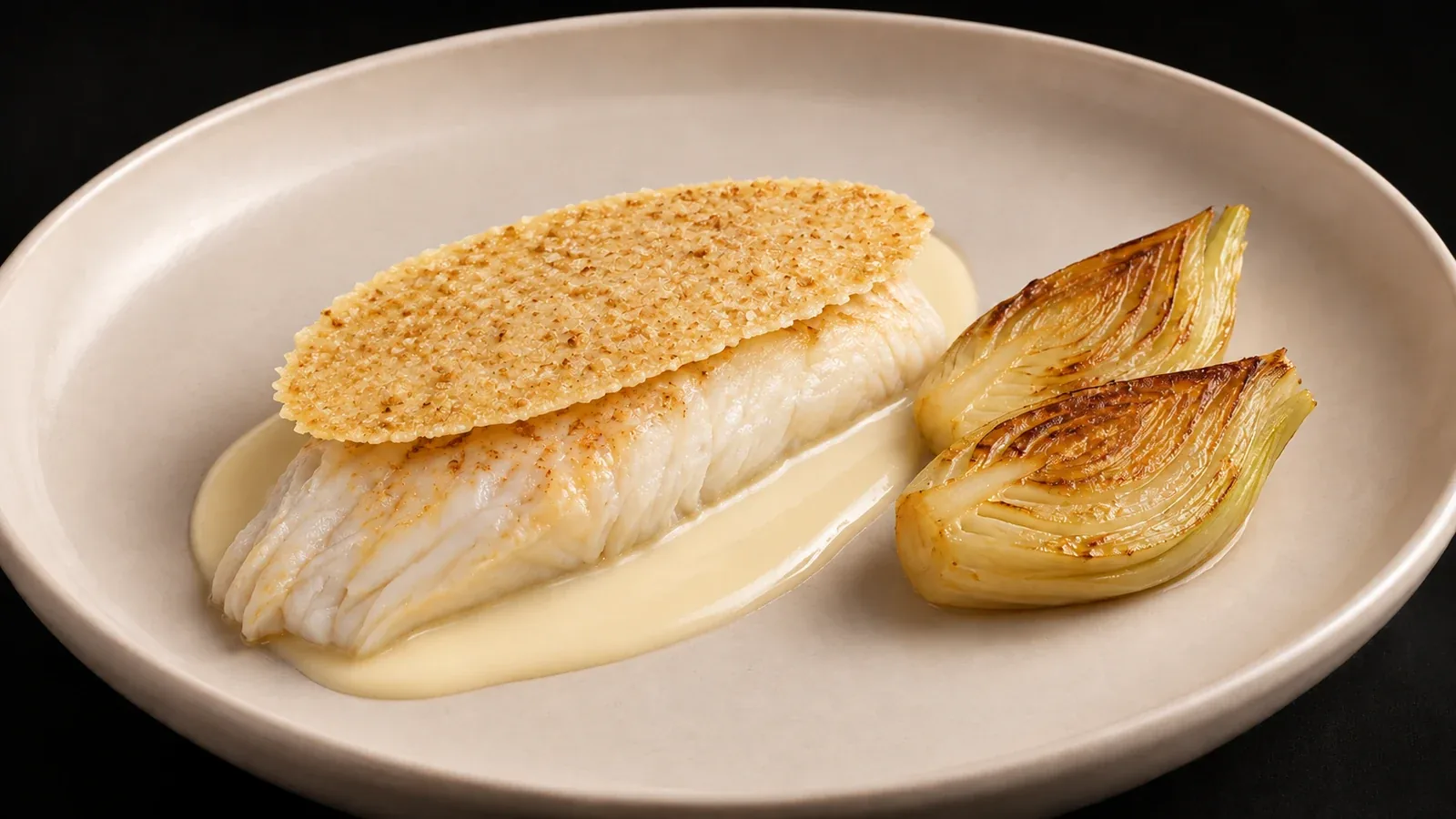
The sole with Roquefort keeps its creamy sauce and the perfume of the whisky, with the fish at the center of the plate. The braised fennel brings vegetal sweetness and a lemon finish refreshes the whole without making the cream acidic.
The idea is a deconstructed gratin: the sauce stays silky around the fish and the browning arrives in a Parmesan and walnut wafer baked separately. The controlled bath limits overcooking, while the crisp reproduces the toasted flavor without reheating the fillet under the broiler.
Special equipment: sous vide circulator, bags suitable for cooking at 65 °C and thin-probe thermometer
Ingredients
Lemon-braised fennel
- 600 g cleaned fennel, in 8 wedges held together by a bit of base.
- 15 g butter.
- 10 ml olive oil.
- 100 ml water.
- 10 ml lemon juice.
- 1 teaspoon finely grated lemon zest, without the white part.
- Salt and pepper, to taste.
Parmesan and walnut crisp
- 40 g Parmesan cheese, finely grated.
- 20 g walnuts, chopped very small without making a paste.
Roquefort and whisky sauce
- 20 ml whisky, preferably without strong smokiness.
- 200 ml heavy cream, of about 35% fat.
- 70 g Roquefort cheese, crumbled.
- 20–40 ml hot water, only if adjustment is needed.
- Black pepper, to taste.
Sous vide sole
- 720 g skinless, boneless sole fillets, divided into 4 portions of 180 g.
- 12 g butter, in 4 portions.
- 3 g fine salt, or less if the cheese is very salty.
Method
Lemon-braised fennel
- Browning. Heat oil and butter in a wide pan. Set the wedges on a cut side and cook over medium heat 3–4 minutes per side, until golden spots form without burning the outer layers. Salt moderately.
- Braising. Add the 100 ml of water, cover and cook over low heat 15–20 minutes, until the base is pierced by a knife without hard resistance. If it dries out sooner, add a little water; it should be tender without falling apart.
- Glazing and freshening. Uncover and evaporate the excess liquid until a glossy film remains. Off the heat, add juice, zest and pepper. Keep hot briefly, without reducing further; reheat with a spoonful of water if needed. The lemon belongs to this side, not to the fish bag.
Parmesan and walnut crisp
- Forming. Heat the oven to 180 °C (355 °F), conventional heat. Mix Parmesan and walnut. On baking paper or silicone, form four flat ovals, about 12 × 5 cm, with the mixture divided equally; leave space between them. A thin layer turns brittle; a mound stays greasy and soft in the center.
- Baking. Cook about 6–9 minutes, watching from minute 5: the cheese should melt, bubble and take a light golden color in the center too. Remove before the edges turn dark brown, because the walnut turns bitter.
- Cooling. Rest on the tray 3 minutes and lift off when the wafer is firm. Cool on a rack; it will finish hardening as it loses heat. If the center is still flexible and moist once cold, return to the oven 1–2 minutes and cool again. Keep dry and protected, away from steam and the refrigerator, until service the same day.
Roquefort and whisky sauce
- Concentrating the whisky. Pour it into a small saucepan off the flame; return to medium heat and let it bubble 30–60 seconds until reduced by about half. Do not flambé. The reduction softens the alcoholic note, but does not guarantee removing all the alcohol.
- Melting. Add the cream and heat until steam rises and small bubbles appear at the edge. Lower the heat and add the Roquefort in two batches, stirring until melted. Cook gently 2–4 minutes: it should coat the back of a spoon with a continuous film, without boiling hard or separating fat.
- Adjusting. Taste before salting; the formula needs no added salt in the sauce. Add pepper and hot water 10 ml at a time if it is too thick. Keep at 60 °C (140 °F) or more, in a gentle water bath, during the brief cooking of the fish; stir and avoid excessive evaporation. Do not add the raw liquid from the bags.
Sous vide sole
- Regularizing. Work with thawed fish refrigerated at 5 °C (41 °F) or below. Check for bones and dry. Each portion can combine two small fillets placed side by side; do not overlap or roll them. Select pieces with a maximum thickness of 10–20 mm and group those of similar thickness. The thinner pieces are checked sooner and removed individually.
- Preparing the bath. Stabilize at 65 °C (149 °F) a container with capacity for four separate bags and free circulation. Verify the temperature with an independent thermometer. Use food-grade bags expressly suitable for that temperature and cooking, one per portion. Salt right before bagging and add 3 g of butter to each bag; do not add whisky or lemon.
- Bagging without compressing. Remove the air by water displacement and keep the seal above the surface, clipped to the edge; the fish must be completely submerged. Avoid strong vacuum, which deforms the flesh. The bags must not float, touch the heating element or pile up.
- Cooking and measuring. Put them in and wait for the bath to recover 65 °C (149 °F). For 10–20 mm of thickness from the refrigerator, plan as a guide about 15–30 minutes; begin measuring at 12 minutes on the thin pieces. The clock organizes, but does not decide doneness. Open the seal above the water and insert a clean thin probe from above, through the edge to the center of the thickest part, keeping that part of the fish submerged and without letting water in. Check each portion: the center must reach at least 63 °C (145 °F) and stay there 15 seconds. If the temperature is short, continue in the bath and measure again; do not automatically extend all the bags equally.
- Removing and serving. Open, drain and lift with a wide spatula. The flesh will be opaque, moist and flake with gentle pressure. Discard the liquid from the bag and serve immediately; do not leave the fish waiting in the bath. This formula uses full cooking with a measured endpoint, not a pasteurization protocol at 45–55 °C (113–131 °F). It requires a probe: do not replace the control with a fixed time.
The dish
Use four wide, low-rimmed plates, warmed; spread a generous spoonful of sauce in an elongated central area and set the sole slightly off-center, leaving part of the white surface visible. Arrange two fennel wedges at one side, golden side up with their lemon juices clinging, without pouring loose liquid over the sauce. Distribute the rest of the sauce next to the fish, without flooding the plate or covering the fennel. Rest a Parmesan and walnut wafer on the back at the last moment, with most of it outside the sauce to keep it dry. Serve the four plates immediately: you should read a pearly fillet on ivory cream, the golden fennel and a thin crisp that can be broken with the fork to add to each bite.
Key points
- The bath limits the exterior temperature; the measured center determines when it comes out. Do not rely on minutes alone.
- Do not use rolls or overlapping layers: they would change the heat transfer and the planned times.
- The Roquefort must go with the sole; taste the sauce before salting the whole.
- The cheese and walnut brown separately; the cooked fish does not return to the oven.
- Keep the crisp dry until serving and avoid hot waiting of the fish.
Pairing
Chardonnay without marked oak, served cool, for its body and acidity. Without alcohol, sparkling water and a strip of lemon peel, with no added juice.
Notes
- The formula produces a moderate main portion of fish with fennel. The Parmesan and walnut wafer is a salty crisp, not an adhered crust or a literal gratin of the cream. The method at 63 °C (145 °F) gives a firmer texture than sous vide at lower temperatures; the advantage sought is to stop the cooking and preserve the browning separate.
- Storage. The fish is cooked to be eaten immediately; bagged cooking for storing or reheating is not proposed. Thaw in the refrigerator at 5 °C (41 °F) or below and dry well. The sauce and side can be prepared up to the day before if chilled quickly: from 60 to 21 °C (140 to 70 °F) in up to 2 hours and from 21 to 5 °C (70 to 41 °F) in another 2 hours, pre-chilling to 60 °C (140 °F) in under 30 minutes. Use shallow containers and an ice bath; keep covered at 5 °C (41 °F) or below and reheat to 74 °C (165 °F) at the center. It is a quality and organization window, not a universal shelf life. For leftover fish, apply the same chilling and eat the next day, reheating to 74 °C (165 °F); it will lose delicacy. Do not store closed bags with cooked fish.