Essential · about 6 hours spread over 2 days, plus 12–24 hours of resting the noodles and 6–12 hours of marinating the eggs · Serves 4
Shoyu ramen
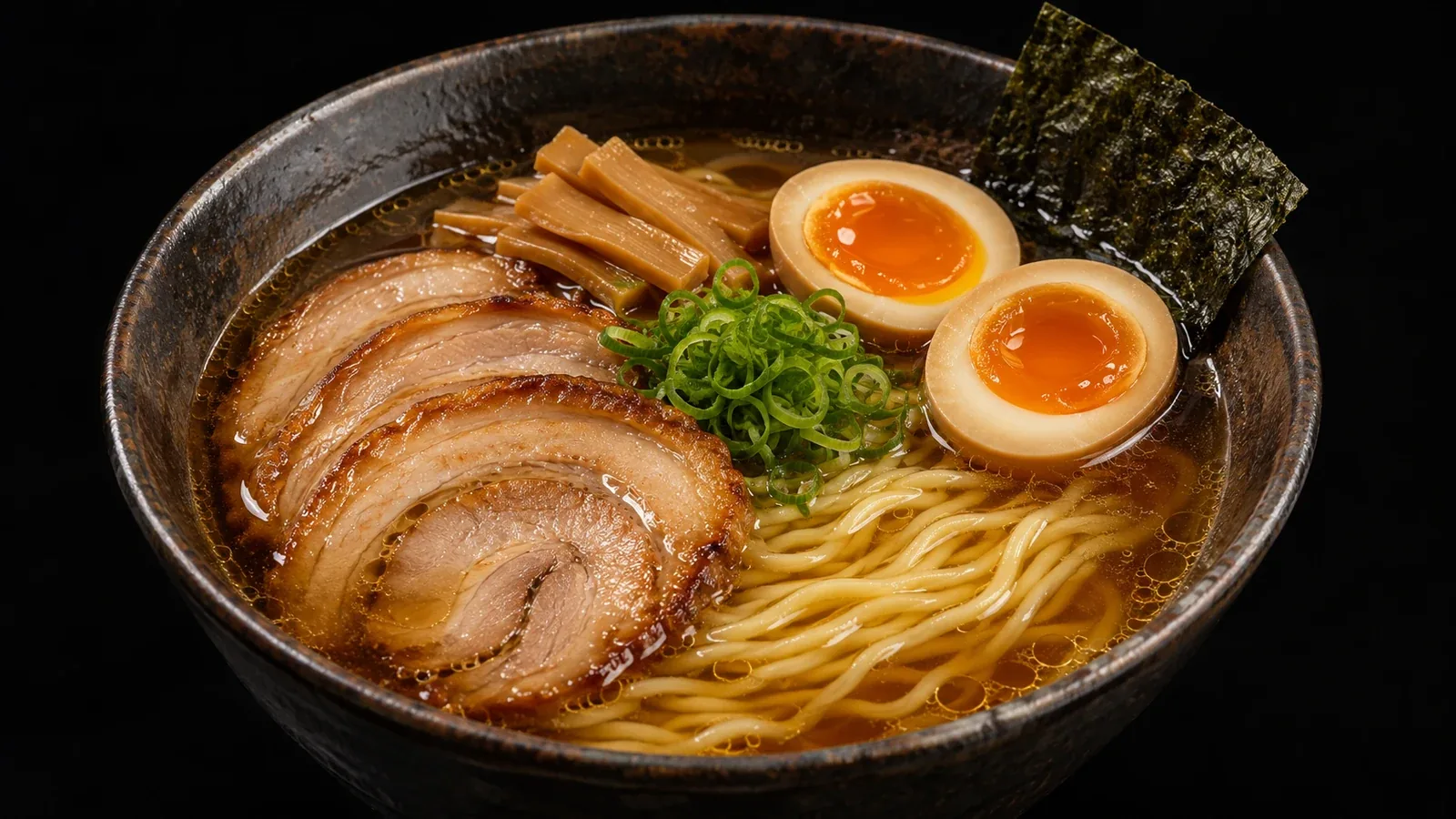
Illustrative image generated with AI, not a photo of the cooked dish.
Kitchen test pending
The shoyu ramen of Tokyo: a clear chicken broth seasoned with a soy sauce tare, firm alkaline noodles, pork chashu, marinated egg and scallion. The aim is a ramen of deep but clean flavor, in which broth, tare, aromatic fat and noodle remain distinct in every spoonful.
The recipe follows the classic structure of the bowl, built in layers. The chicken chintan broth is cooked below the boil so it stays clear and full-bodied, and is cut with a kombu and katsuobushi dashi. The tare concentrates soy with mirin, sake, kombu and shiitake, and a scallion oil made with the fat from the chicken skin gives the aroma. The noodles are made at home with kansui, which gives them their characteristic bite and color.
Special equipment: pasta machine with cutter; kitchen thermometer; cheesecloth or fine filter; precision scale for the kansui
Ingredients
Chicken chintan broth
- 1.5 kg chicken carcasses
- 500 g chicken wings
- 3–3.5 liters cold water, plus hot water if needed
- 30 g ginger
- 3 garlic cloves
- 2 scallion stalks, green part
Dashi
- 500 ml water
- 8 g kombu
- 20 g katsuobushi
Shoyu tare
- 220 ml Japanese koikuchi soy sauce
- 60 ml usukuchi soy sauce
- 80 ml hon-mirin
- 60 ml sake
- 10 g sugar
- 5 g kombu
- 1 large dried shiitake
- 5 g ginger
Negi oil and schmaltz
- 100 g chicken skin, in small pieces
- 30 ml water
- 80 g scallion
- 30 ml neutral oil, only if needed
Chashu
- 500–600 g skinless pork belly
- Kitchen twine
- 80 ml soy sauce
- 60 ml mirin
- 60 ml sake
- 120 ml water
- 20 g sugar
- 10 g ginger
- 2 garlic cloves
Ajitama eggs
- 4 large eggs
- 150 ml shoyu tare
- 50 ml water
Ramen noodles
- 280 g bread flour (12–13% protein)
- 120 g weaker flour (9–10% protein)
- 144 g water
- 7 g fine salt
- 5 g kansui powder
- Potato starch or cornstarch, for dusting
Toppings and assembly
- 2–3 scallions, green part only
- 60–80 g menma
- 1 large sheet of nori
- Yuzu zest, optional
Method
Chicken chintan broth
- Blanching. Cover the carcasses and wings with water, bring to a boil and boil 5 minutes: foam, coagulated blood and proteins rise. Discard the water and wash the bones and the pot.
- Cooking. Return the bones to the pot with the ginger, garlic and scallion, cover with 3–3.5 liters of cold water and slowly bring to 90–95 °C (194–203 °F). Hold about 3 hours, without boiling, skimming the foam regularly and adding hot water if the bones become exposed.
- Filtering. Turn off the heat, rest 20–30 minutes and strain first through a coarse sieve and then through a fine one or cheesecloth. It should be clear, barely golden and full-bodied, and gel when cooled: it yields about 1.2–1.4 liters. Do not over-salt it: the tare seasons the bowl.
Dashi
- Infusion. Heat the water with the kombu to 60–65 °C (140–149 °F), hold 15 minutes and remove the kombu. Raise to 80 °C (176 °F), turn off the heat, add the katsuobushi, infuse 4–5 minutes and strain without pressing. It yields about 400–450 ml.
Shoyu tare
- Infusion. In a small pot, heat the two soy sauces, mirin, sake, sugar, kombu, shiitake and ginger to 80–85 °C (176–185 °F), without a hard boil, and hold 10 minutes. Remove from the heat, cover, infuse 20–30 minutes and strain. It yields about 350–400 ml; it is better after a night in the refrigerator.
Negi oil and schmaltz
- Schmaltz. Put the chicken skin with the water in a cold pot and cook over very low heat 30–40 minutes, until it releases its fat. Strain: the liquid fat is the schmaltz, and the crisp solids can be saved as chicken cracklings.
- Negi oil. Over low heat, heat 60–80 ml of schmaltz, topping up with neutral oil if short, and cook the cut scallion 10–12 minutes, until barely golden, never burnt. Strain right away, leaving no bits of scallion, and keep only the oil: it yields 60–100 ml.
Chashu
- Shaping and browning. Roll the pork belly into a cylinder, tie it firmly with twine and brown it all over in a pan.
- Cooking. Put it in a pot with the soy, mirin, sake, water, sugar, ginger and garlic and cook gently, with the liquid at 90–95 °C (194–203 °F), for 60–90 minutes, turning it occasionally, without a hard boil. Remove it, chill it quickly and keep it in the refrigerator, ideally overnight.
- Glazing. Strain the cooking liquid and reduce it until just syrupy. At serving, slice the chashu, briefly brown the slices until hot and brush them with the reduction.
Ajitama eggs
- Cooking. Carefully lower the eggs into boiling water and cook 6 min 15 s – 6 min 30 s, moving them gently the first few seconds to center the yolk. Move them right away to water with plenty of ice for 10 minutes and peel carefully.
- Marinating. Mix the tare with the water and put the eggs with the marinade in a bag, removing the air. Marinate in the refrigerator 6–12 hours; 8 hours is a good starting point.
Ramen noodles
- Alkaline liquid. Completely dissolve the salt and kansui in the water.
- Mixing and first rest. Slowly pour the liquid over the two flours while mixing. At first the mixture looks dry, sandy and in fragments: do not add water. Cover and rest 30 minutes.
- Sheeting. Press the dough into a block, without kneading it like bread, and divide it in two. Pass it through the thickest opening of the machine, fold it and pass it again, 5–6 times, until it comes together, softens and develops gluten. Leave the sheets in a bag 20–30 minutes.
- Cutting and resting. Gradually reduce the thickness to 1.3–1.5 mm and cut at 1.6–1.8 mm, dusting right away with starch. For a slightly wavy style, gently compress the noodles between your hands. Form portions of 135–140 g, store them separately and leave them in the refrigerator 12–24 hours: the rest greatly improves the texture. It yields about 550 g.
Toppings and assembly
- Scallion. Cut the green part with a very sharp knife, into 1–2 mm rings, 2 mm diagonals or 0.8–1 mm julienne. Submerge it 5–10 minutes in water with plenty of ice, at 0–4 °C (32–39 °F), unsalted, and dry it very well with a salad spinner, paper towels or a cloth. Keep it in the refrigerator until the end.
- Menma and nori. Drain the menma and, if very salty, rinse it lightly; 15–20 g per bowl are used. Cut the nori in four and keep it completely dry, out of the refrigerator.
- Bowl broth. Heat the broth and dashi: per bowl go 240 ml of chintan and 60 ml of dashi, about 300 ml. The broth should arrive very hot, without boiling violently when served.
- Noodles. Cook each portion in plenty of water at a hard boil, unsalted, about 90 seconds, tasting: the center should keep elasticity, resistance and bite. Drain very well.
The dish
Use hot ramen bowls and work fast. Put in each bowl 22–25 ml of tare and 8–10 ml of aromatic oil, add the 300 ml of hot broth and dashi and mix briefly. Add the well-drained noodles and arrange them with chopsticks so they are oriented. Arrange on top 2–3 slices of glazed chashu, an ajitama egg cut in half with the yolk in view, the menma, the very cold scallion and, last, the quarter of nori resting on the rim; if using, a minimal grating of yuzu zest. Serve at once. Final look: a clean amber broth with dots of golden oil, the orderly noodles, the glossy chashu, the orange, gelatinous yolk, the green of the scallion and the dark nori.
Key points
- Cook the broth and chashu below the boil: a hard boil clouds the broth and toughens the meat.
- Brown the oil's scallion without burning it, and strain it out completely.
- Do not add water to the noodle dough even if it looks dry: the 36% hydration is correct.
- Cook the noodles in unsalted water at a hard boil, and drain them very well.
- Dry the scallion thoroughly and add the nori at the end, so they do not soften.
Pairing
A junmai sake or a very cold Japanese lager. Without alcohol, cold green tea or mugicha.
Notes
- Kansui: it is an alkaline powder. Measure it with a precision scale and do not touch it with wet hands.
- Liquid yolk: the ajitama egg has a barely set yolk. For pregnant women, small children, the elderly or the immunocompromised, cook it until the yolk is firm.
- Dough proportions: water 36%, salt 1.8% and kansui 1.2% of the flour weight, useful for scaling.