Signature · about 2 hours, plus 24–36 hours of curing the yolks · Serves 4
Roasted squash soup with dashi and cured egg yolk
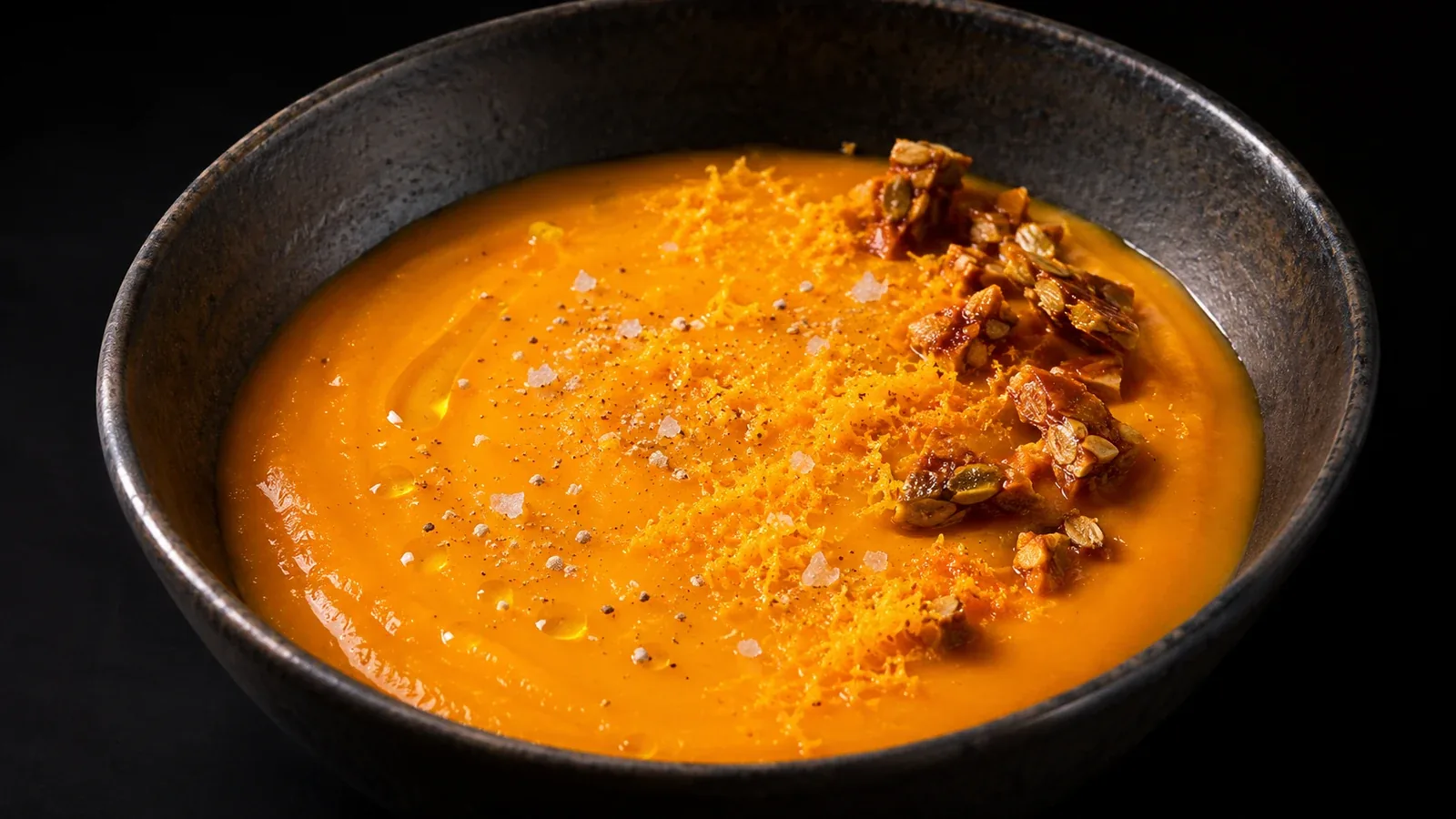
Illustrative image generated with AI, not a photo of the cooked dish.
Kitchen test pending
The squash soup as always, taken to a deep but clean flavor. The squash is roasted first to develop caramelization and concentrate its flavor, and the soup is finished silky, fluid and coating, to serve as a starter.
The twist is to cook it in a kombu dashi instead of stock: it brings umami without resorting to mushrooms and leaves the squash as the protagonist. A brown butter with zest and drops of lemon adds toasty notes and a very fine acidity. At serving, a grated cured yolk gives a salty finish and a savory pumpkin-seed praline, the crunchy contrast.
Special equipment: high-power blender or hand blender; fine sieve; kitchen thermometer; microplane
Ingredients
Cured yolks
- 2 egg yolks
- 100 g fine salt
- 100 g sugar
Kombu dashi
- 900 ml water
- 8 g kombu seaweed
- 10 g katsuobushi, optional, for a non-vegetarian version
Savory pumpkin-seed praline
- 50 g pumpkin seeds
- 35 g sugar
- 1 pinch of fine salt
Soup
- 1.2 kg kabocha (cabutia) or similar winter squash
- Olive oil and salt, for roasting
- 120 g white onion, finely cut
- 80 g carrot, finely cut
- 2 garlic cloves, about 8 g, chopped
- 15 ml olive oil
- 70 g butter
- Finely grated zest of ½ lemon and 3–5 drops of its juice
- 60 ml heavy cream
- Fine salt and white pepper
Finishing
- Extra virgin olive oil
- Freshly ground white pepper
- Flaky salt, optional
Method
Cured yolks
- Curing. Mix the salt with the sugar and put half in a small container. Make two wells with a spoon, carefully separate the yolks and set one in each well. Cover them completely with the rest of the mixture, cover and refrigerate at 5 °C (41 °F) or below for 24–36 hours.
- Washing. Carefully remove them, rinse very briefly with cold water and pat dry with paper towels. They should be firm enough to grate finely. Keep them in the refrigerator.
Kombu dashi
- Infusion. Hydrate the kombu in the water for 30 minutes. Heat slowly to 60–65 °C (140–149 °F) and hold that temperature for about 30 minutes, without boiling. Remove the kombu.
- Katsuobushi. If using, bring the liquid almost to a boil, turn off the heat, add the katsuobushi, infuse 1–2 minutes and strain without pressing. Keep hot.
Savory pumpkin-seed praline
- Caramel. Lightly toast the seeds. Make a dry caramel with the sugar in a pan, to a light amber, add the seeds and salt and mix quickly. Pour onto a silicone sheet or baking paper and let cool completely. Break it and chop it irregularly, and store it in an airtight container so it does not absorb moisture.
Soup
- Roasted squash. Preheat the oven to 210 °C (410 °F). Cut the squash into wedges, remove the seeds, lightly season with oil and salt and roast 35–45 minutes, until completely tender and with caramelized edges. Separate the pulp from the skin.
- Base and cooking. Cook the onion and carrot in the oil over medium-low heat for about 10 minutes, without over-browning; add the garlic and cook 1 minute. Add the pulp and 700 ml of dashi, and cook at a very gentle simmer 8–10 minutes.
- Blending. Process 2–3 minutes, to a completely smooth texture, adding dashi if needed: it should be silky, fluid and coating. Pass through a fine sieve.
- Citrus brown butter. Heat the butter until the milk solids begin to brown and a hazelnut and toasted-butter aroma appears. Remove at once from the heat and add the zest and drops of lemon.
- Finishing the soup. Add the brown butter and cream to the hot soup and emulsify with the hand blender. Adjust the salt, white pepper and density with dashi. From here on, avoid a hard boil.
Finishing
- Temperature. Serve the soup at 70–75 °C (158–167 °F). If made ahead and refrigerated, bring it first to 74 °C (165 °F) and emulsify again.
The dish
Use dark deep plates, warmed. Serve 220–240 ml of soup per person. Scatter the savory pumpkin-seed praline over one area of the surface, only at the pass so it stays crunchy. Finely grate the cured yolk with a microplane over the soup, about half a yolk per plate, so it falls like an orange powder. Finish with a few drops of olive oil, freshly ground white pepper and, if you like, a few flakes of salt. Final look: an intense, glossy orange soup on the dark plate, an area of golden, brittle praline, and the yolk powder and dots of oil.
Key points
- Roast the squash until it has caramelized edges: it is the base of the deep flavor.
- Do not boil the dashi: above 65 °C (149 °F) the kombu releases bitter, viscous notes.
- Remove the butter from the heat as soon as it smells of hazelnut, before it burns.
- Store the praline in an airtight container and add it at the pass, because it absorbs moisture.
- Avoid a hard boil once the butter and cream are added.
Pairing
A cold junmai sake or an unoaked Chardonnay, which go with the umami of the dashi and the sweetness of the squash. Without alcohol, cold sencha green tea.
Notes
- Raw yolk: the cured yolk is not cooked. Use fresh, healthy eggs and always cure at 5 °C (41 °F) or below. For pregnant women, small children, the elderly or the immunocompromised, replace it with sieved, lightly salted hard-boiled yolk.
- Intended result: intense roasted squash flavor, controlled natural sweetness, subtle umami, toasted butter notes, a very fine citrus acidity, a crunchy contrast and a salty finish from the yolk.
- Storage: the soup is kept covered in the refrigerator up to 48 hours, chilled quickly in a shallow container. Reheat it to 74 °C (165 °F) before serving.