Signature · 3 hours 30 minutes, plus 4 days of curing and 2 hours of draining · Serves 4
Roasted asparagus ravioli with asparagus-stem butter and cured egg yolk
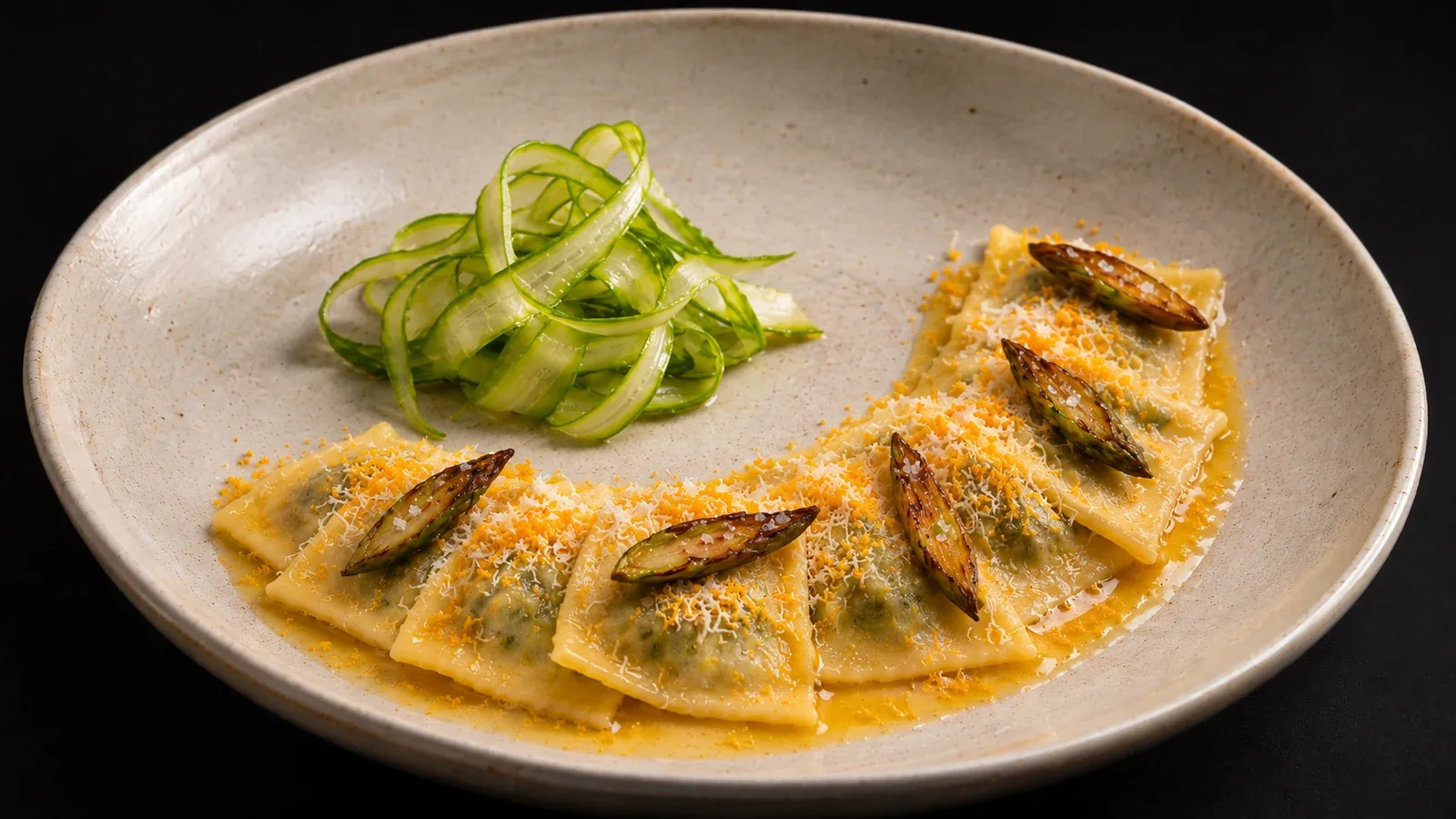
Illustrative image generated with AI, not a photo of the cooked dish.
Kitchen test pending
The root is the asparagi alla milanese: asparagus, butter, egg and Parmigiano, a classic Lombard combination. That combination is taken to a filled pasta with a yolk dough. The dish aims for a bite in which the asparagus appears in three different ways and the egg and cheese stay in the background, with no cream or second sauce.
The twist is to use the whole asparagus. The stalks are roasted over high heat until blistered and go into the filling: they bring smoke and toasted sweetness that ricotta alone lacks. The peels and woody bases, which are normally thrown away, are made into a stock, reduced and mounted with butter, so the sauce tastes of the asparagus itself and not just of fat. The tips are divided: some are browned and others are shaved raw with lemon, to add freshness and crunch. The cured yolk, grated at the moment, replaces the Milanese fried egg with a salty, umami flavor, as a powder.
Special equipment: pasta machine; cast-iron griddle or pan; mandoline or sharp peeler; microplane
Ingredients
Cured yolks (start 4 days ahead)
- 4 yolks from very fresh eggs, with clean, sound shells (2 are used; the others are spare)
- 150 g fine salt
- 150 g sugar
Asparagus (broken down for the three uses)
- 800 g medium to thick green asparagus, about 2 bunches of 24–28 spears
Asparagus butter
- The woody bases and peels of the asparagus, about 250 g
- 5 ml olive oil
- 1 medium shallot, about 40 g, in thin slices
- 50 ml dry white wine
- 600 ml cold water
- 90 g very cold unsalted butter, in 1 cm cubes
- 3–5 ml lemon juice
- Fine salt
Filling
- The middle stalks of the asparagus, about 350 g raw
- 10 ml olive oil
- 180 g fresh ricotta, which should yield 120 g once drained
- 30 g finely grated Parmigiano Reggiano
- 1 yolk, about 18 g
- Finely grated zest of ½ lemon
- 3 g fine salt, plus more to adjust
- Freshly ground white pepper
Yolk dough
- 220 g 00 flour, plus more for rolling
- 30 g fine durum wheat semolina
- 50 g egg without shell, 1 unit
- 90 g yolks, about 5 units
- 5 ml olive oil
- 2 g fine salt
- 5–10 ml water, only if the dough does not come together
- 30 g fine semolina, for the trays
Tips and finishing
- 8 asparagus tips of 5 cm, to shave raw
- The rest of the tips, about 18, halved lengthwise
- 10 g butter and 5 ml olive oil, for browning the tips
- 5 ml lemon juice and 5 ml extra virgin olive oil, for the shavings
- 20 g Parmigiano Reggiano, in one piece, to grate at serving
- Flaky salt
- 5 l water and 50 g coarse salt, to cook the pasta
- 60–80 ml pasta cooking water
Method
Cured yolks
- Cured yolks. Mix the salt with the sugar and spread half in a small container with a lid, in a layer 1.5 cm thick. Make 4 wells with the back of a spoon and set the whole yolks in them, carefully separated from the white so as not to break the membrane. Cover them with the rest of the mixture without pressing. Cover and refrigerate at 5 °C (41 °F) or below for 4 days. They are ready when firm and elastic throughout, an intense amber color, with no liquid center when gently squeezed. Rinse them under cold water, pat dry and finish drying them in the oven at the lowest temperature (60–70 °C / 140–160 °F), on a rack, for 1½–2 hours. They should be dry outside and barely flexible, so they can be grated on a microplane without sticking. If they dry too much they crumble, but can be used anyway.
Asparagus
- Breaking down the asparagus. Bend each asparagus near the base until it snaps by itself: what remains below is the woody base and goes into the stock. Cut tips of 5 cm. Peel the lower third of the middle stalks with a peeler and add the peels to the bases. Set aside 8 tips, the straightest, for shaving, and cut the rest in half lengthwise. About 250 g should be left for the stock, about 350 g of stalks and about 200 g of tips. Keep the tips in the refrigerator wrapped in damp paper.
Asparagus butter
- Stock and reduction. Cut the bases into 2 cm pieces. Heat the oil in a saucepan over medium heat and sweat the shallot 2 minutes, until translucent but without color. Add the bases and peels, stir 1 minute and deglaze with the wine until almost evaporated. Cover with the cold water, bring to a gentle boil and cook 20 minutes uncovered. Longer, the asparagus gives sulfurous, cabbage-like notes and the stock turns cloudy. Strain pressing the solids well and reduce over medium heat to 100 ml, about 15–20 minutes: it should be greenish gold, intense, slightly syrupy and a bit bitter, because the butter and lemon will balance it. If not used right away, chill it in a small container over ice water and keep it covered in the refrigerator.
Filling
- Ricotta. Put the ricotta in a fine sieve lined with a cloth over a bowl and drain it in the refrigerator at least 2 hours, until it holds its shape and stops releasing whey. Weigh 120 g.
- Roasted stalks. Heat a griddle or cast-iron pan over maximum heat for 4–5 minutes. Brush the stalks with the oil lightly, so they do not drip. Roast them in a single layer 6–8 minutes, turning every 2 minutes, until they have black blisters on 20–30% of the surface and an interior that a knife passes through without resistance. Move them to a bowl, cover 5 minutes so they finish in the steam and cool them uncovered. Cut half into 3–4 mm cubes and process the other half to a coarse paste. Take the paste to a nonstick pan over medium heat and dry it 2–3 minutes, stirring, until the spoon leaves a clean furrow when dragged. This step defines the stability of the filling. Mix with the cubes, cool and weigh: 200 g are needed. If the roasting yielded less, adjust the ricotta to 0.6 times the weight of asparagus obtained.
- Filling. Pass the drained ricotta through a sieve or mash it with a fork until smooth. Mix with the 200 g of cold asparagus, the Parmigiano, yolk, lemon zest, salt and white pepper. It should be a paste that holds on the spoon without releasing liquid, with visible green pieces. Taste and leave it slightly below the salt point, because the cured yolk and cheese are added at the end. Transfer to a piping bag with a 1 cm plain tip and chill at least 30 minutes. It yields about 370 g.
Yolk dough
- Dough. Make a well with the flour, semolina and salt. Beat the egg, yolks and oil, pour them into the center and add the flour little by little with a fork. Bring together by hand and knead 8–10 minutes until the dough is smooth, firm and elastic, and springs back slowly when pressed. With so many yolks, it is at first harder and more brittle than a regular dough. Add water 5 ml at a time only if loose crumbs remain after 3 minutes of kneading. Wrap in plastic film and rest at least 30 minutes at room temperature; if waiting more than 1 hour, keep it in the refrigerator, up to 12 hours.
- Rolling and shaping. Divide the dough into 4 parts and work one at a time, covering the rest. Roll it, lowering one setting at a time, to 1 mm: the sheet should show the shadow of your hand and not tear when lifted. On the lengthwise half of each strip, put 11 g portions of filling every 5 cm, 1.5 cm from the edge. Lightly brush with water around each portion. Cover with the other half and press from the filling outward, surrounding each portion with your fingers, until all the air is out: the bubbles are what break the ravioli in the boil. Cut 5 cm squares with the wheel and press the edges once more. Arrange them on trays with semolina, not touching. This makes 32 ravioli, 8 per plate. Refrigerate them uncovered for the first 20 minutes, to air-dry, and then covered.
Tips and finishing
- Tips. A while before cooking the pasta, shave the 8 reserved tips lengthwise with a mandoline or peeler, into 1 mm ribbons, and leave them in ice water so they curl. Drain and dry them well. Dress them with the lemon juice, extra virgin olive oil and a pinch of salt 5 minutes before serving; longer softens them. Heat a pan over high heat with the butter and oil, and brown the half tips cut side down for 1½–2 minutes, until golden on that side and crisp inside. Salt them and keep them warm on the stove.
- Asparagus butter. In a wide 28 cm pan, heat the 100 ml of reduction until it barely steams. Lower to the minimum and add the butter two cubes at a time, moving the pan in circles and adding the next ones when the previous almost disappear, until an opaque, glossy sauce that coats the back of a spoon. It must not boil or exceed 85 °C (185 °F): above that it splits. Adjust with the lemon juice and salt. Leave it at the minimum or off the heat, warm.
- Cooking and glazing. Bring the water with the salt to a boil and lower it to a gentle boil. Cook the ravioli in 2 batches of 16, for 2½ to 3 minutes from when the water returns to a boil, until the double edge is tender to the bite and the dough looks translucent and rippled. Move each batch with a slotted spoon to the pan with the butter and add 30–40 ml of cooking water per batch. Move the pan 30 seconds over minimal heat, until the sauce clings to the pasta and leaves it lustrous. If it thickens too much, loosen it with a few more spoonfuls of cooking water.
The dish
Use deep wide-rimmed plates, warmed in the turned-off oven to about 50 °C (122 °F). Arrange 8 ravioli per plate, overlapping by half, in a half-moon that leaves the upper third of the plate free. Coat with the asparagus butter left in the pan, about 2 tablespoons per plate, so a little pools at the bottom and each raviolo is glossy without being covered. Distribute 4–5 browned half tips over the ravioli, with the toasted cut up and in different directions, so each bite can take one. Take the dressed raw ribbons to the free area of the plate and build with your fingers a loose, tall nest, leaning against the half-moon but outside the sauce, so it keeps its crunch. Grate with a microplane, over the ravioli and the edge of the sauce, first a fine rain of Parmigiano and then the cured yolk, about ½ yolk per plate, so it falls like an orange powder. Finish with a few flakes of salt only on the browned tips and serve at once. Final look: thin, pale yellow ravioli, with the dark, smoky green of the filling visible through the dough, a golden, lustrous sauce, contrast between the toasted tips and the bright green of the raw ribbons, and the orange of the yolk as the only warm note.
Key points
- Dry the roasted asparagus paste until it leaves a clean furrow and drain the ricotta well: a wet filling wets the dough and the ravioli open or stick to the tray.
- Roast for real: a barely grilled stalk adds no smoke. You want black blisters in parts, not a charred stalk, which gives bitterness.
- Cook the stock only 20 minutes: a longer boil brings out sulfur flavor and leaves the reduction cloudy.
- Mount the butter without exceeding about 85 °C (185 °F). If it splits, add off the heat a spoonful of cold cooking water and whisk until it binds again.
- The cured yolk is not cooked: use fresh, sound eggs, always cure at 5 °C (41 °F) or below and, for pregnant women, small children, the elderly or the immunocompromised, use the cooked yolk alternative given in the notes.
Pairing
A high-altitude Sauvignon Blanc from the Uco Valley or an unoaked Patagonian Chardonnay: they have the acidity and green notes that go with the asparagus, which turns metallic with tannic or heavily oaked wines. Without alcohol: very cold sparkling water with a twist of lemon peel and a tarragon sprig.
Notes
- Without curing: cook 2 eggs 10 minutes from the boil, cool them in ice water, pass the yolks through a fine sieve and salt them lightly. They are grated or sprinkled in the same way. It loses salty concentration, but keeps the reading of the dish and eliminates the raw yolk.
- Storage of the cured yolks: once dry, wrapped in plastic film and in the refrigerator, they keep in good quality for 2 weeks.
- Freezing: freeze the raw ravioli on a tray, not touching, for 1 hour and move them to a bag. For quality, use them within 2 weeks. Cook them without thawing, adding 1 minute to the cooking.
- Yields to confirm: the weight of the roasted stalks and the reduction time of the stock are estimates, because they depend on the thickness of the asparagus and the heat. Record them at the first test.