Signature · about 4 hours, with the osso buco and pressing the day before · Serves 4
Risotto alla Milanese with glazed osso buco cubes
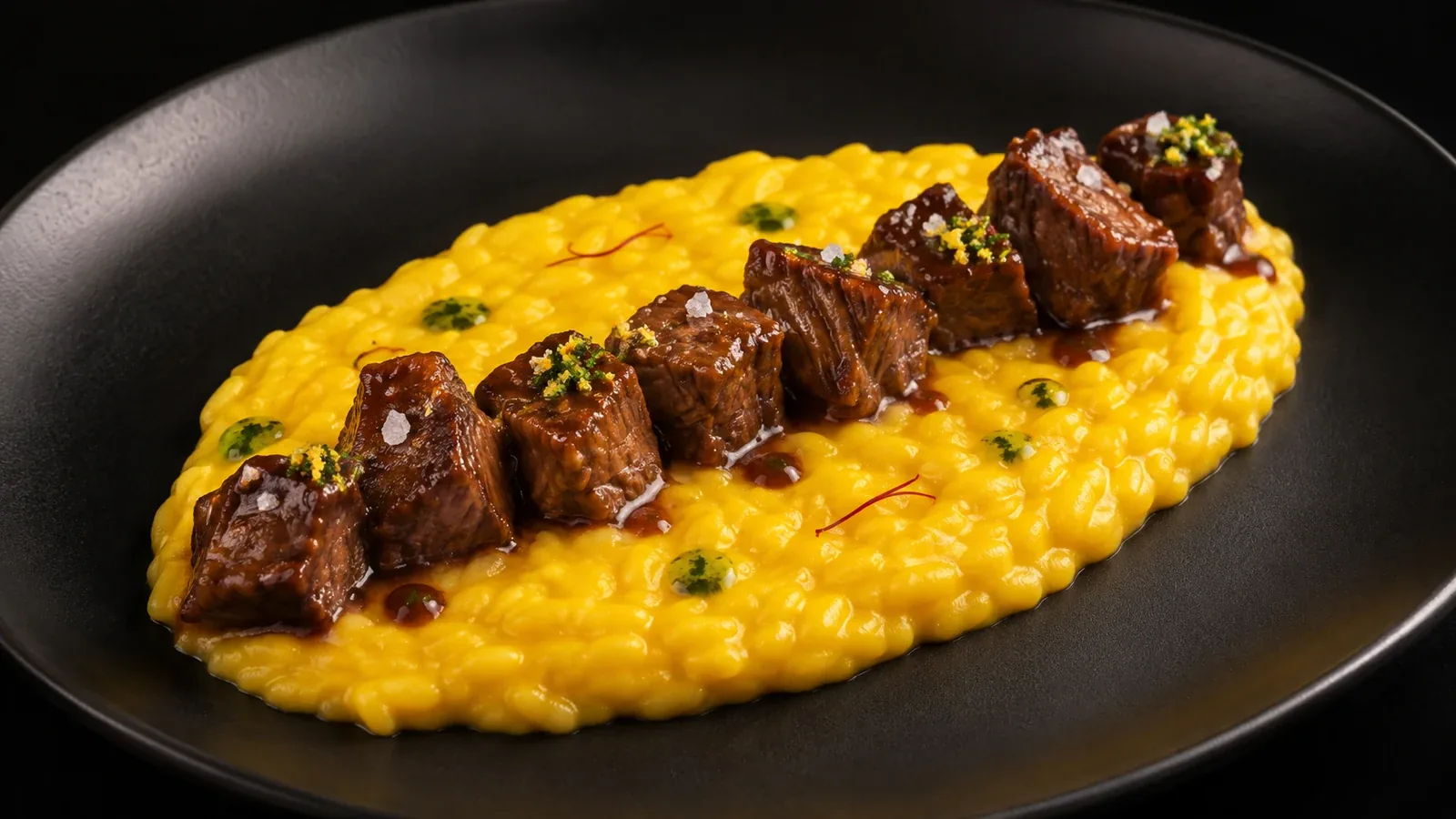
Illustrative image generated with AI, not a photo of the cooked dish.
Kitchen test pending
The risotto alla milanese with ossobuco, the emblem dish of Milan: saffron rice, braised osso buco, Parmigiano and gremolata. The risotto stays deliberately classic in technique and texture, as the cultural anchor of the dish: intense yellow, finished with butter and all'onda.
The twist is in the treatment of the osso buco. It is braised until very melting, boned and pressed cold to obtain a uniform meat that is cut into geometric cubes; they are then reheated and lacquered with their own reduced juice, which concentrates the flavor of the braise into a glossy, slightly tacky surface. The gremolata is used as a precise perfume, so the garlic and lemon do not cover the saffron, and a parsley oil adds color and freshness.
Special equipment: heavy oven-safe casserole; trays for pressing; cheesecloth or fine filter; squeeze bottle
Ingredients
Braised osso buco
- 700–800 g bone-in veal shank (osso buco)
- Fine salt and black pepper
- 2 tablespoons mild olive oil
- 80 g onion, in small cubes
- 60 g carrot, in small cubes
- 40 g celery, in small cubes
- 1 garlic clove
- 150 ml dry white wine
- 600 ml clear veal or poultry stock
- 1 bay leaf
- 1 thyme sprig
- 2 g hydrated gelatin, optional, to stabilize the glaze
Green parsley oil
- 15 g parsley leaves
- 80 ml neutral oil or very mild olive oil
- Salt, for the blanching water
Risotto alla Milanese
- 1.2–1.4 liters hot clear stock
- 0.3 g saffron threads
- 60 g white onion, in very fine brunoise
- 80 g butter: 20 g for the base and 60 g cold, in cubes, for finishing
- 1 tablespoon mild olive oil
- 320 g Carnaroli rice
- 80 ml dry white wine
- 90 g grated Parmigiano Reggiano of about 24 months
- Fine salt and white pepper
Micro gremolata
- 1 tablespoon very finely chopped fresh parsley
- Finely grated zest of 1 lemon
- ¼ garlic clove, micro-grated
Finishing
- 2–3 saffron threads per plate
- Flaky salt
Method
Braised osso buco
- Searing. Dry the osso buco well, season it and sear it in a heavy casserole with the oil 2–3 minutes per side, to an intense, even caramelization; remove it. In the same casserole, cook the onion, carrot, celery and garlic 5–6 minutes, stirring. Deglaze with the wine, scraping the bottom, and reduce until almost all the alcohol evaporates.
- Braising. Return the osso buco with the stock, bay leaf and thyme: the liquid should come up two thirds of the meat. Cover and cook in the oven at 150 °C (300 °F) for 2½–3 hours, until the meat is very tender and separates from the bone on its own. In a pressure cooker, about 45–60 minutes.
- Juice. Remove the osso buco, strain the liquid, discard vegetables and herbs, skim it and slowly reduce it until glossy, intense and slightly unctuous. For a more stable glaze, add the hydrated gelatin to the still-hot reduction.
- Pressing. With the meat still warm, remove the bones, thick cartilage and hard tissue, keeping part of the gelatinous fibers, which give juiciness. Spread it between two sheets of film or paper on a small tray, in a layer of 2–3 cm, set another tray with a light weight on top and refrigerate at least 2 hours, ideally overnight.
- Cutting. Cut the pressed meat with a very sharp knife into 1–1.2 cm cubes: 7–9 per plate are counted. Keep them in the refrigerator until serving.
Green parsley oil
- Blending. Blanch the leaves 10 seconds in salted water and move them to ice water; drain and dry them carefully. Heat the oil to 55–60 °C (131–140 °F) and blend it with the parsley 2–3 minutes. Filter with cheesecloth, coffee filter or a very fine sieve, move to a squeeze bottle and keep in the refrigerator.
Risotto alla Milanese
- Saffron. Heat 50 ml of the stock without boiling, add the saffron and infuse 10–15 minutes. Keep the rest of the stock hot in another pot.
- Base and toasting. In a wide casserole, cook the onion with the 20 g of butter and the oil, slowly and without color, until translucent. Add the rice and toast it 1–2 minutes, until the grains look barely pearly: it helps them keep their structure.
- Cooking. Add the wine and cook until it almost evaporates. Add the hot stock in small ladles, letting the rice absorb it slowly and stirring regularly so it releases the starch in a controlled way. At the midpoint, add the saffron infusion. In about 14–16 minutes, the grain should keep a slight resistance at the center.
- Finishing with butter. Remove from the heat and add the cold butter and Parmigiano, emulsifying with circular movements and wrist flicks; add a little stock if needed. It should be all'onda: it spreads softly when the plate is moved, neither compact nor dry, and not like a soup. Adjust salt and white pepper.
Micro gremolata
- Mixing. Right before plating, mix the parsley, zest and garlic. It is used in minimal amounts, as a perfume and fresh counterpoint, not as a garnish.
Finishing
- Glazing the cubes. In a small pan over gentle heat, heat a few spoonfuls of the reduced juice and add the cubes, moving the pan carefully so as not to break them, until hot —74 °C (165 °F) at the center, because the meat is cooked and chilled—, melting inside, glossy outside and very flavorful.
The dish
Use wide, slightly deep matte black plates, which contrast with the yellow of the saffron. Put a generous ladle of risotto in the center and gently tap the base of the plate with your palm so it spreads by itself into an oval, organic, somewhat asymmetric shape, with visible waves. Arrange 7–9 glazed cubes on the risotto in a clean diagonal, without covering the whole surface: the geometry of the meat contrasts with the texture of the rice. Add small drops of reduced juice around the cubes and 5–8 drops of parsley oil around the risotto, without flooding the plate. Scatter a minimal amount of gremolata over some cubes, without making mounds, and finish with 2–3 saffron threads, a few flakes of salt and, if needed, a little more lemon zest. Clean the edges and serve at once. Final look: an intense yellow, wavy oval on the black, a diagonal of dark, lustrous cubes, green dots and the red threads of saffron.
Key points
- Braise until the meat separates from the bone on its own: otherwise the pressing does not compact.
- Reduce the juice until glossy and slightly unctuous, without reaching sticky.
- Add the stock little by little and stop the cooking with the grain still firm at the center.
- Finish with butter off the heat until reaching an all'onda risotto, neither compact nor soupy.
- Glaze the cubes carefully and to 74 °C (165 °F) at the center, without breaking them.
Pairing
A Franciacorta Satèn Blanc de Blancs, from Lombardy: its fine bubbles, acidity and creamy texture cleanse the fat of the osso buco and the butter finish without competing with the saffron. As a red alternative, a Valtellina Superiore DOCG Nebbiolo, of elegant structure, fine tannin and floral notes, which goes with the braised meat, the Parmigiano, the saffron and the lemon.