Signature · about 2 h 30 min of work, plus 12–24 hours of resting in semolina and 12 hours of draining the ricotta · Serves 4
Ricotta and spinach malfatti in whipped Parmigiano broth with crisp spinach and sage oil
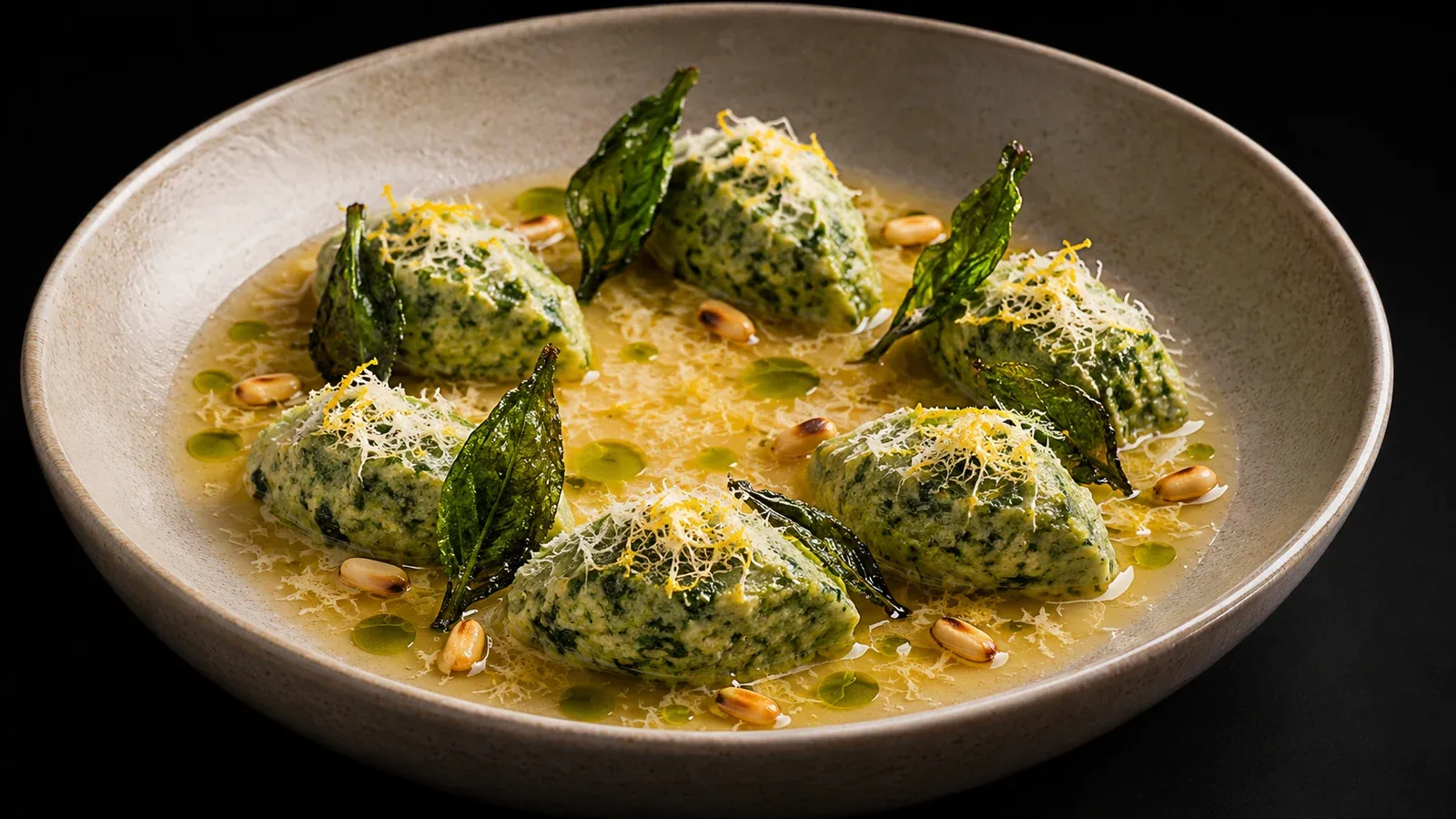
The root is the malfatti of Lombardy and the Tuscan gnudi: the filling of a ricotta and spinach ravioli cooked without its pasta, tender and light, with butter, sage and Parmigiano. This version keeps the mixture and the idea of a bite with almost no flour, and takes it to a lighter signature dish with more umami.
The twist lies in two established techniques. The malfatti are formed as quenelles, rolled in semolina and rested overnight in the refrigerator: the semolina absorbs the surface moisture and forms a thin skin that holds them with very little flour in the mixture. Instead of brown butter, they are served in a broth made from Parmigiano rinds, reduced and whipped with butter until glossy and just coating. The spinach returns in two forms, in the mixture and in fried leaves, crisp and translucent, and a sage oil and lemon zest cut the richness.
Special equipment: semolina-lined tray that fits in the refrigerator; fine sieve or cheesecloth; hand blender; kitchen thermometer
Ingredients
Malfatti
- 400 g whole fresh ricotta, drained 12 hours (about 340 g after draining)
- 300 g fresh spinach, without thick stems
- 60 g very finely grated Parmigiano Reggiano
- 1 egg yolk
- 0.5 g freshly grated nutmeg
- 4 g fine salt
- Freshly ground white pepper
- 20–30 g 00 flour
- 300 g fine durum wheat semolina, for rolling and for the tray
Whipped Parmigiano broth
- 150 g Parmigiano Reggiano rinds, scraped and in 3 cm pieces
- 1 liter cold water
- ½ white onion
- 1 garlic clove, lightly crushed
- 1 bay leaf
- 4 black peppercorns
- 60 g cold butter, in cubes
- 5 ml lemon juice
- Fine salt, only if needed
Sage oil
- 15 g fresh sage leaves
- 10 g parsley leaves
- 100 ml neutral oil
Crisp spinach
- 24 large spinach leaves, very dry
- Neutral oil for frying
- Flaky salt
Finishing
- Finely grated lemon zest
- 20 g toasted pine nuts
- Very finely grated Parmigiano Reggiano
Method
Malfatti
- Ricotta. Pour the ricotta into a fine sieve lined with cheesecloth or paper towel, set a plate with a light weight on top and leave it in the refrigerator 12 hours: it should lose about 60 g of whey and be dense. Pass it through a sieve so it is completely smooth.
- Spinach. Blanch the spinach 20–30 seconds in boiling salted water, move it to ice water and squeeze it in a cloth until not a drop comes out: about 110–120 g should remain. Chop it very finely by knife.
- Mixing. Mix the ricotta with the spinach, Parmigiano, yolk, nutmeg, salt and pepper, without beating. Add 20 g of flour and fold in with a spatula. Do a test: form a small ball, cook it 3 minutes in salted water at a gentle simmer and taste it. It should hold together whole and be tender and creamy; if it falls apart, add the remaining 10 g of flour. Less flour gives a lighter malfatti.
- Forming and semolina. Cover a tray with a 1 cm layer of semolina. With two dessert spoons, form 24 quenelles of about 25 g and let them fall onto the semolina. Cover them with semolina on all sides, rolling them lightly, and leave them half buried, not touching. Refrigerate them uncovered 12–24 hours, turning them once: the semolina forms a thin, firm skin.
Whipped Parmigiano broth
- Infusion. Put the rinds with the cold water, onion, garlic, bay leaf and pepper in a heavy-bottomed pot. Bring to a very gentle simmer and cook 1 h 30 min over the minimum heat, stirring every 15 minutes and scraping the bottom, because the rinds stick. It should take on a pale golden color and a deep cheese flavor.
- Straining. Strain through a fine sieve lined with cheesecloth, without pressing; it yields about 600 ml. If made the day before, chill it quickly and refrigerate it: the fat that rises is removed or kept to give more body.
- Reduction and whipping. At serving, reduce 400 ml of broth over medium heat to 250 ml. Lower the heat to the minimum and whisk in the cold butter in cubes, without boiling, to a glossy, lightly bound sauce that coats the back of a spoon. Add the lemon and taste: it almost never needs salt.
Sage oil
- Blending. Blanch the sage and parsley 10 seconds, move them to ice water and dry them very well. Blend them with the oil at maximum speed 2 minutes, until the oil warms to about 60 °C (140 °F). Strain through cheesecloth without pressing, letting it drip 30 minutes, and keep it in the refrigerator in a squeeze bottle.
Crisp spinach
- Frying. Heat the oil to 160 °C (320 °F) and fry the leaves two or three at a time, standing back because they splatter, 15–25 seconds, until they stop bubbling and turn translucent and dark green. Drain on paper towels and salt with flakes. They should shatter when touched.
Finishing
- Cooking the malfatti. Shake off the excess semolina. Bring plenty of salted water to a gentle simmer, never turbulent, and cook the malfatti 12 at a time for 3–4 minutes, until they float and feel firm and springy to the touch. Lift them out with a slotted spoon, drain and move them to the pan with the whipped broth, bathing them for 30 seconds, without stirring.
The dish
Use low, deep plates in light or gray ceramic, warmed. Pour into each plate 3–4 spoonfuls of whipped broth, which should cover the bottom in a thin, golden layer, and set 6 malfatti in a loose circle, with space between them, glossy from the broth. Let fall 8–10 drops of sage oil onto the broth, between the malfatti, so they form green eyes. Scatter a few toasted pine nuts and set 6 crisp spinach leaves upright or slightly tilted between the malfatti, without covering them. Finish with a minimal grating of lemon zest and a veil of Parmigiano over each piece. Final look: oval pieces in a soft, matte green, a golden, glossy broth with green eyes, the translucent dark leaves standing high and the pale dots of the pine nuts.
Key points
- Drain the ricotta and squeeze the spinach thoroughly: moisture forces adding flour.
- Always do the test ball before forming all of them.
- Respect the semolina rest: it is what holds the malfatti with so little flour.
- Cook the rind broth over the minimum heat, scraping the bottom, and whip it without boiling.
- Cook the malfatti at a gentle simmer and serve them right away.
Pairing
A Chardonnay with moderate aging and good acidity, or a Pinot Grigio from northern Italy. Without alcohol, sparkling water with lemon and a sage leaf.
Notes
- Rinds: keep the rinds from each wheel of Parmigiano in the freezer until you collect 150 g. Scrape the outer surface and discard any part with wax or ink.
- Storage: the malfatti formed in semolina hold up to 24 hours in the refrigerator; longer, they soften. The unwhipped broth keeps 3 days at 5 °C (41 °F) or below, or 3 months frozen.