Signature · about 3 hours, plus 2–12 hours of draining the ricotta · Serves 4
Raviolone “Bergese 2.0”
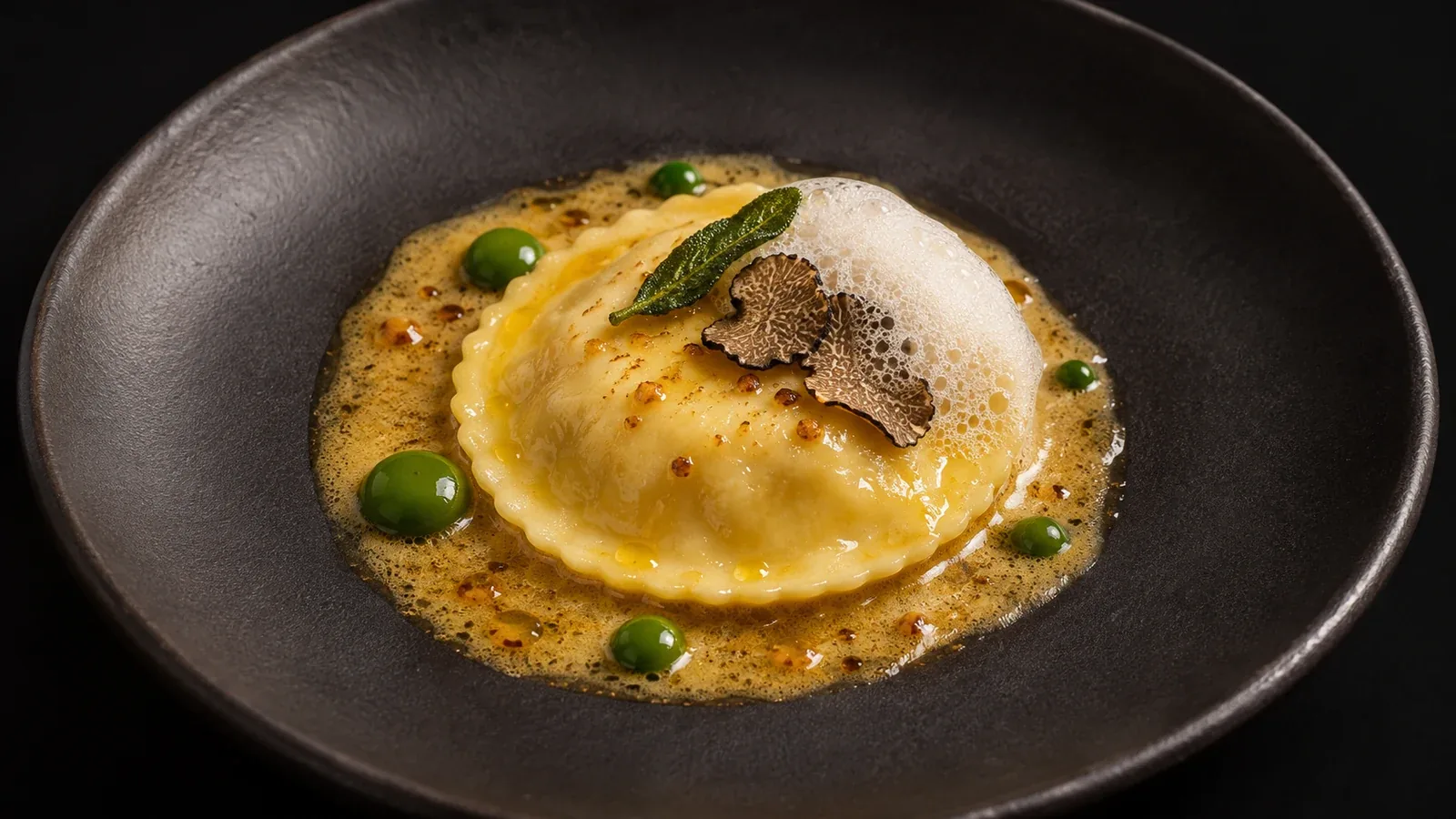
Nino Bergese's raviolone, the Piedmontese classic built on three elements: fresh pasta, a crown of ricotta and spinach and an egg yolk that stays fluid after cooking, with butter, sage and Parmigiano. When cut, the yolk spills over the sauce: that experience is kept intact.
The twist takes the dish to a contemporary language without moving it away from its identity, rather concentrating it. The butter is browned and emulsified with cooking water and Parmigiano for a glossy, coating sauce; a spinach gel repeats the green of the filling in dots of color and freshness; a light Parmigiano foam adds umami without weight, and truffle shaved at the moment works as a final perfume.
Special equipment: pasta machine; 11–12 cm cutter; piping bag; hand blender; squeeze bottle
Ingredients
Fresh dough
- 270 g 00 flour
- 70 g fine durum wheat semolina
- 1 pinch of fine salt
- 1 egg
- 3 egg yolks
- 1 tablespoon olive oil
- 50–60 ml water, depending on the flour's absorption
Ricotta and spinach filling
- 300 g well-drained ricotta
- 300–350 g fresh spinach
- 90–100 g finely grated Parmigiano Reggiano
- 1 pinch of nutmeg
- Fine salt and freshly ground black pepper
- 1 egg white, optional
Yolks
- 4 very fresh egg yolks, or 8 quail yolks for a double center
- Fine salt and sugar in equal parts, for the optional curing
Spinach gel
- 120 g very fine spinach juice or purée, made with blanched spinach, blended and strained
- 40 g water
- 1.2 g agar-agar
- Fine salt
Parmigiano foam
- 120 g whole milk
- 60 g grated Parmigiano Reggiano
- 1 g soy lecithin, optional
Shaping and cooking
- Semolina, for the tray
- Plenty of water and salt
Sage brown butter
- 140 g butter
- 10–12 fresh sage leaves
- 80–120 ml pasta cooking water, up to 250 ml if needed
- 40 g finely grated Parmigiano Reggiano
- Black pepper and salt, only if needed
Finishing
- Fresh black or white truffle, or a few drops of very good quality truffle oil
- Very finely grated Parmigiano
- 1 small fried sage leaf per plate, optional
Method
Fresh dough
- Kneading. Mix the flour, semolina and salt and form a mound. Put in the center the egg, yolks, oil and about 50 ml of water, and incorporate the flour with a fork; when it takes body, continue by hand. Knead 8–10 minutes, to a smooth, elastic, firm, barely satiny and non-sticky dough, adding water 5 ml at a time if dry.
- Resting. Wrap well in plastic film and rest 60 minutes at room temperature.
Ricotta and spinach filling
- Ricotta. It must be very dry: drain it in a fine sieve, in the refrigerator, 2–12 hours.
- Spinach. Blanch the leaves 30–45 seconds in plenty of boiling salted water and move them to ice water. Squeeze them thoroughly, because a wet filling softens the pasta, is hard to seal, generates steam and opens the raviolone in cooking. Chop them very fine by knife.
- Mixing. Mix the ricotta with the spinach, Parmigiano, nutmeg, pepper and salt and, if cohesion is needed, a little egg white. It should be firm and quite dry, able to hold shape in the piping bag. Transfer to a piping bag and refrigerate.
Yolks
- Separating. Carefully separate the yolks, without breaking the membrane.
- Brief curing, optional. Make small wells in a mixture of salt and sugar in equal parts, set the yolks in, cover them lightly and leave 6–8 minutes. Remove them very carefully, rinse quickly with cold water and pat dry gently.
Spinach gel
- Gelling. Mix the spinach purée with the water, agar and a pinch of salt, bring to a boil and hold 20–30 seconds. Pour onto a tray and let set. Once cold, cut it and process to a completely smooth cream, with a few drops of water if needed. Strain and move to a squeeze bottle.
Parmigiano foam
- Infusion. Heat the milk with the Parmigiano to 75–85 °C (167–185 °F) for 2–3 minutes, remove, infuse a few minutes and carefully strain.
- Foam. At serving, add the lecithin if using, tilt the container and work with the hand blender with the blades just at the surface. Take only the foam from the top.
Shaping and cooking
- Rolling. Divide the dough and work one portion at a time, keeping the rest covered. Pass it through the machine from the thickest setting, lowering gradually, to 1–1.2 mm: thin enough to be elegant, but strong enough to hold the filling, the yolk, the seal and the cooking. Cut 8 discs of 11–12 cm: 4 bases and 4 tops.
- Assembly. With the piping bag, form on each base a crown of filling with the center free and enough height so the yolk does not touch the top. Place a yolk in the hollow, without breaking it. Lightly moisten the perimeter, set the top on and seal from the center outward, pressing around the filling. Trim the edge with a cutter, wheel or fluted cutter and set aside on semolina.
- Cooking. Boil plenty of salted water in a wide pot and lower the heat slightly: the boil should be constant, never turbulent. Cook the raviolone 2 min 15 s – 3 min, depending on the thickness of the pasta, the temperature of the filling, the size and the boil. You want cooked pasta, hot filling and a completely fluid yolk at once.
Sage brown butter
- Brown butter. While the pasta cooks, heat the butter over medium heat: it melts, the water evaporates and the solids begin to toast. When it takes on a hazelnut golden color and an intense nutty aroma, add the sage 20–30 seconds.
- Emulsion. Add 80–120 ml of cooking water and move the pan vigorously or whisk: the starch emulsifies water, fat and milk proteins. It should be glossy, light, unctuous and coating. Off the heat, add the Parmigiano and correct the salt only if needed.
- Glazing. Move each raviolone with a wide slotted spoon to the pan and bathe it with the emulsion 20–30 seconds, without breaking it. If fresh truffle is not used, add a few drops of truffle oil off the heat.
Finishing
- At serving. Have the clean truffle ready to shave at the moment, the gel in its bottle and, if using, the fried sage.
The dish
Use warmed plates of dark stone, matte black ceramic or artisanal ceramic in charcoal tones. Form in the center a circular, slightly irregular mirror with a little emulsified brown butter, without flooding the plate, and set on it a raviolone perfectly centered, with the smoother side up. Distribute 5–7 dots of spinach gel of slightly different sizes, without strict symmetry, and partly crown the raviolone with a little Parmigiano foam, without covering it. Shave a few slices of truffle on top right before serving, so the heat releases its aroma, and finish with a few drops of brown butter, very fine Parmigiano if needed and, if using, a small fried sage leaf. Final look: a pale, glossy raviolone on a golden mirror, green dots of gel, a white cloud of Parmigiano and dark slices of truffle.
Key points
- Drain the ricotta and squeeze the spinach thoroughly: moisture opens the raviolone.
- Leave the center of the crown completely free and with height, and place the yolk without breaking the membrane.
- Seal from the center outward, to push out the air.
- Control the cooking time with a gentle boil: the yolk must arrive fluid.
- Use the truffle or truffle oil very sparingly.
Pairing
A Franciacorta Brut, whose acidity and bubbles cleanse the richness of the yolk, butter, ricotta and Parmigiano, and whose autolytic notes go with the brown butter. As alternatives, a Chardonnay of good acidity and moderate aging with integrated oak, or a young, delicate Nebbiolo, with high acidity, perfume and fine tannins.
Notes
- Fluid yolk: the yolk is only lightly cooked. For pregnant women, small children, the elderly or the immunocompromised, use pasteurized eggs.
- Intended result: when cut, the pasta offers a delicate resistance and the yolk comes out glossy, hot and fluid; the ricotta brings creaminess, the spinach vegetal notes, the brown butter toasty depth, the Parmigiano umami and the truffle the final perfume.