Signature · 1 h 30 min, with dough rest and pickling overlapping; about 60 active minutes · Serves 4
Queso Jorguito in two layers — silky semi-hard cheese base, stretchy provolone strands and crisp chorizo
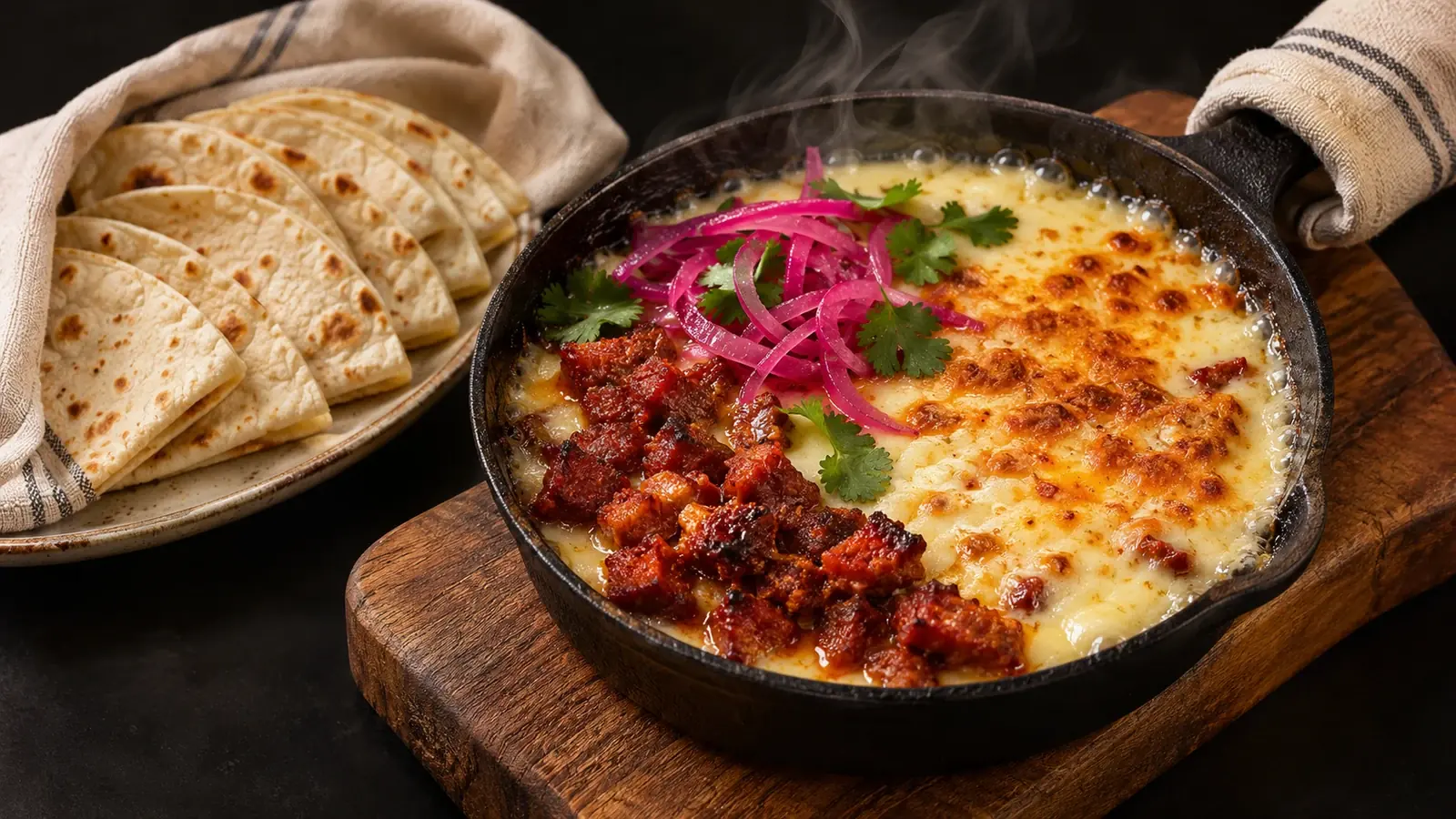
Concept: the skillet choriqueso is kept as it is eaten at the Mexican table —melted cheese in iron, spiced chorizo and hot flour tortillas to assemble small tacos—, but the cheese balance is built with pieces from any Argentine supermarket aisle. Each cheese has a job: the semi-hard, Gouda-style Pategrás brings lactic, nutty flavor and melts evenly; the Fontina adds butteriness and fluidity; the block mozzarella gives the long strand; the provolone, in small amount, brings the sharpness of an aged cheese and the toasted spots on the surface. The bite sought is double: an elastic strand on top and, underneath, a creamy base that wraps the chorizo.
Twist: classic melted cheese has a five-minute window before turning leathery or releasing oil. Here the skillet is built in two layers. Below, a silky base of Pategrás and Fontina bound with milk and sodium citrate, an emulsifying salt that keeps the fat and protein of the cheese together and holds the emulsion as the skillet cools, so it is expected to stay creamy considerably longer than an ordinary melt; on top, a thin layer of mozzarella and provolone that is broiled only until mottled. The chorizo is cooked until crisp, so it adds snap and not fat, and a red onion pickled in lime with a few cilantro leaves cuts the richness in every taco. The pickled jalapeño, chopped into the base, gives an even heat without staining the surface.
Special equipment: 18–20 cm oven-safe cast-iron skillet, probe thermometer and a 0.1 g scale for the citrate
Ingredients
Flour tortillas
- 220 g 00 flour
- 4 g fine salt
- 40 g refined lard or butter
- 120–130 g warm water
Lime red onion
- 120 g red onion, peeled weight, in very thin slices
- 50 ml freshly squeezed lime juice; lemon if lime is not available
- 20 ml apple cider vinegar
- 3 g fine salt
- 3 g sugar
- 1 pinch of dried oregano
Crisp chorizo
- 150 g mild fresh pork chorizo, casing removed
- 40 g Argentine paprika chorizo (chorizo colorado), skinned, in 2–3 mm dice
- 1 small garlic clove, grated
- 1 teaspoon sweet paprika
- ½ teaspoon crushed chili flakes
- ¼ teaspoon ground cumin
- ½ teaspoon dried oregano
- 10 ml apple cider vinegar
- 15 ml water
Silky cheese base
- 90 ml whole milk
- 4 g food-grade sodium citrate
- 100 g semi-hard cheese (Pategrás, Gouda-style), rind removed, coarsely grated
- 50 g Fontina cheese, rind removed, coarsely grated; Danbo (Havarti-style) as an alternative
- 15 g jalapeño pickled in vinegar, from a jar, drained and finely chopped
- Fine salt, only if needed
Strand layer
- 140 g block pizza mozzarella, cold and coarsely grated
- 50 g provolone, rind removed, coarsely grated
Finishing
- 5 g fresh cilantro leaves, without thick stems
Method
Flour tortillas
- Dough. Mix the flour with the salt. Add the lard or butter and rub with your fingertips to a coarse sand. Add 120 g of warm water, bring together and knead 5–6 minutes; if dry areas remain, add the rest 5 g at a time. The finished dough is smooth, flexible and barely moist, not sticking. Divide into 8 balls of about 48 g, cover and rest 30 minutes. If the discs shrink when rolled, wait 10 more minutes.
- Shaping and cooking. Heat a heavy dry griddle or pan over medium-high heat. Roll each ball on the lightly floured counter to 15–16 cm and about 1 mm thick, and shake off the excess flour. Cook 25–35 seconds on the first side and 15–25 on the second: it should puff in some areas and show small toasted spots, keeping pale, flexible areas. If it cracks, the griddle was cold or the cooking was long. Stack and wrap at once in a clean kitchen towel to retain the steam.
Lime red onion
- Quick pickle. Dissolve the salt and sugar in the lime juice and vinegar. Separate the onion slices, add them with the oregano, press so they are covered and cover. Rest at least 30 minutes in the refrigerator, stirring once. The onion is ready when it has gone from dull purple to bright magenta and lost its raw bite, but still crunches. Drain well before using: the liquid must not touch the cheese.
Crisp chorizo
- Browning. Set the cold cast-iron skillet over medium heat and add the fresh chorizo crumbled into 5–8 mm pieces. Cook 6–8 minutes, stirring little, until the pieces are browned on several faces and the fat bubbles clear. It must lose all trace of pink; check that the thickest piece reaches at least 71 °C (160 °F) at the center.
- Crisping and spices. Add the paprika chorizo and cook 2–3 minutes more, until the edges of the pieces darken and crunch when pressed with the spoon; that texture is the goal, not a juicy chorizo. Lower the heat, add the garlic and cook 20 seconds; add paprika, chili flakes, cumin and oregano and stir another 20 seconds, without letting the paprika darken. Immediately deglaze with the vinegar and water and cook 1 minute, scraping the bottom, until the liquid disappears and the pieces are glossy and loose.
- Draining. Move the chorizo to a plate with paper towels and set aside a quarter for finishing. Remove the fat from the skillet and wipe it with paper towels, leaving only a film. Preheat the oven to 220 °C (430 °F) with a rack on the upper third and leave the skillet over minimal heat or in the oven so it reaches assembly warm.
Silky cheese base
- Binding. In a small saucepan, heat the milk over medium heat until it steams and the first bubbles appear at the edge, about 75–80 °C (167–176 °F), without letting it boil. Add the citrate weighed on a 0.1 g scale and whisk 30 seconds, until no crystals remain on the bottom: the milk looks the same, only slightly more translucent.
- Melting. Return to minimal heat and add the Pategrás and Fontina in three batches, whisking each until the strands disappear before adding the next. Do not let it boil once the cheese has gone in: excess heat hardens the protein and turns the base elastic and grainy even with citrate. The base is ready when it is smooth, glossy, falls from the whisk in a thick ribbon and holds between 70 and 75 °C (158–167 °F). Add the jalapeño, taste and salt only if needed, since the top layer and the chorizo bring salt. If too thick to spread, add hot milk 1 tablespoon at a time. If it looks grainy or oily, remove from the heat, add 1 tablespoon of cold milk and whisk vigorously until it binds again.
Strand layer
- Mixing. Right before assembling, mix the cold, freshly grated mozzarella and provolone. Do not use pre-grated cheeses with anti-caking agents or fresh mozzarella with visible whey: the strand turns pasty or watery.
- Assembly. Pour the hot base into the warm skillet and spread it in an even layer of about 8–10 mm. Spread over it the assembly chorizo, barely pressed in. Cover with the mozzarella and provolone mix in a loose, even layer, reaching the edge; a few red dots of chorizo should show through the cheese.
- Oven and broiler. Bake 4–5 minutes, until the top layer is completely melted and the edges show slow bubbles. Turn on the broiler and bring the skillet close 30–60 seconds, without walking away, until irregular golden spots appear on a third to half of the surface; the provolone toasts quickly. Do not aim for an even provoleta crust: it hardens the strand.
Finishing
- Last minute. Remove and rest 30 seconds. Scatter the reserved crisp chorizo, place the well-drained onion and pick the cilantro according to the plating. Serve immediately.
- Doneness check. When a tortilla is pushed in, the top layer should stretch into long strands and the bottom come out creamy, wrapping the chorizo. If the top is leathery, it was over-broiled; if there is free oil below, the base boiled or the chorizo was not drained; if the base is thick as paste, there was not enough milk or it was cooked too long after the cheese went in.
The dish
Bring the cast-iron skillet on a wooden board or a heat-resistant support, with the handle toward whoever serves and protected with a kitchen towel. Keep the surface as it comes from the broiler, mottled with gold, and distribute the reserved crisp chorizo in a half-moon over the half closest to the handle, so its dark red shows on the cheese. On the opposite half, set the drained lime onion in a loose tuft, slightly off center, covering no more than a quarter of the surface, and scatter the cilantro leaves between the onion and the chorizo, so each taco can take all three. Leave one area of cheese without finishes, where the gold and the strand read on their own. Place the eight hot tortillas to one side, folded in quarters in the towel, on a warmed plate. The final look is a skillet bubbling at the edges, with toasted spots, the red of the chorizo, the bright magenta of the onion and the green of the cilantro; lifting the cheese with a tortilla reveals the strand and, below, the creamy base. Each person assembles their tacos straight from the skillet.
Key points
- The base must not boil after adding the cheeses: keep it between 70 and 75 °C (158–167 °F) and whisk in batches.
- Weigh the citrate on a 0.1 g scale: with less than 3 g the base can split; with more than 5 g a salty, soapy hint shows.
- The chorizo must reach 71 °C (160 °F) in its thickest piece and be crisp and drained: it is the texture contrast of the dish, not a source of fat.
- Broil only until mottled; the strand layer is thin and hardens in seconds under the broiler.
- Drain the onion well: acid on hot cheese cuts the strand and wets the surface.
Pairing
A very cold pilsner-style lager cleans the fat and goes with the paprika without competing with the provolone. Without alcohol, a cold hibiscus water with lime and little sugar echoes the acidity of the onion.
Notes
- Status: Signature development with documentary QA and no physical test recorded. How long the creamy base lasts at the table is a design expectation to measure in the first test. The sibling recipe Queso Jorguito — skillet choriqueso keeps the single-layer version of mozzarella and Danbo.
- Cheeses: all are domestically produced and available at supermarkets. If Fontina is not available, use the same amount of Danbo (Havarti-style): the base turns out somewhat milder and less buttery. If the provolone is very aged and dry, drop to 40 g and raise the mozzarella to 150 g so as not to lose strand. Do not replace the semi-hard cheese with Parmesan-style or pecorino sardo: they are hard cheeses that do not melt smooth.
- No sodium citrate: replace the 90 ml of milk and 4 g of citrate with 120 ml of milk with 6 g of cornstarch dissolved cold; bring to a boil whisking, cook 1 minute, let it drop to 75–80 °C (167–176 °F) and continue with the melting the same way. The base is thicker and less glossy and is expected to hold its texture for less time. Do not combine both methods. Buy citrate labeled food-grade, not laboratory grade.
- Base ahead of time: chill in a shallow container over an ice bath according to the ANMAT criterion —60 °C (140 °F) in under 30 minutes, from 60 to 21 °C (140 to 70 °F) in 2 hours and from 21 to 5 °C (70 to 41 °F) in another 2— and keep covered at 5 °C (41 °F) or below until the next day. Reheat over minimal heat with 1–2 tablespoons of milk, whisking, to at least 74 °C (165 °F), and let it drop to 70–75 °C (158–167 °F) before assembling.
- Chorizo and onion ahead of time: the chorizo is chilled quickly, kept at 5 °C (41 °F) or below up to 1 day and reheated in a pan to 74 °C (165 °F), taking the chance to restore the crispness. The onion keeps covered by its liquid in the refrigerator up to 2 days; it is a quick acidic pickle, not a fermentation.
- Leftovers: refrigerate within 2 hours and eat within 2 days, reheating to 74 °C (165 °F) or more; the two-layer separation and the strand are not recovered.
- Scaling: for 8 servings use two 18–20 cm skillets and broil one at a time; a larger skillet leaves a thin layer that dries out or a thick one that does not melt evenly in the same time.