Essential · 2 hours 30 minutes, plus 6 hours of chilling · Serves 4
Potato and smoked bacon millefeuille
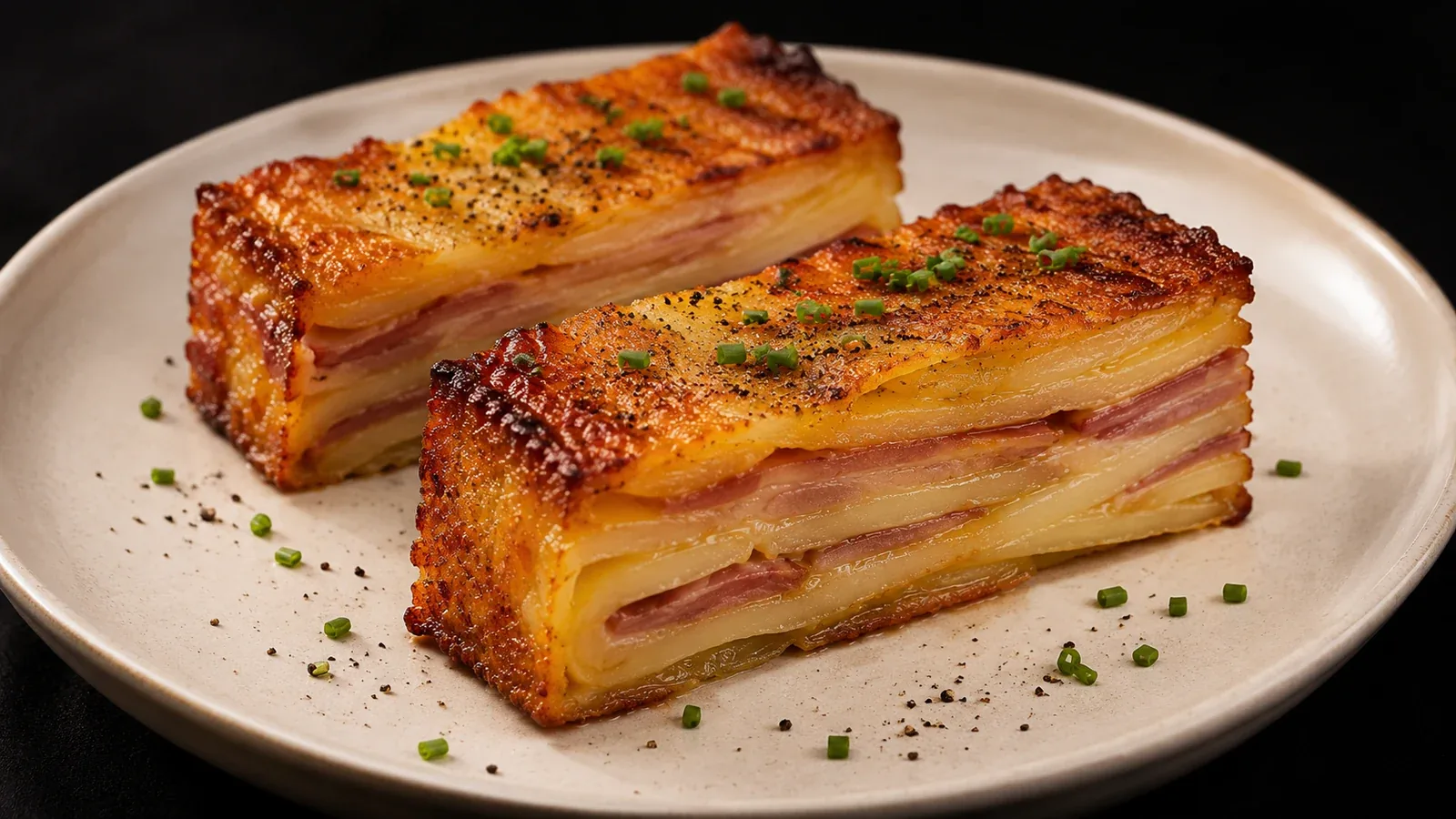
A compact, layered piece halfway between a gratin dauphinois and a potato pavé. It keeps the original idea —layers of potato and smoked bacon cooked with cream, salt and pepper—, but controls the fat, distributes the bacon every few layers and presses the whole for clean portions.
The cream is only lightly perfumed with garlic, thyme and nutmeg. It has no cheese: the bacon already brings salt, fat and umami, and leaving it out lets the potato and the smokiness keep dominating. It yields 8 rectangles, two per person as a generous side.
Special equipment: mandoline; 20 × 20 cm metal pan; kitchen thermometer recommended
Ingredients
Millefeuille
- 1.1 kg medium potatoes of even size and firm flesh
- 180 g thinly sliced smoked bacon, 1–2 mm, without rind or hard cartilage
- 300 ml heavy cream
- 1 small garlic clove, lightly crushed
- 2 sprigs fresh thyme
- Up to 3 g fine salt, depending on the saltiness of the bacon
- 2 g freshly ground black pepper
- 1 pinch of nutmeg
- 20 g butter
Finishing
- 8 g finely chopped chives
- Freshly ground black pepper, as needed
Method
Millefeuille
- Partly rendering the bacon. Lay the slices in a cold pan, in one or two batches, and cook over medium-low heat for 3–5 minutes. They should become flexible and translucent and release part of their fat, without turning crisp. Move them to paper towels and discard the rendered fat. Taste a cooked trimming to decide how much salt the cream needs.
- Preparing the cream. Heat the cream with the garlic and thyme over low heat for 5 minutes, without letting it boil. Turn off the heat, cover and infuse 10 minutes. Remove the garlic and thyme; add between 0 and 3 g of salt depending on the intensity of the bacon, plus the pepper and nutmeg. Keep warm.
- Preparing the pan. Heat the oven to 160 °C (320 °F). Grease a 20 × 20 cm metal pan with 10 g of butter and line the base and two opposite sides with a continuous strip of parchment paper, leaving overhang for unmolding. Prepare another pan or a flat board that fits on the surface and a 1.5–2 kg weight for the later pressing.
- Slicing the potatoes. Peel them and slice them on a mandoline at 1.5 mm. Do not rinse them after cutting: the surface starch is needed to bind the layers. Work without delay and move the slices into the warm cream as they are cut, separating them with your hands so they are barely coated and do not oxidize.
- Building the layers. Cover the base with potato, overlapping the slices and alternating the direction at each level. Repeat until three thin layers of potato are formed; set on top a discontinuous layer of bacon, without overlapping the slices or taking them to the edge. Continue with the same pattern —three layers of potato and one of bacon— until finished, saving enough potato to close with three layers. Gently press each block to expel air pockets.
- Adding the cream. Pour in at the edges the cream left in the bowl. Gently tap the pan against the counter and press the surface: the liquid should distribute among the layers, without going over the potato. If a small amount is left because the pan is shallower, do not force it in.
- Baking. Cover the surface with parchment paper and close the pan with aluminum foil. Bake for 80–100 minutes. Turn the pan halfway if the oven browns unevenly. It is done when a skewer or thin knife goes through the center without resistance and the cream no longer looks liquid at the edges; as a culinary reference, the center is usually between 90 and 95 °C (194–203 °F).
- Pressing. Remove the foil, keep the parchment paper on the surface, rest the second pan or the board on top and distribute the weight evenly. To serve it right away, leave it pressed 30 minutes, unmold carefully and move on to browning; the layers will be tender, although the cut will be more rustic.
- Chilling for a clean cut. If storing, immediately set the already pressed metal pan in an ice water bath, without letting water in. Bring the center down to 60 °C (140 °F) in under 30 minutes from leaving the oven and continue to 21 °C (70 °F) within the first 2 hours; then refrigerate, still under weight, until reaching 5 °C (41 °F) or below within the following 2 hours. Chill a minimum of 6 hours and preferably overnight. The full logistics are in planificacion.md.
- Portioning. Remove the weight, run a knife along the sides without paper and unmold cold. Cut first in half and then each half into four equal rectangles, cleaning the knife between cuts. This gives 8 pieces of approximately 9.5 × 4.5 cm; small variations depend on the shrinkage of the potato.
- Browning and reheating. Heat the oven to 190 °C (375 °F). Melt the remaining 10 g of butter in a wide pan. Brown the cold rectangles on their two wide faces, 2–3 minutes per side, without moving them until they form a crust. Move them to a tray and bake 10–15 minutes, until the center reaches at least 74 °C (165 °F). If the pieces were not chilled, it is enough to brown them and serve them piping hot.
Finishing
- Finishing. Rest 2 minutes on a rack or paper towels so the crust does not turn greasy. Add the chives and a brief turn of pepper right before taking to the table.
The dish
Use light, hot flat plates, or the same platter as the meats if served as a side. Cut the millefeuille with a hot knife and set two rectangles per person on one of their golden faces, slightly apart, with the cut toward the diner so the thin layers of potato and bacon show. If it accompanies roast meat or chicken, place it next to the main piece, on the side opposite its juice, so the crust does not get damp. Finish with a line of chives on the top edge of each rectangle and freshly ground pepper, without covering the crust, and do not add another creamy sauce. Final look: neat blocks with golden, crisp edges, dozens of ivory and pink layers in the cut, the shine of cream and the green of the chives.
Key points
- Keep the potatoes at 1.5 mm and do not rinse them: an uneven thickness or loss of starch keeps the millefeuille from compacting.
- Distribute the bacon every three layers of potato; a slice between every sheet makes the whole greasy and makes it separate more easily.
- Adjust the salt after tasting the cooked bacon, because its intensity varies greatly between brands and producers.
- Cook until the center offers no resistance; pressing does not correct a potato that is still firm.
- Chill under weight and cut very cold for clean faces; the later reheating restores the creamy center and forms the crust.
Pairing
A dry Chardonnay, with good acidity and discreet oak, goes with the cream and the smokiness without hardening the salt. Without alcohol, a very cold soda with lemon peel and a few drops of green apple juice works.
Notes
- The mandoline is important for regularity. If cutting by knife, use a guide and keep all the slices between 1 and 2 mm; do not mix thicknesses.
- The pan should be at least 5 cm tall. In a narrower one, keep a final height of 4–5 cm and extend the cooking according to the doneness signal, not by mathematical proportion.
- For 8 servings it is best to use two 20 × 20 cm pans. Doubling the height in a single pan makes cooking, chilling and cutting difficult.
- Cooked leftovers should be chilled quickly, stored covered at 5 °C (41 °F) or below and reheated to 74 °C (165 °F) at the center. The best quality is kept for 48 hours.