Signature · about 6 hours spread over 3 days (2½–3 h braise two days ahead), plus 3–4 weeks of fermentation and 8–12 hours of salting · Serves 4
Pork collar, barley and apple stuffed cabbage roll
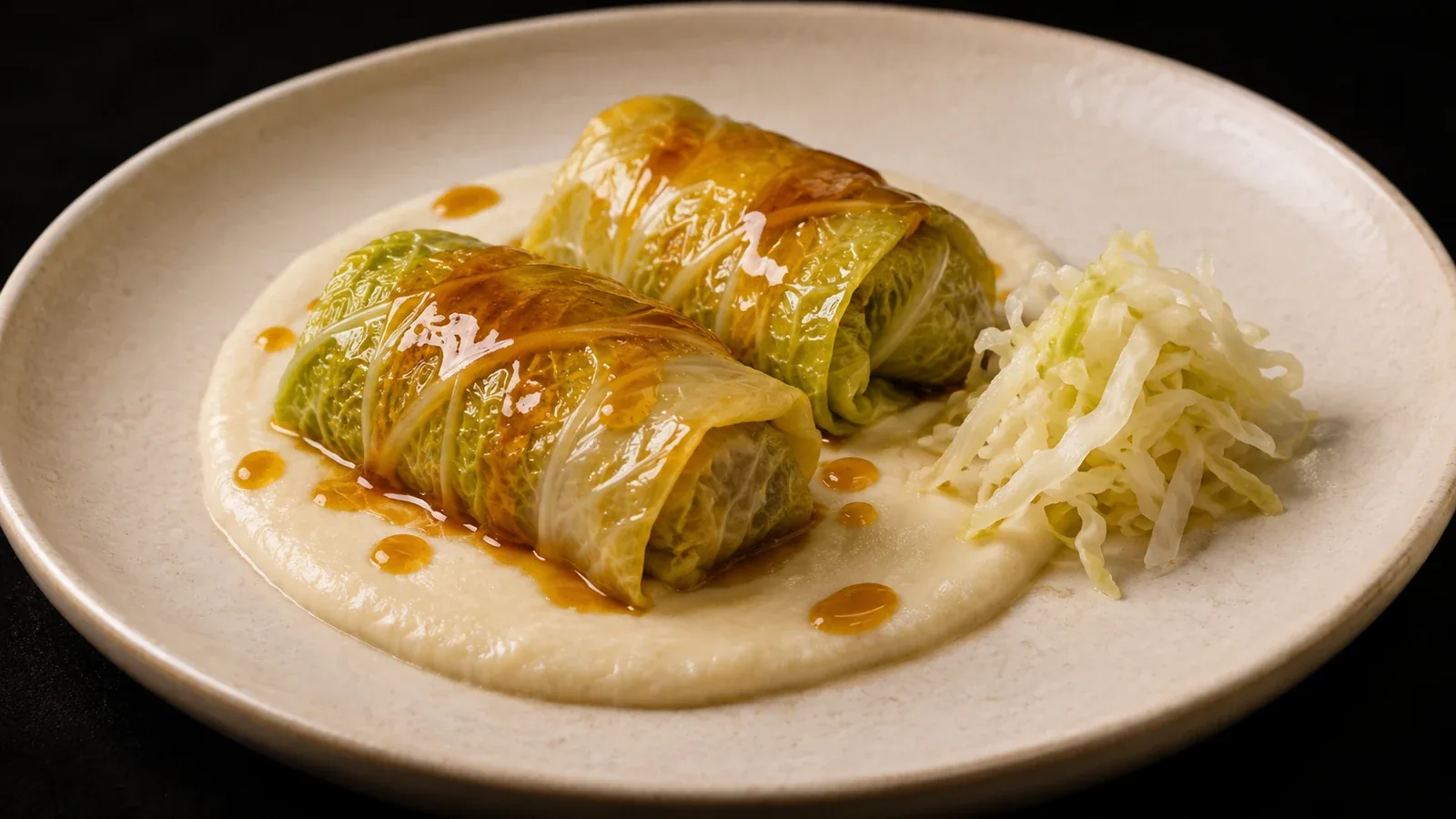
The niño envuelto (stuffed cabbage roll) of Central European roots, with pork, apple, cider and cabbage, the flavors of kohlrouladen and sauerkraut. It is the fattiest and at the same time most acidic course of the stuffed-rolls menu: pork collar braised in cider, barley and green apple wrapped in Napa cabbage.
The twist is to cut the repetition of apple and add real acidity. The apple stays only inside the filling, barely sautéed to add texture and acidity, and the cider stays in the jus. The apple purée is replaced by a cauliflower and mustard cream, ivory, creamy and far less sweet. Instead of a quick pickle, the counterpoint is a truly lacto-fermented cabbage, which cuts the fat of the pork collar.
Special equipment: fermentation jar with weight and, if possible, airlock; oven-safe Dutch oven; blender; steamer or steam oven; probe thermometer; pH meter optional
Ingredients
Lacto-fermented cabbage
- 300 g fresh white cabbage, in fine julienne of 1.5–2 mm
- 7.5 g non-iodized fermentation salt (2.5% of the weight of the cabbage)
Pork collar
- 900 g pork collar
- 10 g salt
- 20 ml neutral oil
- 120 g onion, in small cubes
- 70 g carrot, in small cubes
- 2 garlic cloves
- 4 g mustard seeds
- 300 ml dry cider
- 500 ml pork or chicken stock
- 2 thyme sprigs
Onion and apple
- 80 g onion, finely chopped
- 100 g Granny Smith apple
- 24 g butter
Filling
- 330 g braised pork
- 50 g dry pearl barley (110 g cooked)
- 70 g sautéed apple
- 50 g sweated onion
- 16 g whole-grain mustard
- 24 g reduced pork jus
Wrapping
- 10–12 large Napa cabbage leaves
- Salt for the blanching water: 10 g per liter
Cauliflower and mustard cream
- 380 g cauliflower
- 120 ml milk
- 30 g butter
- 8 g Dijon mustard
- Salt
Cider glaze
- 200 ml dry cider
- 200–240 ml pork jus
- 6 g honey, optional and only for shine
- 16 g cold butter
Finishing
- 100–120 g drained lacto-fermented cabbage
Method
Lacto-fermented cabbage
- Salting. Remove the damaged outer leaves, gently wash the cabbage, dry it and cut into fine julienne. Weigh exactly 300 g, add the 7.5 g of salt and massage 3–5 minutes. Rest 15 minutes and massage again, until it releases liquid.
- Fermentation. Move it to a very clean fermentation jar, packing it hard to remove air, and pour in all the released liquid. Put a fermentation weight: the cabbage must be completely submerged. Use a lid with an airlock whenever possible. Ferment protected from light, ideally at 20–22 °C (68–72 °F): in the first days small bubbles appear, and a complete sauerkraut-style fermentation takes about 3–4 weeks, depending on temperature. If you have a pH meter, the safety reference is pH 4.6 or lower. When it reaches the acidity wanted and the fermentation has clearly slowed, move it to the refrigerator. For this dish a young but stable ferment is best: still crunchy, clearly lactic and not too sulfurous. Do not add vinegar.
- Discarding. Discard the batch if mold appears on the cabbage, if it turns pink or dark, if it softens or becomes slimy, or if it has an unpleasant smell other than sour.
Pork collar
- Salting and browning. Salt the pork collar 8–12 hours ahead. Dry it, brown it thoroughly in the oil and remove it. Cook the onion and carrot 8 minutes, add the garlic and mustard seeds and deglaze with the cider. Reduce by half.
- Braising. Add the stock and thyme, return the pork, cover and cook at 140 °C (285 °F) for about 2½–3 hours, depending on the thickness of the piece. The meat should be able to separate but keep recognizable zones of fiber: do not shred it into tiny strands. Strain and skim the stock, and reduce a portion for the filling and the glaze.
Onion and apple
- Apple. Cut the apple into 4–5 mm dice. Melt half the butter in a very hot pan and sauté the apple only 60–90 seconds: it should heat through and take some golden edges, but stay firm. Remove at once; 70 g are needed.
- Onion. Slowly sweat the onion with the rest of the butter, without browning. About 50 g cooked are needed.
Filling
- Barley. Cook the barley in plenty of salted water 25–35 minutes, depending on the brand, until it keeps a slight bite. Drain and cool spread out; 110 g cooked are used.
- Mixing. Mix the pork, barley, apple, onion, whole-grain mustard and reduced jus, keeping the components recognizable: this filling is deliberately more textured than the others on the menu. Divide into 8 portions of 75 g.
Wrapping
- Blanching and assembly. Separate the leaves, shave down the central rib with a knife and blanch them 30–40 seconds in salted water. Move them to ice, dry them very well and wrap the filling, seam side down.
Cauliflower and mustard cream
- Cooking. Cut the cauliflower into small florets. For a very discreet toasted note, brown a third of the florets in the oven at 200 °C (390 °F) for 12–15 minutes. Cook all the cauliflower with the milk, covered, over gentle heat, 12–15 minutes.
- Processing. Process it hot, add the butter and mustard and pass it through a fine sieve. It should be creamy, ivory-colored and with the mustard in the background.
Cider glaze
- Reduction. Reduce the cider to a third, add the pork jus and reduce until it barely coats a spoon. If the cider is very dry and the lacquer needs shine, add at most the 6 g of honey: a honey flavor is not wanted. Save the butter for the end.
Finishing
- Reheating and lacquering. Heat the rolls with steam at 90 °C (194 °F) —in a steam oven or a covered steamer— to 74 °C (165 °F) at the center, checking with the probe from 12 minutes; for 75 g rolls it usually takes 15–20 minutes (estimate to confirm at the first test). Dry them, brush with glaze and place them under the hot broiler 30–45 seconds. Mount the remaining glaze with the butter.
- Ferment. Lightly drain the lacto-fermented cabbage, without rinsing it.
The dish
Use warmed flat plates. Spread about 60–70 g of cauliflower and mustard cream and set the 2 lacquered rolls on top, slightly on the diagonal. Add about 25–30 ml of glaze around and 25–30 g of lacto-fermented cabbage in a small, airy volume to the side, not as a mountain of sauerkraut: its acidity is the counterpoint to the fat of the pork collar. Final look: two pale green rolls glossy with amber lacquer on an ivory cream, with the pale, crisp julienne of the ferment.
Key points
- Keep the cabbage completely submerged throughout the fermentation, and discard it if there is mold, odd smells or a slimy texture.
- Braise the pork collar until it separates, but without shredding it into strands: the filling needs texture.
- Sauté the apple only 60–90 seconds, so it stays firm and acidic.
- Assemble the Napa rolls as close to serving as possible and dry the leaves very well.
- Reheat to 74 °C (165 °F) at the center, checking with the probe.
Pairing
A dry Riesling, a dry Chenin Blanc or a brut nature cider. Without alcohol, very dry non-alcoholic apple cider, or a cold infusion of green apple and white tea.
Notes
- Servings: the original was a tasting course of 50 g of filling per person. This version is a main course: it doubles the original batch for 6 and serves 2 rolls of 75 g per person. The reheating time for rolls of this size is an estimate: the probe rules.
- Ferment: the 300 g batch yields a bit more than the dish uses. The leftover keeps in the refrigerator, submerged in its liquid.
- It is wise to blanch two or three extra leaves in case one tears.