Signature · 5–7 hours; about 110 minutes of active work; ragù and eggplant can be made a day ahead · Serves 4
Patagonian lamb lasagna with flame-roasted eggplant and pecorino
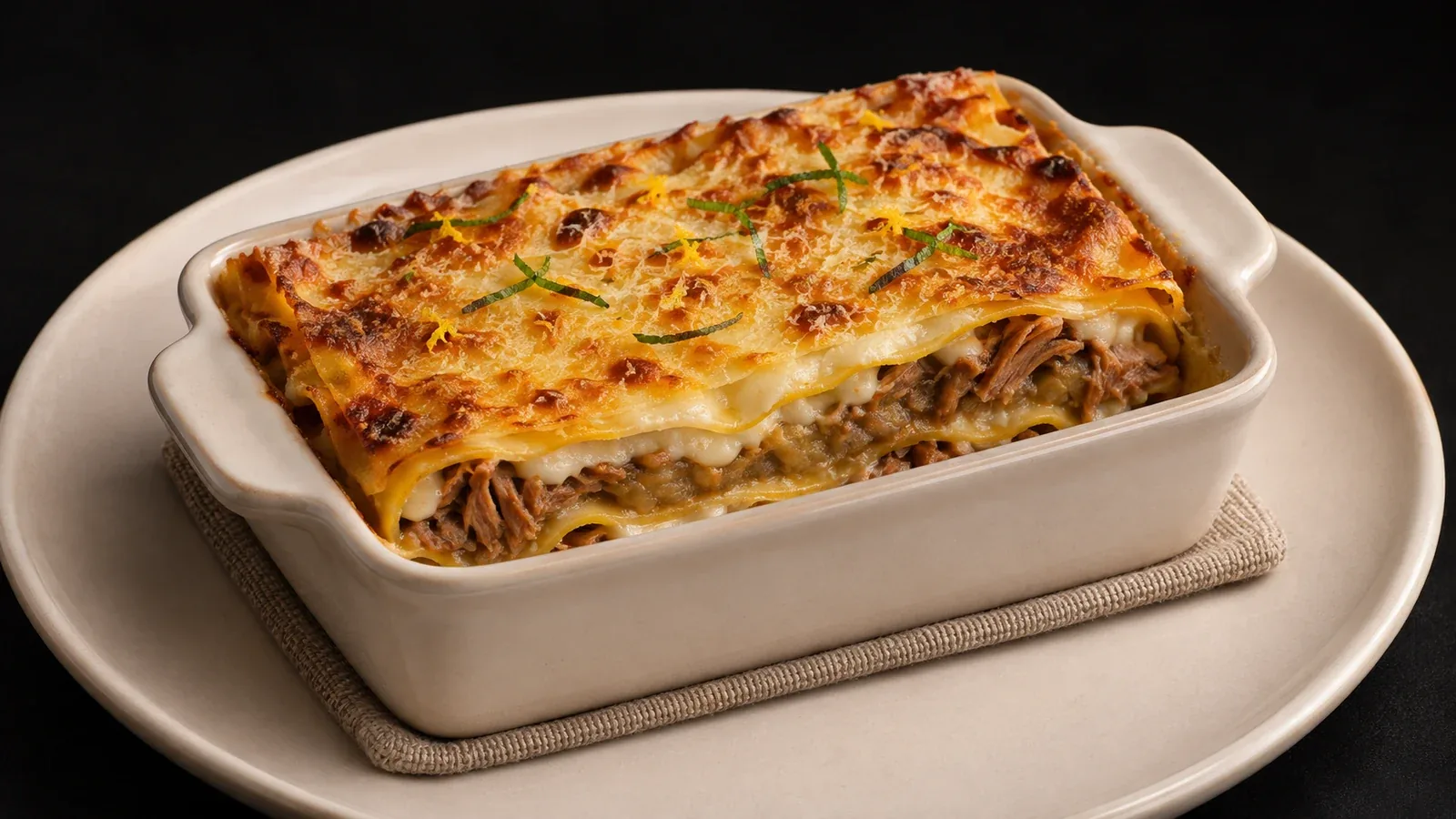
Illustrative image generated with AI, not a photo of the cooked dish.
Concept: fresh-pasta lasagna with classic béchamel takes on an Argentine character through Patagonian lamb. The shoulder is braised until it separates into short strands, accompanied by a layer of flame-roasted eggplant and Pecorino Romano. It is served in four individual baking dishes, with a moist center and a golden top.
Twist: braised lamb provides a different texture from minced ragù, and eggplant brings the aroma of fire into the center of the layers. The béchamel retains its milky flavor and a restrained touch of nutmeg; freshness arrives at the end with lemon zest and mint. The Patagonian ingredient is the starting point for an original interpretation of an Italian structure, combining smoke, tender meat and an aromatic finish that balances its richness.
Special equipment: 3–4 l ovenproof casserole with a lid; pasta machine or rolling pin; four individual ovenproof and broiler-safe dishes measuring about 12 × 9 cm inside and at least 5 cm deep; gas flame or embers with a suitable grate; probe thermometer
Ingredients
Patagonian lamb ragù
- 650 g boneless Patagonian lamb shoulder, of identified provenance, trimmed of excess exterior fat and tough tendons, cut into 5 cm pieces.
- 150 g peeled onion, finely chopped.
- 60 g peeled carrot, finely chopped.
- 40 g trimmed celery, finely chopped.
- 200 g crushed tomatoes.
- 150 ml dry red wine.
- 350 ml unsalted vegetable stock, homemade or store-bought, plus hot water to adjust if needed.
- 25 ml olive oil, divided into 15 ml for the meat and 10 ml for the vegetables.
- 1 bay leaf.
- Fine salt and black pepper, to taste.
Flame-roasted eggplant
- 600 g whole eggplants, approximately 2 medium ones.
- 10 ml olive oil.
- Fine salt, to taste.
Homemade egg pasta
- 200 g 00 flour.
- 100 g egg without the shell, approximately 2 medium eggs, beaten for weighing.
- Up to 10 g additional 00 flour for rolling and resting the sheets.
- 30 g coarse salt for 3 l cooking water.
Classic béchamel
- 550 ml whole milk.
- 40 g butter.
- 40 g 00 flour.
- A small pinch of freshly grated nutmeg.
- Fine salt, to taste.
Assembly and finishing
- 80 g Pecorino Romano, finely grated.
- 8 g butter for the four dishes.
- Finely grated zest of ½ lemon, yellow part only.
- 4 g fresh mint leaves, washed and thoroughly dried.
Method
Patagonian lamb ragù
- Brown. Heat a conventional oven to 160 °C (320 °F). Pat the shoulder dry, season moderately with salt and brown in the 15 ml oil in a hot casserole, in 2 batches of 6–8 minutes. Allow a brown crust to form on several sides; remove before the fond burns. Browning builds the flavor base, while braising will develop tenderness.
- Vegetables and wine. Reduce to medium heat, add the remaining 10 ml oil and cook the onion, carrot and celery for 10–12 minutes, until soft and lightly browned. Add the wine, scrape up the fond and reduce to approximately one-third, 5–8 minutes: the aggressive aroma of raw wine should fade. Add the tomatoes and cook for 3–4 minutes, stirring.
- Braise. Return the meat with its juices, add the stock and bay leaf and bring to a very gentle simmer. The liquid should reach halfway to two-thirds up the pieces; adjust with hot water according to the casserole's shape. Cover and cook in the oven for 2½–3½ hours, turning the meat halfway through and checking from 2½ hours. Maintain gentle bubbling and add water if the bottom threatens to dry out. The meat is ready when two forks pull it apart effortlessly; if it resists, continue in 20-minute intervals.
- Ragù texture. Remove the meat and bay leaf. Spoon off fat from the liquid's surface and reduce the vegetable base uncovered for 10–20 minutes if watery. Separate the meat into 1–2 cm strands, discarding cartilage or tough tendons, and return it to the sauce. It should be moist and glossy, with juices clinging to the meat and no free broth when the casserole is tilted. If too dry, restore moisture with a little hot water. Adjust the salt and pepper and weigh the finished ragù so it can later be divided into 8 equal parts. Keep hot, above 60 °C (140 °F), during immediate assembly; if storing, follow the cooling process in Notes.
Flame-roasted eggplant
- Direct cooking. Wash and dry the eggplants and pierce the skin in two places. Place whole on a metal grate suitable for a gas flame or embers, with good ventilation and no contact with plastic parts. Turn with tongs every 4–5 minutes, for about 20–30 minutes, until the skin is black, the eggplant has collapsed and its center is completely soft. Burnt skin with firm flesh means it still needs cooking: move to a less intense heat zone and continue.
- Drain. Split over a strainer set over a container and drain for 15–20 minutes. Remove the blackened skin and burnt fragments without rinsing the flesh, to retain the fire-roasted aroma. Chop with a knife and mix with the 10 ml oil and salt. If it releases liquid when set down, dry it in a skillet over medium heat for 3–5 minutes, stirring. Aim for spreadable flesh that retains texture, with neither bitterness from burnt skin nor free water. Divide all the flesh into 4 equal parts and keep hot until assembly.
Homemade egg pasta
- Dough and resting. Mix the 200 g flour with the 100 g egg and knead for 8–10 minutes, until firm, smooth and free of dry flour. If sandy at first, press it together and knead for a few minutes before adjusting: different flours absorb differently. Only if it still will not come together, add water a teaspoon at a time; if sticky, use a small part of the additional 10 g flour. Wrap and rest for 30–45 minutes in a cool place; in a hot kitchen, rest in the refrigerator and roll once the dough is flexible again.
- Roll. Divide into pieces and pass progressively through the machine, or roll with a rolling pin, to 0.8–1 mm. It should bend without breaking and allow some light through; it need not be transparent. Cut 16 rectangles of about 12 × 9 cm, adjusted to the dishes' actual internal measurements. Gather the trimmings only once, rest for a few minutes and roll again if more pieces are needed. The dough may leave spare trimmings; do not thicken the sheets to use them all.
- Boil, cool and dry. Bring the 3 l water with the 30 g coarse salt to a boil. Cook the sheets in small batches for 30–45 seconds after the water returns to a gentle boil, until flexible but still firm. Transfer to clean cold water for 10–15 seconds, remove and spread in a single layer on clean lint-free cloths. Blot surface water with another cloth. The pasta should remain moist and flexible, without droplets that dilute the filling; do not stack wet sheets or let them dry until hard. Use during immediate assembly.
Classic béchamel
- Pale roux. Heat the milk without letting it boil hard. Melt the butter in another saucepan, add the flour and cook over medium-low heat for 2–3 minutes, stirring, until bubbling and no longer smelling of raw flour. Keep it pale.
- Cook and adjust. Add the hot milk in several additions, whisking each smooth. Bring to a gentle simmer and cook for 6–8 minutes, stirring the bottom, until smooth, coating a spoon and falling in a wide ribbon. Season moderately with salt and a small pinch of nutmeg; the pecorino will add salt later. It should spread in a thin film over the pasta: if it thickens while waiting, loosen with a little hot pasta cooking water. About 600 g béchamel is used; divide all of it between the dishes as directed in assembly. Keep covered in contact and hot until use, without allowing a skin to form.
Assembly and finishing
- Distribution. Heat the oven to 180 °C (355 °F). Butter each individual dish measuring about 12 × 9 cm with 2 g butter. Divide the pecorino into 16 portions of 5 g. Each dish will use 4 sheets, 2 parts ragù, 1 part eggplant and about 150 g béchamel. Put about 10 g béchamel on the base and lay down the first sheet.
- Meat, eggplant and meat layers. Over the first sheet, spread one part ragù, about 35 g béchamel and 5 g pecorino. Cover with the second sheet, one part eggplant, another 35 g béchamel and 5 g pecorino. Add the third sheet, the second part ragù, 35 g béchamel and 5 g pecorino. Finish with the fourth sheet, about 35 g béchamel and the last 5 g pecorino. Repeat in all four dishes, distributing any small difference in sauce evenly. Final height should be around 4 cm, below the rim; settle the layers without compressing them.
- Bake and brown. Place the four dishes on a baking sheet with space between them. Cover loosely with foil without touching the cheese; place baking parchment underneath if necessary. Cook at 180 °C (355 °F) for 25–35 minutes, until the center is thoroughly hot and the edges bubble. Remove the cover and brown under a hot grill or broiler for 3–6 minutes, watching closely: the surface should turn golden with some toasted tips, without burning the pecorino. If refrigerated components were used, check at least 74 °C (165 °F) in the center before broiling and extend the covered stage if needed. Rest for 8 minutes out of the oven, uncovered.
- Fresh finish. Finely zest the yellow part of ½ lemon and cut the mint into very thin strips during resting. Divide both between the four dishes just before serving. The lemon should smell fresh and the mint should appear in small accents; distribute them so they do not concentrate in a single bite.
The dish
Serve each lasagna in its shallow individual baking dish on a wide support plate, with suitable heat protection between the two pieces. Orient the dish to show the golden top and one edge where layers of pasta, dark ragù and pale béchamel appear. Keep the sauce within the layers without adding an exterior pool. After resting, scatter one-quarter of the zest and mint over each surface, leaving broad golden areas visible and avoiding a mound of herbs. Present all four dishes together as soon as finished, with the vessels still hot and the fresh aroma just added; the first spoonful or cut should bring together tender pasta, short lamb strands and eggplant, contrasting the moist center with the toasted top. The finished palette is golden, cream and brown, with small green and yellow accents.
Key points
- Braise the shoulder until it shreds effortlessly and remove excess free fat; meat texture takes precedence over the clock.
- Drain the eggplant well and remove burnt skin: smoke should come from cooking rather than adding charcoal to the filling.
- Keep the ragù coating and the béchamel fluid; free water displaces the layers and a stiff sauce leaves dry patches.
- Briefly boil the pasta, cool and dry the surface before assembly; adjust the rectangles to the actual dishes.
- Add zest and mint after baking and resting to preserve freshness.
Pairing
A Patagonian Pinot Noir with fresh acidity and restrained oak complements the lamb and smoke without masking the herbal finish. Without alcohol, light cold black tea with a strip of lemon peel, unsweetened.
Notes
- Ingredient and Argentine identity: look for shoulder of identified Patagonian provenance and record the producer or origin when cooking it. Lamb is one of Patagonia's emblematic products; here it provides ingredient identity within a reinterpretation of lasagna. It can be made with another good-quality lamb shoulder, recording the substitution and checking braising doneness.
- Storage: ragù and eggplant can be made the day before. Spread separately in shallow metal containers, cool over ice and verify with a probe: from cooking temperature to 60 °C (140 °F) in less than 30 minutes, from 60 to 21 °C within 2 hours and from 21 to 5 °C within another 2 hours. Store covered at 5 °C or below and preferably use the next day, within 48 hours of cooking as a quality window conditional on correct cooling. Reheat separately to at least 74 °C (165 °F) before assembly. These are the guidelines in ANMAT's 2024 manual, pp. 49–50; do not store the batch if the curve is not met. If previously refrigerated and reheated components were used, serve all the dishes at that baking and do not plan another reheating of leftovers.
- Leftovers from the same-day route: if all components were made that day and served without a previous chilling and reheating cycle, the remaining portions can be cooled using the same curve, stored at 5 °C or below and reheated once, covered at 170 °C (340 °F), to 74 °C (165 °F) in the center. Check from 25 minutes and brown only at the end. Reserve zest and mint for those portions until after reheating; freezing the lasagna is not proposed because of pasta and eggplant quality.
- Dough trimmings: keep raw trimmings separately in a sealed freezer bag and use as short pasta at another meal; they are not part of the four assembled portions.
- First cooking trial pending: record the lamb's origin, ragù and eggplant flesh yields, actual sheet fit, béchamel quantity and oven times. The formulation has documentary QA; no physical cooking trial has been recorded yet.