Essential · 3–4 hours, including both rises · Serves 4
Nutella-filled doughnuts with coffee sugar and cream ice cream
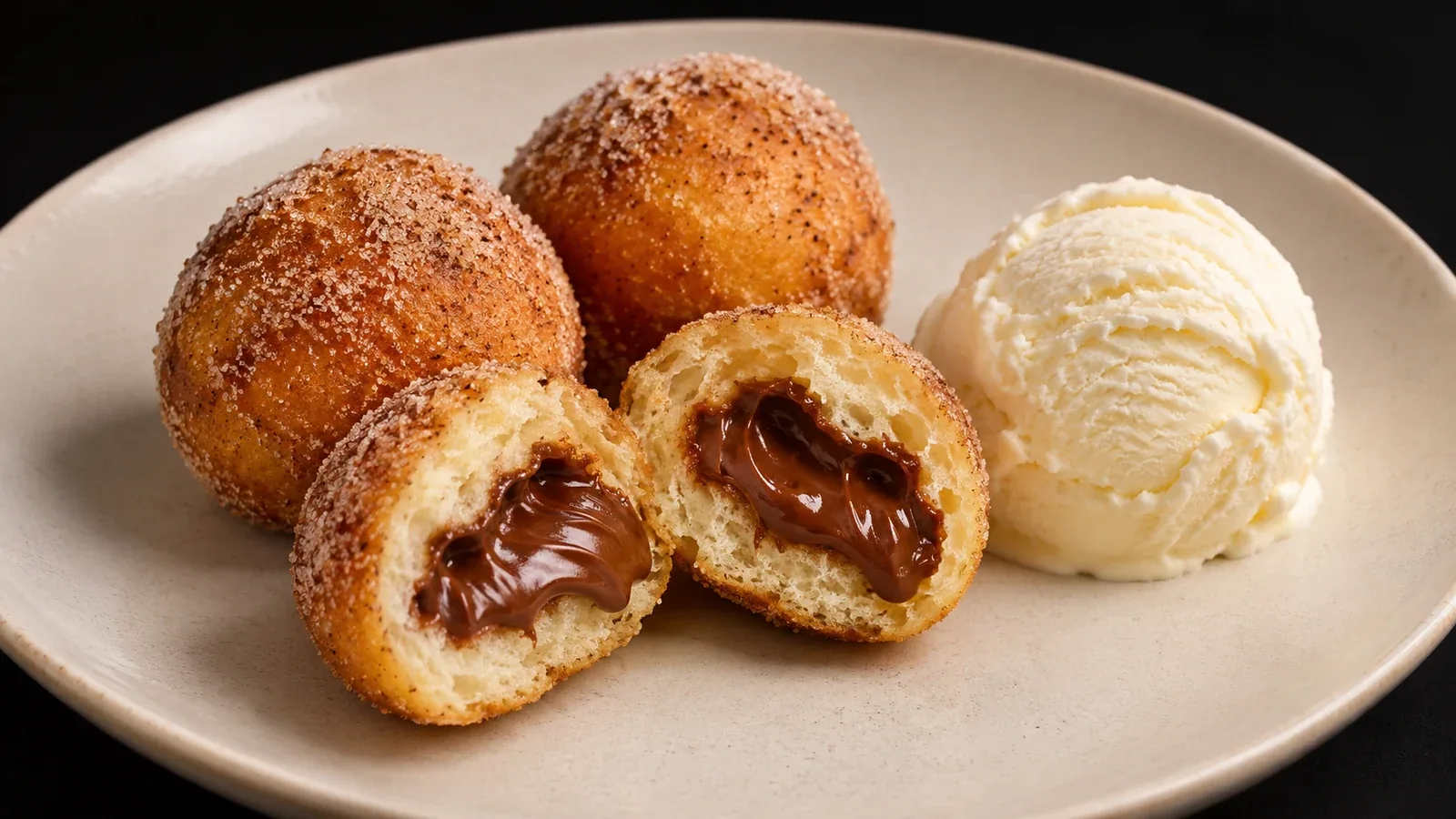
Concept: freshly made doughnuts with tender dough, a Nutella center and a thin coffee sugar coating. Three small pieces and a serving of cream ice cream per person turn a sweet afternoon pastry into a dessert to share at the table.
Twist: coffee appears on the surface while chocolate and hazelnut remain dominant in the center. Store-bought cream ice cream adds a cold dairy contrast with straightforward organization: the work focuses on kneading, proofing and frying well, with the filling added while the doughnuts are still warm.
Special equipment: frying thermometer and probe; piping bag with a filling nozzle
Ingredients
Dough and frying
- 200 g medium-strength all-purpose flour, plus up to 10 g for the work surface.
- 25 g sugar.
- 3 g instant dry yeast.
- 3 g fine salt.
- 75 g pasteurized whole milk, at room temperature.
- 50 g beaten egg without the shell, approximately 1 medium egg.
- 2 g vanilla extract.
- 25 g unsalted butter, softened but not melted.
- 1.5 l sunflower oil for frying; adjust to the pan to obtain a depth of 4–5 cm without exceeding half its height.
Coffee sugar
- 40 g fine granulated sugar, not confectioners' sugar.
- 2 g pure instant coffee, crushed to a fine powder; not ground coffee or a sweetened mix.
Nutella filling
- 160 g Nutella, at room temperature: 144 g for filling and approximately 16 g allowance for the piping bag.
Cream ice cream
- 300 g store-bought cream ice cream, 75 g per person.
Method
Dough and frying
- Mix and hydrate. Combine the flour, sugar, yeast and salt. Add the milk, egg and vanilla. Mix for 4–5 minutes until no dry flour remains, cover and rest for 10 minutes. The dough starts sticky; this rest improves hydration and allows kneading without adding excess flour.
- Knead. Work for 5–7 minutes by hand or on a stand mixer's low speed. Add the softened butter in 3 parts and knead for another 5–8 minutes, until smooth, elastic and able to form a thin membrane when stretched. Use a scraper if sticky. It should be at 24–26 °C; if heat makes it greasy, refrigerate for 10 minutes before continuing. Do not melt the butter to make mixing easier.
- First rise. Cover the bowl and leave for 60–90 minutes at 24–26 °C, until nearly doubled and visibly aerated. If the kitchen is colder, extend the rise; do not compensate with a hot oven that melts the butter. The surface should remain supple without a dry crust.
- Shape the pieces. Gently deflate, weigh the dough and divide it into 12 equal portions, approximately 32 g each. Round each one with the seam closed underneath and flatten slightly to about 4.5 cm across and 2 cm thick. Set on individual squares of baking parchment, with very little of the reserved flour if needed. Cover without pressing.
- Second rise. Wait 40–60 minutes at 24–26 °C, until puffy. Gently touch a side: the mark should return slowly and leave a small indentation. If it springs back immediately, keep waiting; if the piece deflates, it has overproofed. Transfer using the paper to avoid compressing the air gained.
- Fry. Use a deep saucepan approximately 20 cm in diameter with 4–5 cm of oil, without exceeding half its height. Heat to 170–175 °C (338–347 °F), measuring with a thermometer without touching the bottom. Add 3 pieces per batch, seam-side down, and immediately remove the papers with tongs. Fry for approximately 1.5–2 minutes per side, 3–4 minutes total, maintaining that oil temperature range. Allow the temperature to recover before each new batch; the oil must not smoke.
- Check the center. In the first batch, measure one piece with a thin probe from the side: aim for approximately 90–93 °C (194–199 °F) as a crumb doneness reference, then open it to check there is no wet or pasty band. This is a bread-quality criterion, not a universal food safety limit. If it browns too fast and remains raw, hold the oil near 170 °C (338 °F) and extend cooking. Reserve the opened piece to serve in halves.
- Drain. Remove to a rack over a tray without stacking. Drain for 1–2 minutes before coating each batch with sugar; an oil-wet surface makes the sugar clump, while a cold doughnut loses adhesion.
Coffee sugar
- Prepare. During the first rise, crush the 2 g instant coffee into a fine powder and mix with the 40 g sugar. Keep dry and covered until frying. Do not use ground coffee, which would leave hard particles on the surface.
- Coat. Roll each freshly drained batch in the mixture while still hot. Shake off the excess: the coating should be thin and leave the golden color visible. Some of the 42 g mixture will remain; it does not all need to adhere.
Nutella filling
- Prepare the piping bag. Stir the Nutella to soften it and load a piping bag with a long nozzle. If a cold room has made it firm, warm only the amount needed in a closed container set in 30–35 °C (86–95 °F) water for 5–10 minutes. Do not introduce water into the Nutella or thin it with milk, cream or oil.
- Fill while warm. Wait approximately 5–8 minutes after removal from the oil, until the doughnuts are comfortable to hold and remain warm. Make a channel from the side with a clean skewer and move it inside to create space without piercing the opposite wall. Pipe 12 g Nutella into each piece, weighing the gain on the first few to adjust pressure. The halves of the test piece each receive 6 g through their inner face. Use 144 g total; the rest is a piping allowance. If resistance develops, stop before breaking the dough.
Cream ice cream
- Store and serve. Keep the ice cream according to its packaging, normally at −18 °C. Before frying, check whether it can be portioned; if very hard, transfer the closed container to the refrigerator for 10–20 minutes, until only soft enough to serve. Serve 75 g per person after plating the doughnuts. Do not refreeze melted ice cream or return anything that has touched the plate to its container.
The dish
Use four broad, light-colored dessert plates, dry and at room temperature. Arrange three warm doughnuts on each in a compact group that leaves each piece and its coffee sugar visible. Split one of the three in half and face the cuts toward the guest to show the crumb and filling; on one plate, use the piece already opened to check frying. Keep the other two whole, with the piping holes toward the inside of the group. Place a 75 g portion of cream ice cream beside them with a small gap from the warm dough. Clear stray grains from the rim and take to the table immediately, contrasting golden dough, glossy Nutella and white ice cream without covering the doughnuts with another sauce.
Key points
- Keep pieces at about 32 g and judge both rises by appearance and indentation.
- A sticky dough needs kneading and resting; adding too much flour makes it tough.
- Control the oil at 170–175 °C (338–347 °F) and check the crumb before repeating the timing on subsequent batches.
- Coat with sugar while hot, but fill after the intense heat subsides so the Nutella retains its body.
- Serve immediately and place the ice cream separately from the doughnuts.
Pairing
A short unsweetened espresso or its decaffeinated version, served separately to accompany the chocolate and hazelnut.
Notes
- Serving and leftovers: this version is designed to be eaten in the same service, ideally within 15–20 minutes of frying. Storing or reheating filled pieces is not proposed as part of the plan. Keep remaining ice cream protected and frozen according to its packaging.
- Fresh yeast: replace the 3 g instant dry yeast with 9 g fresh yeast, crumbled into the recipe's milk. The rises still depend on volume and indentation.
- Scaling: multiply ingredients by the guest-count factor, retain 32 g pieces and 12 g filling, and recalculate batches and serving time. Do not increase the pan's load or multiply frying times. For 4 people, fry 4 batches of 3 pieces.
- Status: an original development with documentary QA, awaiting a cooking trial. Record lightness, actual frying time and the balance between coffee and Nutella.