Signature · about 6 hours of cooking spread over 2 days, plus 12 hours of soaking and 6 hours of pressing · Serves 4
Locro with pressed crisp meats, white corn cream and paprika chorizo
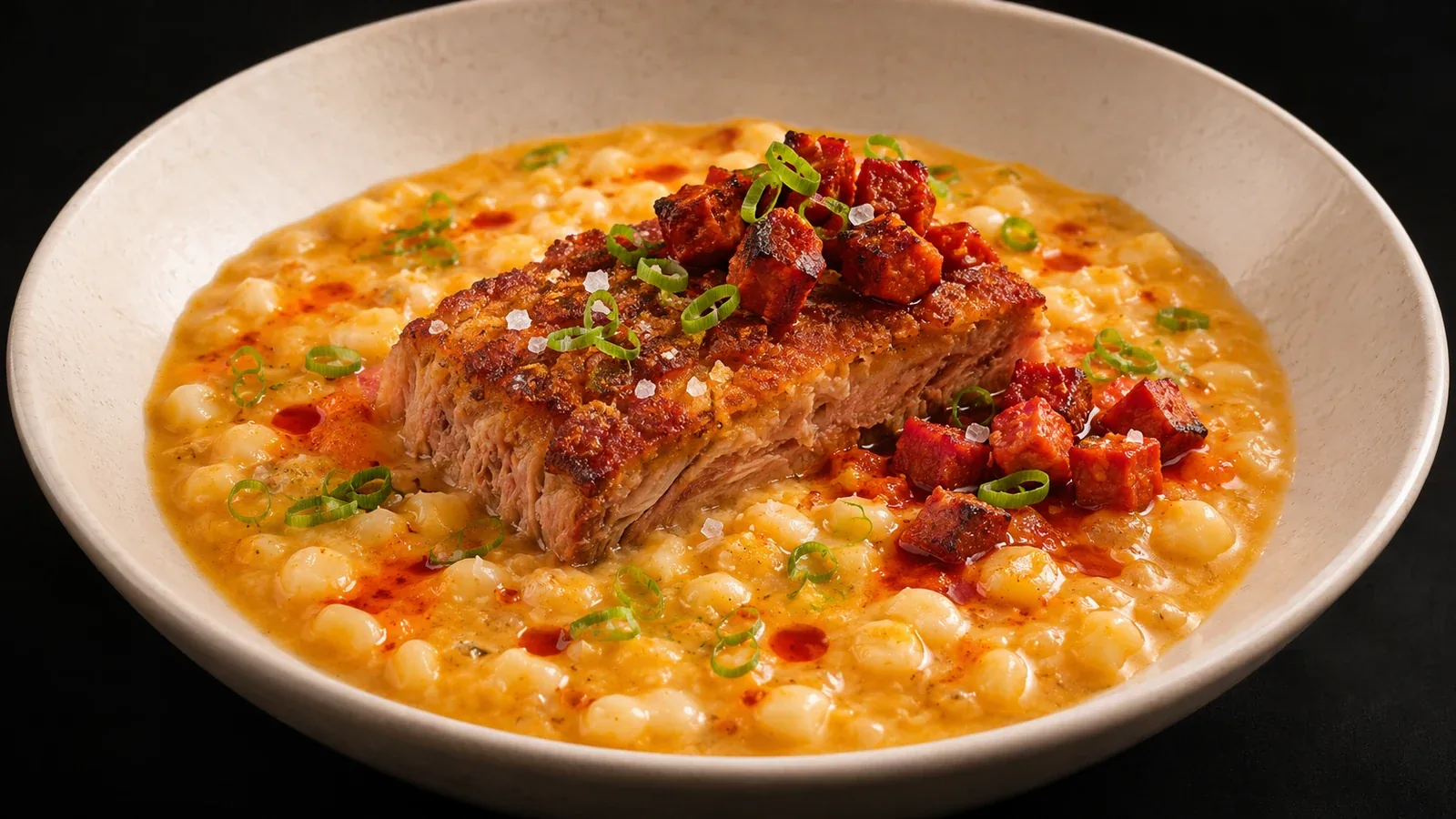
Illustrative image generated with AI, not a photo of the cooked dish.
Kitchen test pending
The root is the criollo locro of the patriotic holidays: white corn, beans and squash cooked long with beef and pork until thick, with its little red fat on top. This version keeps all its flavors and its slow-cooking logic, but separates them on the plate so each has its own texture: a creamy locro with whole kernels, a block of melting meats with a crisp edge and a toasted paprika chorizo.
The twist is in the meats. The veal shank, pork belly ribs and pork trotter are cooked together until they fall apart, shredded and pressed in a mold with their own gelatinous stock; the next day, the block is cut and browned in a pan until it forms a crisp crust with a tender center. That same stock cooks the corn, and part of the locro is blended and strained to give it a velvet texture without losing the kernel. The chorizo, chopped and toasted dry, releases the fat used to make the red fat.
Special equipment: large heavy-bottomed pot; 20 × 10 cm rectangular mold or similar and a 1 kg weight; blender; fine sieve; nonstick pan
Ingredients
Soaking
- 250 g cracked white corn for locro
- 40 g pallar beans (lima beans) or white beans
Pressed meats
- 500 g bone-in veal shank (osso buco)
- 300 g pork belly ribs, in one piece
- 1 pork trotter, about 300 g, split
- 1 bay leaf
- 2 liters cold water
- 6 g fine salt, plus more to adjust
- Black pepper
- 1 teaspoon sweet paprika
Sofrito
- 150 g white onion, in brunoise
- 40 g leek, in brunoise
- 2 garlic cloves, chopped
- 15 ml neutral oil or fat from the stock
- 1 heaped teaspoon sweet paprika
- ¼ teaspoon crushed chili flakes
- 1 pinch of ground cumin
Creamy locro
- 1.2 liters of the meat stock, skimmed of fat
- 400 g winter squash (anco type), in 2 cm cubes
- 100 g sweet potato, in 1 cm cubes
- Hot water, to adjust
- Fine salt
Crisp paprika chorizo
- 100 g good-quality paprika chorizo (chorizo colorado), casing removed, in 3 mm cubes
Red fat (grasita colorada)
- The fat the chorizo releases, topped up with neutral oil to 40 ml
- 1 scallion, white part only, very finely chopped
- ¾ teaspoon sweet paprika
- ¼ teaspoon crushed chili flakes
- 1 pinch of salt
Crisp meats
- 15 g cornstarch or flour
- 15 ml neutral oil
Finishing
- The green part of the scallion, in very thin rings
- Flaky salt
Method
Soaking
- Hydration. Wash the corn and beans and soak them separately, with three times their volume of cold water, for 12 hours in the refrigerator. Drain and rinse them.
Pressed meats
- Blanching. Cover the trotter with cold water, bring to a boil, boil 5 minutes, discard the water and rinse: the strong smell and gray foam go away.
- Cooking. Put the trotter, veal shank, pork belly ribs and bay leaf in the pot with the 2 liters of cold water and slowly bring to a boil. Skim carefully, lower to the minimum and cook with the surface barely trembling for 3–3 h 30 min, skimming occasionally, until the meat comes away from the bone on its own and the trotter skin is gelatinous and soft.
- Shredding. Take out the meats and strain the stock. With the meats still hot and wearing gloves, remove the bone, hard cartilage and excess fat, and shred the veal shank and pork belly ribs into strands; chop the skin and meat of the trotter, which is what binds the block. Mix everything with the salt, pepper, paprika and 100 ml of the hot stock, which is first reduced for 5 minutes to concentrate its gelatin. Taste: it should be well seasoned, because cold it is perceived less.
- Pressing. Line the mold with plastic film, letting it overhang, pour in the mixture and press it with a spatula to an even layer of 3–4 cm. Close with the film, set an identical mold with the weight on top and move it to the refrigerator only once it stops steaming, within the first hour. Press at least 6 hours, better overnight, until the block is firm.
- Stock. Quickly chill the rest of the stock in an ice bath and refrigerate it: the fat rises and hardens, and is removed whole with a spoon. Underneath is a gelatinous broth, which is the base of the locro.
Sofrito
- Slow cooking. Heat the oil in the pot over low heat and cook the onion and leek 15–20 minutes, stirring, until very soft, sweet and barely golden. Add the garlic 1 minute, turn off the heat and add the paprika, chili and cumin off the heat, so the paprika does not burn.
Creamy locro
- Cooking the corn. Add to the sofrito the drained corn and beans and 1.2 liters of the skimmed stock, bring to a gentle boil and cook partly covered 1 h 30 min, stirring often from the bottom and adding hot water if it thickens too much.
- Squash and sweet potato. Add the squash and sweet potato and continue 45–60 minutes, until the corn is tender but whole, the squash breaks down and the whole thickens.
- Silkiness. Set aside a third of the locro, blend it until smooth and pass it through a fine sieve, pressing; return it to the pot. The result should be creamy and coating, with the whole kernels suspended, and fall from the spoon in a thick ribbon. Adjust with hot water and the salt at the end. Keep hot without boiling hard, stirring so it does not stick.
Crisp paprika chorizo
- Toasting. Put the chorizo cubes in a cold pan over medium-low heat and cook them 8–10 minutes, stirring, until they release their fat and are toasted and crisp. Drain on paper towels and reserve the fat.
Red fat
- Infusion. Top up the chorizo fat with oil to 40 ml and heat it over low heat with the white scallion 3–4 minutes, without browning. Turn off the heat, wait 1 minute and add the paprika, chili and salt. It should be red, glossy and perfumed, without a burnt-paprika taste.
Crisp meats
- Cutting. Unmold the cold block and cut it into 4 rectangles of about 8 × 4 cm with a hot, dry knife.
- Browning. Lightly dust the faces with the cornstarch and shake off the excess. Heat the oil in the pan over medium-high heat and brown the rectangles 3–4 minutes per side, without moving them, to a brown, crisp crust; brown the sides too with tongs. Finish them in the oven at 180 °C (355 °F) for 6–8 minutes, to 74 °C (165 °F) at the center. Inside, the gelatin melts and the strands stay moist.
Finishing
- At serving. Have the scallion rings in ice water and well dried, and the flaky salt.
The dish
Use wide, hot deep plates, in light ceramic or glazed earthenware. Serve about 250 ml of creamy locro and tap the plate against your palm so it levels into a smooth surface with the kernels in view. Set in the center a rectangle of crisp meats, with the most golden side up, and scatter over it and to one side a spoonful of crisp paprika chorizo. Draw around it a thread of red fat, in drops that spread across the surface of the locro, without covering it. Finish with a few rings of green scallion and a few flakes of salt on the meat. Final look: a smooth ivory and orange locro with whole corn kernels, the block of meat with a glossy brown crust in the center, the red, toasted chorizo, the eyes of red fat and the green of the scallion.
Key points
- Cook the meats without a hard boil and skim: that way the stock is clean and gelatinous.
- Season the mixture well before pressing, because cold it is perceived less.
- Skim the stock cold, when the fat is hard.
- Blend and strain only a third of the locro, to keep the kernels whole.
- Brown the pressed meats without moving them and finish them in the oven to 74 °C (165 °F).
Pairing
A Uco Valley Malbec or a Cabernet Franc, with fruit and spice for the paprika. Without alcohol, a cold peperina tea or sparkling water with orange.
Notes
- Pressing and storage: the block of meats keeps up to 3 days at 5 °C (41 °F) or below, well wrapped. The creamy locro, up to 3 days, chilled in shallow containers.
- Chilling: the meats and stock must drop from 60 to 21 °C (140 to 70 °F) in 2 hours or less and from 21 to 5 °C (70 to 41 °F) in another 2 hours.