Essential · 5–7 hours; about 75 minutes of active work · Serves 4
Layered criollo bake with braised beef and potatoes
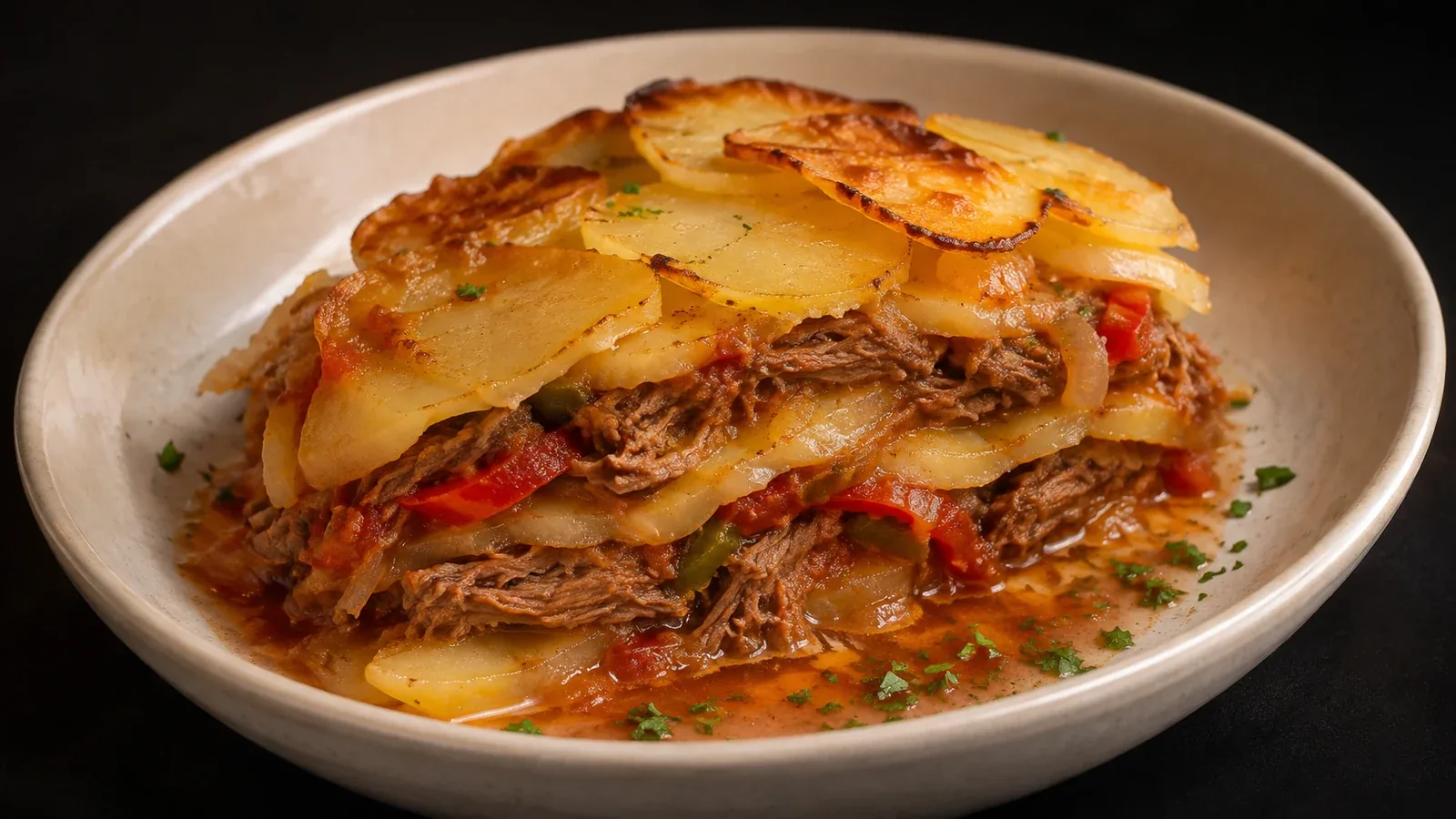
Illustrative image generated with AI, not a photo of the cooked dish.
Concept: fall-apart beef, potatoes that absorb the juices, and slowly cooked onion, bell peppers and tomatoes come together in a layered bake to take to the table in its dish. Each portion retains layers of tender potato, moist filling and a toasted surface.
Twist: the flavor of bifes a la criolla is first concentrated in a braise and then infuses the potatoes during baking. Assembling in a baking dish allows it to be served freshly made, without pressing or overnight resting, and combines sauce and filling in one preparation. A little vinegar balances the sweet vegetables, and parsley adds freshness at serving.
Special equipment: 4 l ovenproof casserole with a lid; baking dish measuring 24 × 20 cm and at least 6 cm deep; probe thermometer if reheating
Ingredients
Beef and criollo vegetables
- 800 g boneless beef chuck, trimmed of tough tendons and excess exterior fat, cut into 5–6 cm pieces.
- 200 g peeled onion, thinly sliced lengthwise.
- 150 g trimmed red bell pepper, cut into 5 mm strips.
- 100 g trimmed green bell pepper, cut into 5 mm strips.
- 400 g ripe plum tomatoes, stems removed, chopped with their juices.
- 8 g peeled garlic, chopped.
- 30 ml olive oil, divided into 20 ml for the beef and 10 ml for the vegetables.
- 120 ml dry white wine.
- 400 ml unsalted beef stock, plus hot water to adjust the level if needed.
- 3 g sweet paprika.
- 1 g dried oregano.
- 1 bay leaf.
- 10 ml red wine vinegar.
- Fine salt and black pepper, to taste.
Potatoes and assembly in the dish
- 900 g peeled potatoes suitable for baking, weighed after peeling.
- 30 g butter, divided into 5 g for the dish, 15 g for the inner layers and 10 g for the top.
- Fine salt, to taste.
Finishing
- 8 g fresh parsley leaves, washed and thoroughly dried.
Method
Beef and criollo vegetables
- Brown. Heat a conventional oven to 160 °C (320 °F). Pat the beef dry and season moderately with salt. Brown in the 20 ml oil in a hot casserole, in 2 batches of 8–10 minutes each, without crowding the pieces. Remove when the surfaces are brown and the fond is toasted without burning.
- Vegetables and liquid. Reduce to medium heat, add the remaining 10 ml oil and cook the onion and both bell peppers for 12–15 minutes, until soft with lightly browned edges. Add the garlic and cook for 1 minute; add the paprika and oregano, stir for a few seconds and immediately add the wine. Scrape up the fond and reduce by approximately half, 3–5 minutes. Add the tomatoes, stock and bay leaf; return the beef with its juices. The liquid should reach halfway to two-thirds up the pieces; top up with hot water if needed.
- Braise. Bring to a gentle simmer, cover and cook in the oven for 2½–3½ hours, turning the pieces halfway through cooking. Check from 2½ hours: the beef should separate with two forks without resistance. If still firm, continue in 20-minute intervals. Maintain gentle bubbling and add water only if the bottom threatens to dry out; lower the oven temperature if it boils hard.
- Moist filling. Remove the bay leaf and beef. Spoon off any free fat floating on top and shred the beef into thick strands, discarding cartilage or tough tendons. If the vegetable base is very liquid, reduce uncovered over medium heat for 10–20 minutes before returning the beef. Mix everything together and add the vinegar. The filling should be wetter than an empanada filling: drawing a spoon through it leaves a channel that slowly closes, without a separate layer of broth. Check the salt and pepper. Keep covered and hot, above 60 °C (140 °F), while slicing the potatoes and assembling.
Potatoes and assembly in the dish
- Slice. Increase the oven to 180 °C (355 °F). Grease a baking dish measuring 24 × 20 cm and at least 6 cm deep with the 5 g butter. Slice the potatoes uniformly 2–3 mm thick, using a knife or mandoline with a guard. Do not rinse after slicing: the starch helps bind the layers.
- Assemble. Divide the potatoes into 3 parts and the filling into 2. Arrange one-third of the overlapping slices on the base and lightly salt. Scatter half the 15 g butter intended for the inner layers in small pieces and cover with half the filling. Repeat with potatoes, salt, the remaining inner-layer butter and the rest of the filling. Finish with the final overlapping potatoes, salt and the 10 g butter for the top, scattered in small pieces. Settle gently with a spatula without crushing; the contents should be 4–5 cm high, with space below the rim.
- Bake covered. Cover the dish tightly with foil; place baking parchment underneath if the foil touches the food. Bake at 180 °C (355 °F) for 60–80 minutes. From 60 minutes, insert a thin skewer into the center and check every layer: the potatoes should yield without resistance. If firm, cover again and continue in 10-minute intervals. The filling supplies moisture; if an edge dries before the potatoes are cooked, add 2–3 tablespoons hot water along that edge and seal again.
- Brown and rest. Once the potatoes are tender, remove the cover and increase to 220 °C (430 °F) for 15–20 minutes, until the surface has golden edges and the juices bubble around the perimeter. If the filling was previously refrigerated, also verify 74 °C (165 °F) in the center before serving. Rest for 10 minutes: the juices redistribute and portions lift out more easily, although they will remain softer than a pressed mille-feuille.
Finishing
- Parsley. Finely chop the leaves during resting and scatter over the portions when serving. Do not bake them with the potatoes: their fresh aroma is the aim.
The dish
Set the hot baking dish on a trivet and bring it to the table with the golden top visible. Cut into four equivalent portions with a spatula and lift each from the base, keeping together as many layers as the moist filling allows. Serve on warmed, shallow bowls or wide rimmed plates, with the golden potatoes facing up and an open side showing beef, onion and bell pepper between the slices. Collect any juices left in the baking dish and divide around the portions without wetting the entire top. Finish with chopped parsley over the juices and one edge of the bake. The result should look generous and tender, with a toasted surface, juice-soaked potatoes and reddish sauce that can be eaten with each bite.
Key points
- Finish the braise by texture: the beef must shred before it goes into the dish.
- Keep moisture in the filling without leaving a pool of broth; the potatoes need juices, but the bake should not be flooded.
- Slice the potatoes evenly and bake covered until all layers are tender.
- Brown only after the potatoes are cooked: a toasted surface does not confirm that the center is ready.
- Allow the 10-minute rest and serve with a spatula that supports the whole base.
Pairing
A young Cabernet Franc with fresh acidity and restrained oak. Without alcohol, light cold black tea with a slice of lemon, unsweetened.
Notes
- Storage and reheating: if keeping filling or portions of the bake, divide into shallow containers and cool immediately, using an ice bath when needed. Reach 60 °C (140 °F) in less than 30 minutes after cooking, cool from 60 to 21 °C within 2 hours and from 21 to 5 °C within another 2 hours; monitor with a probe and do not store if these criteria are not met. These are the guidelines in ANMAT's 2024 manual, pp. 49–50. Store at 5 °C or below and preferably eat the next day, within 48 hours of cooking as a prudent quality window. Reheat only once, covered at 170 °C (340 °F), to at least 74 °C (165 °F) in the center; for a refrigerated portion, start checking at 25 minutes and uncover only at the end to restore color. If the filling was made ahead and the bake was then cooked, serve it all at that baking: do not plan another reheating of those leftovers.
- Alternative cut: boneless beef shoulder in the same weight and piece size, retaining easy shredding as the criterion.
- First cooking trial pending: confirm filling moisture, potato doneness, yield and actual oven time in the dish used. This is a documented development with no physical cooking trial recorded yet.