Signature · about 2 hours of work, plus 24 hours for the labneh and 12–24 hours of cold fermentation · Serves 4
Knife-chopped lamb fatay with labneh, za'atar oil and pomegranate
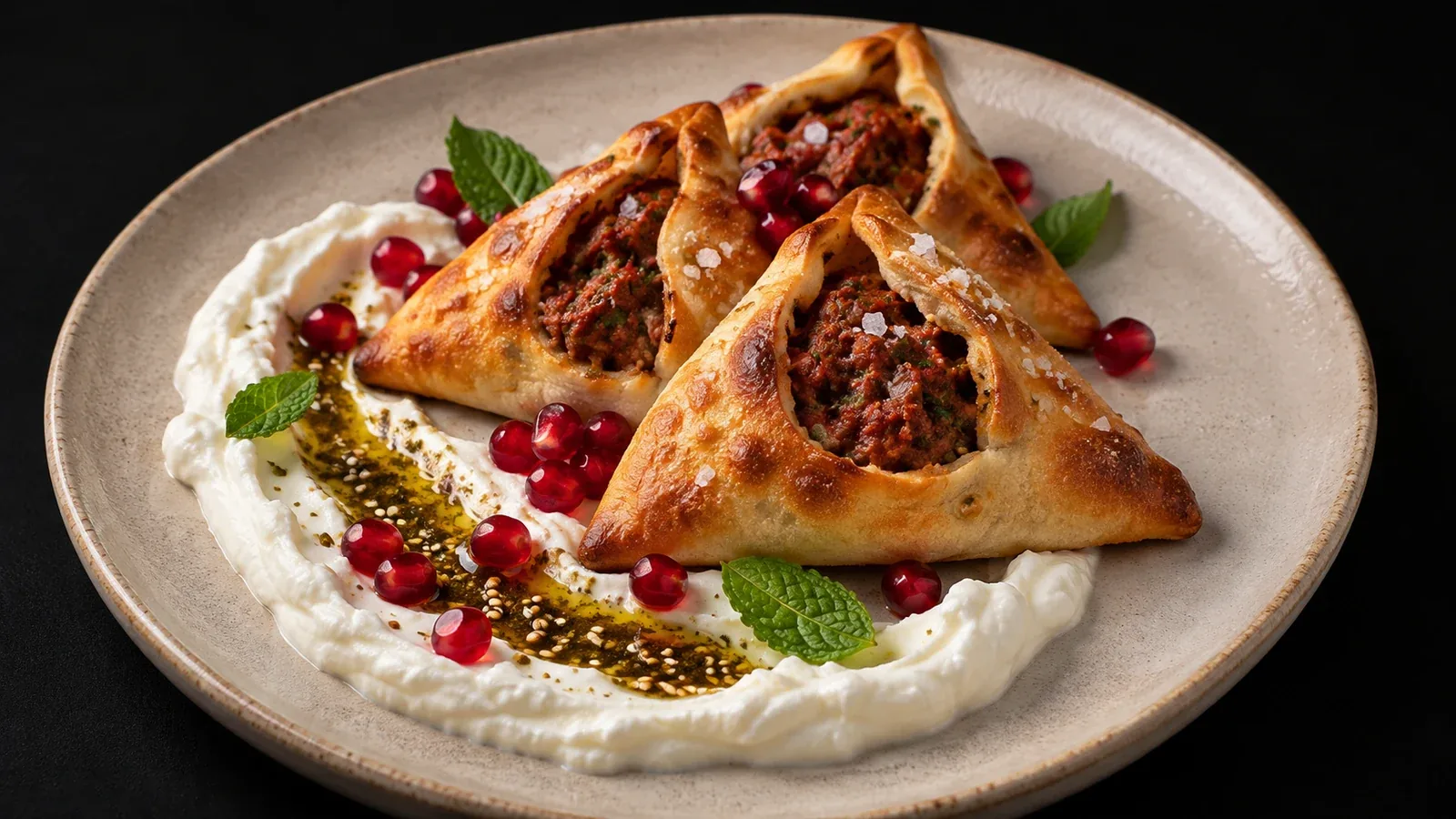
The root is the Arab empanada or Syrian-Lebanese fatay: thin bread dough, closed in a triangle, with a raw filling of meat, onion, tomato and lemon that cooks inside the oven. This version keeps that principle intact, the raw filling that cooks in its own juice, and takes it to a starter of precise bite: three small fatay, open at the tip, with a juicy filling and toasted, blistered dough.
The twist is to treat each part with the technique that favors it most. The lamb is chopped by knife, with part of its fat, so the filling is juicy and textured instead of pasty. The dough ferments cold overnight, which gives it flavor and blisters when baked very hot on a stone. Instead of the yogurt sauce, a homemade labneh strained for 24 hours, rich and tangy; a warm za'atar oil, pomegranate molasses in the filling and fresh pomegranate seeds give perfume, sweet acidity and freshness.
Special equipment: baking stone or thick baking sheet; very sharp chef's knife; cloth or coffee filter for the labneh
Ingredients
Labneh
- 500 g whole plain yogurt, with no thickeners
- 3 g fine salt
Cold-fermented dough
- 250 g all-purpose flour
- 140 g cold water
- 30 g plain yogurt
- 15 g olive oil
- 3 g dry yeast
- 5 g fine salt
- 3 g sugar
Knife-chopped lamb filling
- 400 g boneless lamb shoulder, with 15–20% fat
- 150 g white onion, in 2 mm brunoise
- 80 g seedless, drained tomato, in 4 mm cubes
- 15 g finely chopped parsley
- 5 g finely chopped mint
- 20 g pine nuts, toasted
- 15 ml pomegranate molasses
- 15 ml lemon juice
- 3 g sumac
- 2 g ground cumin
- 2 g ground allspice
- 1 g ground cinnamon
- 7 g fine salt
- Freshly ground black pepper
Assembly and baking
- Flour or semolina, for the stone
- Olive oil, for brushing
Za'atar oil
- 40 ml olive oil
- 2 teaspoons za'atar
- 1 pinch of chili flakes, optional
Finishing
- 40 g pomegranate seeds
- Small mint leaves
- Finely grated lemon zest
- Flaky salt
Method
Labneh
- Straining. Mix the yogurt with the salt, pour it into a sieve lined with a cloth or coffee filter, set over a bowl, and refrigerate 24 hours. It should lose close to half its weight and end up thick and spreadable, like a soft cream cheese. Beat it with a spoon before using; it yields about 250 g.
Cold-fermented dough
- Kneading. Dissolve the yeast and sugar in the water, add the yogurt and oil, and then the flour and salt. Knead 8–10 minutes, to a smooth, soft, elastic dough that stretches into a thin membrane without tearing. Form a ball, put it in an oiled, covered container and refrigerate 12–24 hours: it should grow about 50% and show bubbles at the base.
- Dividing. One hour before assembling, divide the dough into 12 balls of about 35 g, round them and leave them covered at room temperature until soft and relaxed.
Knife-chopped lamb filling
- Chopping. With the meat very cold, cut it into slices, then strips and then chop by knife into pieces of 3–4 mm, without reaching a paste. The fat chopped with the meat is what keeps the filling juicy.
- Draining. Mix the onion with 2 g of the salt, leave it 10 minutes and squeeze it hard in a cloth; do the same with the tomato, without salt. The filling has little free water, so the dough does not get wet.
- Mixing. Right before assembling, mix the lamb with the drained onion and tomato, the herbs, pine nuts, pomegranate molasses, lemon, spices, the rest of the salt and the pepper. It should be moist but with no juice at the bottom of the bowl; cook a pinch in a pan, taste, and adjust the salt and acidity.
Assembly and baking
- Oven. Heat the oven to the maximum, 250–270 °C (480–520 °F), with the stone or thick baking sheet on the lower third, for 45 minutes.
- Rolling. Roll each ball with a rolling pin into a disc of 11–12 cm, about 2 mm thick, without excess flour.
- Forming. Put about 30 g of filling in the center and lift the edge at three points, joining them at the center to form a triangle; pinch the three edges firmly from the base upward and leave a small 1 cm opening at the tip, so the filling shows and the steam escapes. Set them on parchment paper dusted with semolina and brush the dough with oil.
- Baking. Slide the paper with the fatay onto the stone and bake 8–11 minutes, until the dough is golden, with toasted blisters at the edges, and the filling is seen bubbling in the opening, cooked and with no pink. Brush them again with oil as they come out.
Za'atar oil
- Infusion. Heat the oil over low heat to 70–80 °C (158–176 °F), barely warm to the finger, turn off the heat and add the za'atar and chili. Leave 5 minutes: it should perfume without frying the thyme.
Finishing
- At serving. Have the beaten labneh, pomegranate seeds, mint and lemon zest ready.
The dish
Use flat plates of light ceramic or stone, warmed. Put a heaped spoonful of labneh, about 60 g, and drag it with the back of the spoon into a wide half-moon, leaving a small dip. Set three fatay on the labneh, slightly overlapping and with the open tips facing the same direction. Pour a teaspoon of za'atar oil into the dip in the labneh, so it pools and shines, and scatter the pomegranate seeds over the labneh and between the fatay. Finish with a few small mint leaves, a minimal grating of lemon zest and a few flakes of salt on the labneh. Final look: three golden, blistered triangles with the reddish filling in view at the tip, the white half-moon of labneh with its dark green pool of za'atar and the ruby dots of pomegranate.
Key points
- Chop the lamb by knife, with its fat and very cold: machine-ground it turns pasty.
- Drain the onion and tomato well: free water wets the dough.
- Mix the filling only when assembling, because salt and lemon draw out juice.
- Bake very hot, on a hot stone.
- Infuse the za'atar in warm oil, without frying it.
Pairing
A high-altitude Malbec, fresh and spiced, or a Cabernet Franc. Without alcohol, lemonade with mint and orange blossom water.
Notes
- Cooking the filling: the chopped lamb cooks inside the dough. Check in the first batch that the filling reaches 72 °C (162 °F) at the center; if not, add 1–2 minutes.
- Labneh: the whey that drips off can be used in place of the yogurt in the dough.