Essential · about 60 minutes · Serves 4
Homemade spider steak burger with two cheeses and scallions
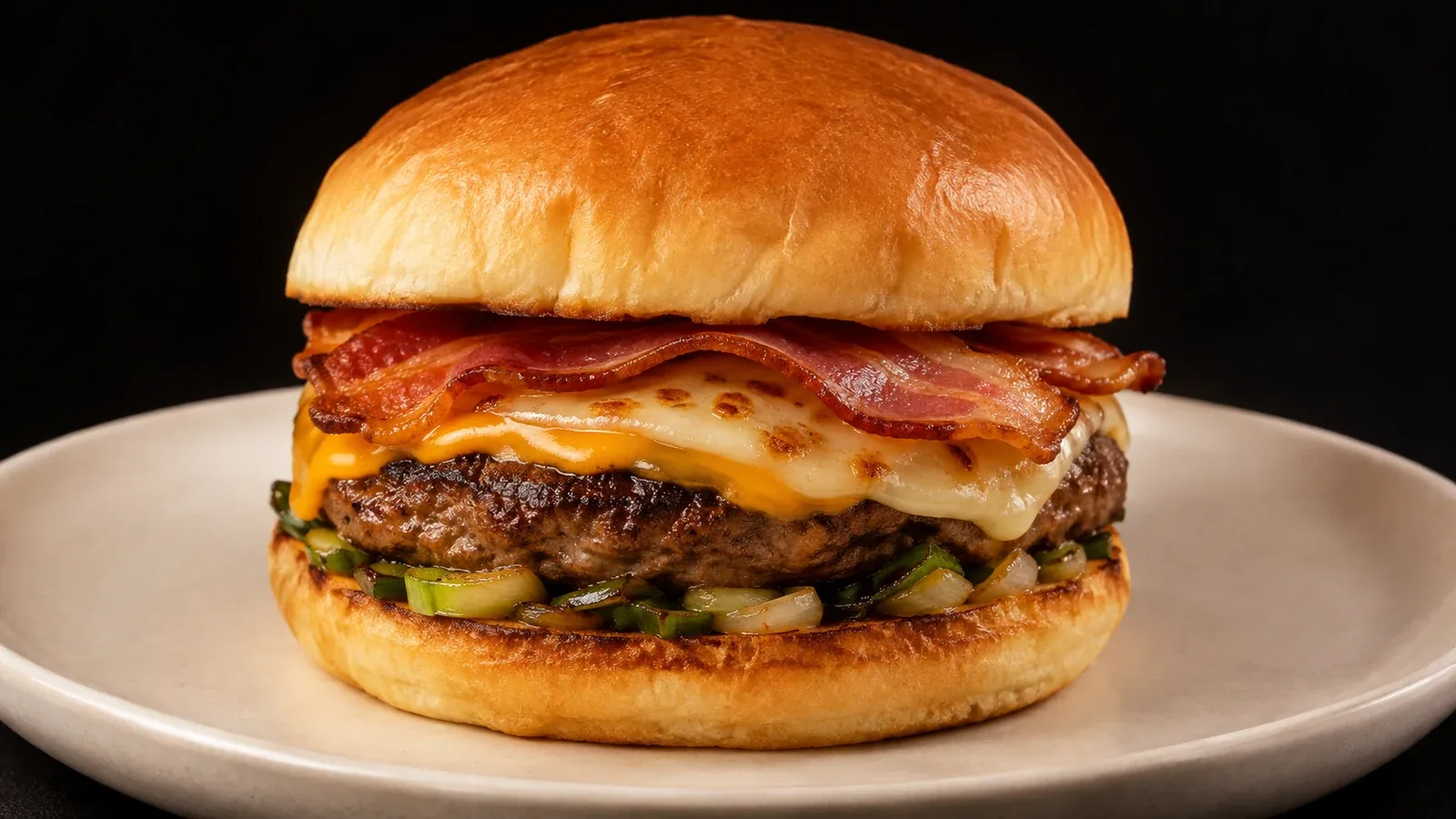
A burger with Argentine roots: spider steak ground with flank steak fat trimmings, garlic, a little fresh parsley and merkén. A potato bun holds crisp bacon, melted Cheddar, browned provolone and sautéed scallions inside the sandwich; the double grind aims for the cohesive texture of the original preparation.
Seasoning uses a measured dry blend and a cooked sample before shaping. The scallions keep their sautéed sweetness with a discreet touch of vinegar, while the two cheeses serve different purposes: melting Cheddar and crusted provolone. The burger stays low enough to eat by hand.
Special equipment: meat grinder with 6–8 mm and 4.5–6 mm plates; thin-probe thermometer; large griddle or two heavy frying pans; non-stick frying pan
Ingredients
Spider steak patties
- 420 g beef spider steak, trimmed weight.
- 60 g raw flank steak fat trimmings, tough membranes removed.
- 4 g fresh parsley leaves, thoroughly dried and finely chopped.
- 2 g garlic powder.
- 1 g merkén (smoked chilli seasoning).
- 3 g reduced-salt beef stock powder containing beef extract.
- 2 g fine salt as a starting point; adjust according to the seasoning and cooked sample.
- 5 g ghee for brushing the cooking surface.
Crisp bacon
- 100 g smoked bacon in 8 thin slices.
Sautéed scallions
- 160 g trimmed scallions (spring onions), white and green parts separated.
- 8 g ghee.
- 5 ml wine vinegar.
- Fine salt, to taste.
Cheeses
- 80 g firm grilling provolone, cut into 4 slices about 3 mm thick.
- 60 g Cheddar in 4 thin slices.
Potato buns
- 4 store-bought potato buns, about 70 g each and 9–10 cm across.
Method
Spider steak patties
- Adjust the blend. Start with 420 g meat and 60 g fat, giving 480 g before seasoning. Spider steak already contains intramuscular fat; the 60 g is added fat, not a measured total fat percentage. If the cut is heavily marbled, use 450 g meat and 30 g fat. Remove tendons and thick membranes without stripping away all the fat.
- Chill and grind. Cut the meat and fat into 2 cm dice; chill for 20–30 minutes in the freezer with the clean blade, plate and auger, until the fat is firm and the meat still bends, without freezing solid. Grind through a 6–8 mm plate. Work in batches and keep the mixture at 5 °C or below; if it softens or smears, stop and chill again.
- Season and grind again. Scatter the parsley, garlic, merkén and salt, together with the stock powder over the first grind. Mix briefly to distribute and pass through a 4.5–6 mm plate a second time. The second pass and incorporated salt are intended to produce a cohesive texture with a fine but still visible grain; mix only until a portion holds its shape, without kneading it into an elastic paste.
- Taste and shape. Cook a 10 g sample until its centre reaches 71 °C (160 °F) for at least 1 second, let it cool slightly and taste the seasoning. Adjust cautiously, allowing for the cheeses. Divide the remainder into 4 patties of about 120 g, approximately 10 cm across and 1.4–1.6 cm thick; round the edges and make a shallow central indentation. Cover and refrigerate while completing the mise en place.
- Cook. Have all toppings ready before taking the patties out of the refrigerator. Heat a griddle or heavy frying pan over medium-high heat, brush with the ghee and place the patties on it without pressing them. Brown for about 3 minutes, turn and cook for another 3–5 minutes; adjust the heat if the crust darkens before the centre is ready. Insert a thin probe sideways into the centre and check that every patty reaches at least 71 °C (160 °F) for 1 second. Thickness and burner power take precedence over the suggested timing; crust and internal colour do not replace measurement.
Crisp bacon
- Render and brown. Arrange the slices in a cold frying pan without oil and set over medium-low heat. Cook for 8–12 minutes in total, turning as they brown, until the fat is translucent and the edges toasted. Drain on a rack; the bacon will firm up as steam escapes. Pour off the fat before reusing the pan.
- Keep it crisp. Cook the bacon close to service and leave uncovered during the brief wait while the patties cook. If made the day before, cool rapidly and refrigerate; reheat in a 180 °C (355 °F) oven until its centre reaches 74 °C (165 °F) and it is crisp, about 5–8 minutes as a guide.
Sautéed scallions
- Brown the whites. Cut the white parts diagonally into 5 mm slices and the green parts into short strips. Heat the ghee in a frying pan over medium-high heat and sauté the whites for 3–4 minutes until tender with golden edges, without burning the outer layers.
- Finish. Add the green parts and sauté for 30–60 seconds, just until slightly softened but still green. Add the vinegar, toss for a few seconds to evaporate excess liquid and adjust the salt. The scallions should be savoury, lightly acidic and free of loose liquid; spread them inside the bun in a shallow layer.
Cheeses
- Choose and dry. Use firm, aged provolone that can withstand brief browning; pat both sides dry. A soft sandwich slice may melt before a crust forms: in that case, use a non-stick pan and remove as soon as golden patches appear.
- Brown the provolone. Heat a non-stick frying pan over medium-high heat without added fat. Brown the slices for 20–40 seconds per side, in batches without overlapping, until toasted patches form and the centre is supple. Lift with a thin spatula and use immediately; if the cheese still sticks, wait a few seconds for the crust to set.
- Melt the Cheddar. Place a slice on each patty for the final 30–60 seconds of cooking, after checking its centre; cover briefly if needed. The Cheddar forms a melted layer on the meat while the provolone keeps its browned face on top.
Potato buns
- Toast the inside. Split the buns and toast the cut faces on a clean, dry frying pan or griddle over medium heat for 1–2 minutes, without pressing the crumb. The outside should be warm and supple, with a toasted interior that holds up during assembly. Do this immediately before cooking the patties.
The dish
Use warm, dry dinner plates, one per person, leaving room to pick up the burger without pulling it apart. Set down the toasted bottom bun and spread one quarter of the well-drained scallions in a shallow layer. Place the patty with its melted Cheddar on top, add a slice of provolone with its most browned face upwards and finish with two crisp bacon slices fitted inside the bun diameter. Close with the warm top without pressing and serve immediately: golden, supple bread, two distinct cheese layers, dry bacon and scallions visible at the edges, with juices contained in each bite.
Key points
- The double grind aims for a cohesive texture; keep the fat firm and avoid prolonged kneading.
- Fresh parsley adds aroma in a small dose: dry it before incorporating.
- Check 71 °C (160 °F) for 1 second at the centre of every patty, inserting the probe from the side.
- Brown the provolone on a separate non-stick surface and assemble while freshly cooked.
- Drain the scallions and use thin layers of both cheeses for stable assembly.
Pairing
A dry amber beer with moderate toastiness and enough bitterness to accompany the fat and cheese. For an alcohol-free option, chilled sparkling water with a slice of lemon.
Notes
- Cuts outside Argentina. Ask for spider steak or topside fillet and confirm the small pelvic cut with the butcher; trade names vary. If unavailable, use chuck with tendons removed and raw beef covering-fat trimmings from the rib or flank in place of flank steak fat. Keep the total at 480 g and adjust the added fat to the marbling. This is a functional grinding substitute with its own flavour, not an anatomical equivalent of spider steak.
- Dry seasoning. Choose a stock powder containing beef extract and compare label salt levels: the 3 g is a starting dose, not blindly interchangeable between brands. Use the initial 2 g salt only with a reduced-salt product; if the available seasoning is salty, reserve additional salt until tasting the cooked sample.
- Optional single grind. For a looser bite, grind once through a 6–8 mm plate, fold in the garlic, merkén and parsley with minimal handling and reserve the salt for the surface just before cooking. For Essential, also apply the dry seasoning outside if it contains salt. This changes texture and seasoning distribution; the double grind remains the main method.
- Storage. Keep the raw meat and patties at 5 °C or below and cook within 24 hours of grinding as a cautious home-kitchen window. For later use, freeze immediately with separators at −18 °C; use within 1 month for quality and thaw in the refrigerator before cooking. Keep cold sauces at 5 °C or below and assemble only at service. Assembled burgers lose quality in storage; refrigerate the components separately and use cooked components within 24 hours as a quality window.
- Cooling and reheating. If storing a cooked preparation, cool to 60 °C (140 °F) in less than 30 minutes; from 60 to 21 °C (140 to 70 °F) within 2 hours, then from 21 to 5 °C (70 to 41 °F) within another 2 hours, taking no more than 4 hours for those two stages. Use shallow containers and an ice bath where appropriate. Reheat patties, stock and other cooked components to a centre temperature of 74 °C (165 °F); prepare fresh vegetables and toast buns at service. Reference: recipe collection safety and storage guidance.
- Development status. The original recipe used meat and fat judged by eye and about 2 stock cubes per 2 kg. This version gives a starting formulation awaiting a physical cooking trial; it is not an exact equivalent of those cubes. Record added fat, seasoning brand where applicable, seasoning balance, shaped weight and cheese behaviour in the first trial.