Essential · 1 hour and 45 minutes, with a 30-minute cure · Serves 4
Grilled pacú with golden cassava and salsa criolla
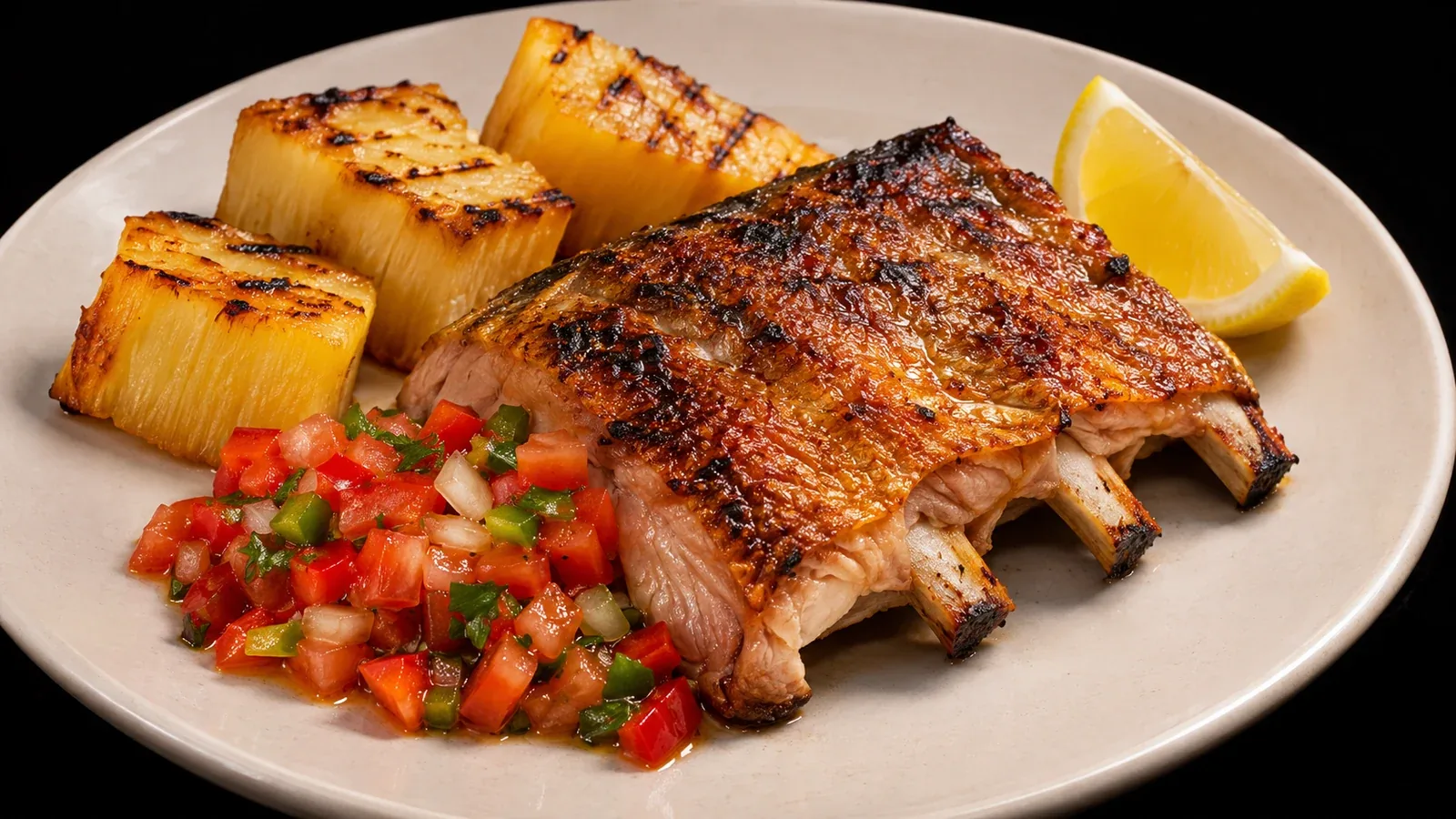
Illustrative image generated with AI, not a photo of the cooked dish.
Pacú rib rack grilled over embers, the way it is eaten on the banks of the Paraná: golden, crackling skin and pink, fatty, juicy flesh that flakes off beside the rib. It comes with tender cassava with toasted edges and a fresh criolla of tomato, bell pepper and onion that cuts the richness of the fish.
The flesh is cured for half an hour with coarse salt, garlic and parsley, so it reaches the fire already seasoned. It is grilled for most of the time skin side down over low embers: the fat melts slowly, without flames, and the skin toasts; only at the end is it turned to brown the flesh. The cassava is boiled first and finished on the grill, so it is creamy inside and crisp outside.
Special equipment: wood or charcoal grill; fine probe thermometer
Ingredients
Grilled pacú
- 1.6 kg pacú rib rack with skin, in 2 pieces of about 800 g, cleaned and scaled.
- 20 g coarse salt.
- 3 garlic cloves, minced very fine.
- 15 g parsley leaves, chopped.
- 1 g ground black pepper.
- 20 g sunflower oil.
- 2 lemons, in wedges, to serve.
Golden cassava
- 800 g peeled cassava (yuca), in pieces of about 6 cm.
- 2 l water and 20 g coarse salt, for boiling.
- 40 g melted butter.
- 0.5 g flaky salt.
Salsa criolla
- 200 g ripe firm tomatoes (2 small), seeded, in 1 cm dice.
- 100 g red bell pepper, in 1 cm dice.
- 100 g onion, in 5 mm dice.
- 10 g parsley leaves, chopped.
- 20 g wine vinegar.
- 40 g olive oil.
- 3 g fine salt.
- 1 g ground chili (ají molido).
Method
Grilled pacú
- Cure. Pat the rib rack dry with paper towels. Mix the coarse salt, garlic, parsley and pepper and rub them over the flesh and between the ribs, without touching the skin. Set it flesh side up on a rack over a tray and leave it 30 minutes in the refrigerator at 5 °C (41 °F) or less, uncovered. The salt draws out moisture: before grilling, pat the flesh dry without rinsing it.
- Build the fire. Light the embers about 40 minutes before grilling. They are ready when the charcoal or wood is covered in gray ash and your hand, held at grill height, can stay 6 or 7 seconds, about 180–200 °C (355–390 °F). Spread them in a low, even layer on one side, leaving a third of the grill without embers, to move the fish aside if the fat flares up. Raise the grill to about 15 cm above the embers, then clean and oil it.
- Grill skin side down. Brush the skin with the oil and set each rib rack skin side down over the low embers. Grill it 25–30 minutes without moving it: the fat drips and melts, and the skin releases from the grill on its own when it is golden and crisp. If a flame flares up, move the piece to the ember-free area until it dies down. Turn with two wide spatulas, carefully, because the flesh is fragile, and grill 8–10 minutes on the flesh side, until it browns. With the probe in the thickest part, not touching bone, it should read 70 °C (158 °F). The total time, 35–45 minutes, is approximate for pieces 3–4 cm thick: the probe decides.
- Rest. Move it to a board, uncovered, for 5 minutes. Cut each piece into two sections of 3 or 4 ribs with a sharp knife, from the flesh toward the skin.
Golden cassava
- Boil. Put the cassava in the water with the coarse salt, bring to a boil and cook over medium heat for 25 minutes, until a knife goes through without resistance. Start at the same time as the fish goes on the grill. Drain and discard the water. Open each piece and remove the fibrous core. Let it air-dry for 3 minutes.
- Brown on the grill. Brush the pieces with the melted butter and grill them over low embers, in the middle area of the grill, 3–4 minutes per side, until they have dark marks and toasted edges, while the pacú finishes on the flesh side. Season with the flaky salt.
Salsa criolla
- Mix. Combine the tomato, bell pepper, onion, parsley, vinegar, oil, salt and chili. Let it rest at least 30 minutes and up to 4 hours in the refrigerator, so the onion softens and the juices come together. Makes about 450 g.
The dish
Use wide, flat, warm plates. Set a section of rib rack on each plate, skin side up with the ribs showing, slightly off-center. Arrange 3 pieces of golden cassava, about 180 g, beside it, cut in half if large, with the grill marks facing up. Spoon about 100 g of salsa criolla, 4 tablespoons, next to the fish and not over the skin, so it stays crisp. Leave a lemon wedge on the rim, for squeezing. Bring to the table right away: copper-colored skin, pink flesh, golden cassava and the criolla red and green, glossy with oil.
Key points
- Dry the flesh and skin well before grilling: moisture keeps the skin from browning and crisping.
- Grill over low embers with an ember-free area: pacú fat causes flare-ups that blacken the skin.
- Do not move the fish until the skin releases from the grill on its own.
- Go by the probe, 70 °C (158 °F) in the thickest part, not by the clock.
- Remove the cassava's central core and cook it until a knife goes in without resistance.
Pairing
Cool Torrontés from Salta or La Rioja, well chilled: its floral aroma and acidity cleanse the richness. Without alcohol, lemonade with plenty of ice.
Notes
- Fish: choose firm-fleshed rib rack with a clean smell, from a trusted fishmonger. Farmed pacú can have muddy notes; the smoke and the final lemon soften them. If rib rack is not available, skin-on fillet 3 cm thick works, with 20–25 minutes of total cooking.
- Cassava: always cook it fully and discard the cooking water; it is not eaten raw. Remove the fibrous core.
- Gas grill: medium heat, lid closed, about 180–200 °C (355–390 °F). The smoke is milder.
- Storage: the pacú is served freshly grilled. Leftover fish, cooled quickly, keeps in the refrigerator at 5 °C (41 °F) or less up to 2 days and is reheated to 74 °C (165 °F) in the center. The criolla keeps 2 days covered in the refrigerator.
- Scaling: by pieces of rib rack; do not crowd the grill so that pieces touch. Grilling time depends on thickness, not weight.