Signature · about 3 hours, with the praline and cream the day before · Serves 4
Golden potato gnocchi with walnut cream, glazed mushrooms, savory praline and crisp sage
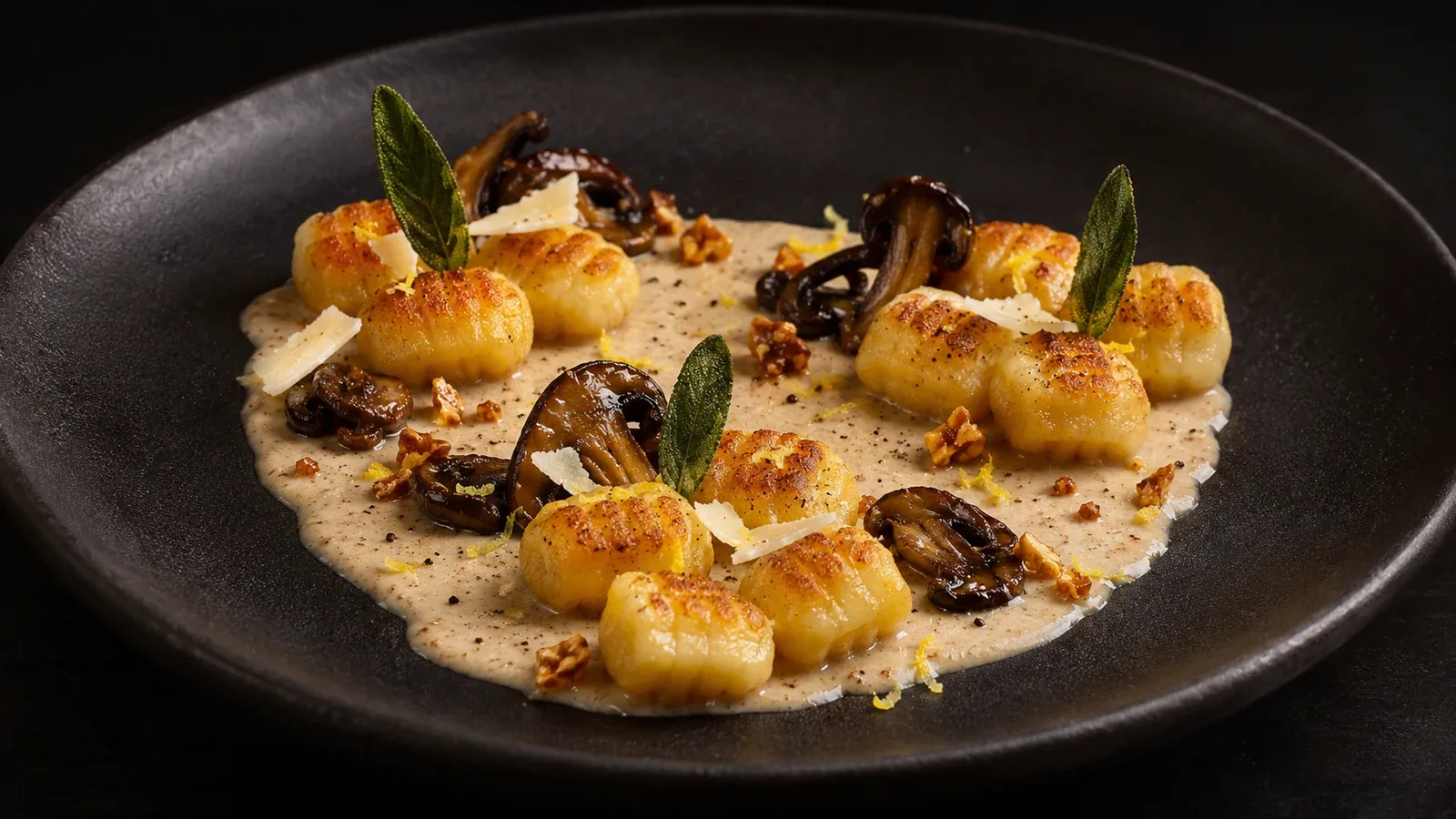
Illustrative image generated with AI, not a photo of the cooked dish.
Kitchen test pending
The potato gnocchi with cream and mushrooms of the family table, in a contemporary reinterpretation. The aim is an earthy, toasty and creamy dish, but with enough freshness not to feel heavy: gnocchi very soft inside and barely golden outside.
The twist is to work each part separately. The potato is baked on salt instead of boiled, so it does not take on water and the dough needs as little flour as possible; the gnocchi are finished golden in brown butter. Instead of heavy cream, a silky cream of toasted walnuts. The mushrooms are browned over high heat and glazed with their own stock to concentrate the umami. A savory walnut praline adds crunchy dots, the fried sage brings perfume and the lemon and Parmigiano balance the richness.
Special equipment: potato ricer; blender; candy thermometer recommended; silicone sheet
Ingredients
Savory walnut praline
- 80 g walnuts
- 80 g sugar
- 20 g water
- 2 g fine salt
- 5 g butter, optional
- 1 teaspoon glucose or a few drops of lemon, optional
Walnut cream
- 150 g walnuts
- 1 tablespoon mild olive oil
- 40 g shallot, finely chopped
- 1 garlic clove, chopped
- 60 ml dry white wine
- 250 ml whole milk
- 150 ml mild vegetable stock
- 80 ml heavy cream
- 20 g grated Parmigiano Reggiano
- Finely grated zest of ½ lemon
- Fine salt and white pepper
Potato gnocchi
- 800 g starchy potatoes, unpeeled
- Coarse salt for the tray, optional
- 160–200 g 00 flour, plus more as needed for working
- 2 egg yolks
- 40 g finely grated Parmigiano Reggiano
- 8 g fine salt
- A pinch of nutmeg
Glazed mushrooms
- 400 g mixed fresh mushrooms: portobello, shiitake, oyster, button or fresh porcini
- 15 g clarified butter or ghee
- 1 tablespoon olive oil
- 2 thyme sprigs
- 80 ml vegetable or mushroom stock
- 1 teaspoon light soy sauce, optional
- Fine salt and black pepper
Brown butter and sage
- 80 g butter
- 12–16 fresh sage leaves, very dry
- Clarified butter or oil, for frying the sage
- Finely grated zest of ½ lemon
- Freshly ground black pepper
Finishing
- 30–40 g Parmigiano Reggiano
- Finely grated lemon zest
- Black pepper
- Extra virgin olive oil, optional
- Dried porcini powder, optional
Method
Savory walnut praline
- Caramel. Toast the walnuts at 160 °C (320 °F) about 8 minutes and keep them warm. Cook the sugar with the water and, if using, the glucose or lemon, which reduce the risk of crystallizing, over medium heat, to a medium amber caramel, at about 175–180 °C (347–356 °F).
- Assembly. Off the heat, add the salt, the butter if using and the walnuts, mix quickly and pour onto a silicone sheet or lightly oiled parchment paper. Let cool completely, break it and chop it irregularly: you want crunchy fragments, not a paste.
Walnut cream
- Base. Toast the walnuts at 160 °C (320 °F) for 8–10 minutes, until aromatic but not dark. Cook the shallot in the oil, slowly, 3–4 minutes, add the garlic without browning it and deglaze with the wine, reducing almost dry.
- Cooking and blending. Add the walnuts, milk and stock and cook gently about 10 minutes. Add the cream and process at high speed to a completely smooth cream; add the Parmigiano, pass through a fine sieve and add the lemon zest. Season. It should be fluid, barely able to coat the back of a spoon, never the density of a purée. If made the day before, reheat gently, without boiling, and correct the texture with a few spoonfuls of milk or stock.
Potato gnocchi
- Baking. Preheat the oven to 200 °C (390 °F). Wash and dry the potatoes without damaging the skin and set them on a bed of coarse salt of 5–8 mm: it separates the potato from the tray, spreads the heat better and absorbs moisture, so the skin ends up dry. Bake 50–70 minutes, depending on size, until completely tender. Since they are not boiled, the potato does not take on water and the dough needs less flour.
- Dough. Work the potatoes while still hot: open them, pass the pulp right away through the ricer and spread it on the counter 2–3 minutes so it releases steam. Add the salt, nutmeg, Parmigiano and yolks and about 150–160 g of flour, and combine without overkneading. Add flour only if needed: the dough should be soft, barely moist, manageable, not too sticky and never hard.
- Shaping. Divide the dough and form cylinders of 1.5–2 cm in diameter. Cut pieces of about 2 cm, smooth or lightly marked with the gnocchi board, and arrange them on a floured tray.
- Cooking. Cook them in batches in plenty of boiling salted water and, when they rise to the surface, count 20–30 seconds more. Lift them out with a slotted spoon to a lightly oiled tray and let them lose some surface moisture before browning.
Glazed mushrooms
- Browning. Clean the mushrooms without soaking them and cut them into large pieces to keep their texture. Heat a wide pan very hot with the oil and clarified butter and add the mushrooms in batches, without filling the pan, leaving them still at first: they should brown, not boil in their water.
- Glazing. Once browned, add the thyme, salt and pepper, deglaze with the stock and, if using, the soy, and reduce quickly until the liquid becomes a glossy glaze that barely coats them. Remove the thyme.
Brown butter and sage
- Crisp sage. Heat a little clarified butter or oil to 160–170 °C (320–338 °F) and fry most of the leaves, well dried, 5–10 seconds. Drain on paper towels and salt lightly: they should be green and crisp, not brown. Set aside a few fresh leaves.
- Brown butter. Heat the butter over medium heat in a wide pan: it melts, foams, and the solids sink to the bottom and take on color. It is ready when they are hazelnut-colored and an intense nutty aroma appears; dark brown is bitter.
- Browning the gnocchi. Add the gnocchi to the brown butter and sauté them 60–90 seconds, letting some faces rest on the pan to form a light crust. In the last seconds, add the fresh sage leaves, the pepper and a little lemon zest.
Finishing
- Balance. Taste salt and acidity before plating. The walnut cream is rich in fat and sweetness: the lemon, sage, browned mushrooms, pepper and a little Parmigiano balance it. The lemon should feel like aroma and freshness, not an acidic sauce.
The dish
Use dark plates —matte black ceramic, stone or artisanal ceramic in earth tones—, only slightly warm. Put 50–60 ml of walnut cream in an irregular circle or a wide brushstroke, without flooding the plate. Distribute 10–14 golden gnocchi leaving spaces between them, without making a mountain, and tuck in the glazed mushrooms at different heights, some resting on the gnocchi. Add 8–10 g of praline in small fragments, especially around the mushrooms, and 2–4 crisp sage leaves upright or slightly tilted. Finish with very fine Parmigiano or small shavings, lemon zest, pepper and, if you like, a few drops of olive oil and a pinch of porcini powder. Serve at once. Final look: golden gnocchi on a pale cream, dark, glossy mushrooms, amber dots of praline and the green of the sage standing high.
Key points
- Dense gnocchi: they usually come from wet potato, too much flour or overworking. Handle the dough as little as possible.
- Watery mushrooms: a pan that is not hot enough, too many mushrooms together or salt added early.
- Heavy walnut cream: lighten it with stock or milk and finish with zest and a few drops of lemon.
- Sticky praline: it is moisture. Store it airtight and outside the refrigerator.
- Bitter brown butter: it was cooked too long. The solids should be hazelnut-colored, not black.
Pairing
A cool-climate Chardonnay with moderate aging, Patagonian or from the high zones of Mendoza: its texture goes with the walnut and butter, and its acidity balances the fat. As a red alternative, a fresh, lightly extracted Pinot Noir, whose earthy profile works with the mushrooms without covering the gnocchi.
Notes
- Lighter variant, without walnut cream: make a brown butter with 100 g of butter, add 16 sage leaves and emulsify with 80–120 ml of hot cooking water. Add the gnocchi and, off the heat, 40–60 g of Parmigiano, the zest of 1 lemon, 1 tablespoon of juice and pepper. It works very well with the glazed mushrooms; in that case it is best to reduce or omit the praline.
- Intended result: gnocchi very soft inside and barely golden outside, silky and not thick cream, well-caramelized mushrooms, crunchy sweet-and-salty dots of praline and a finish of sage, lemon and toasted butter.