Signature · 2 hours and 30 minutes, with a 40-minute cure · Serves 4
Embers-grilled pacú with smoked cassava purée and roasted lemon butter
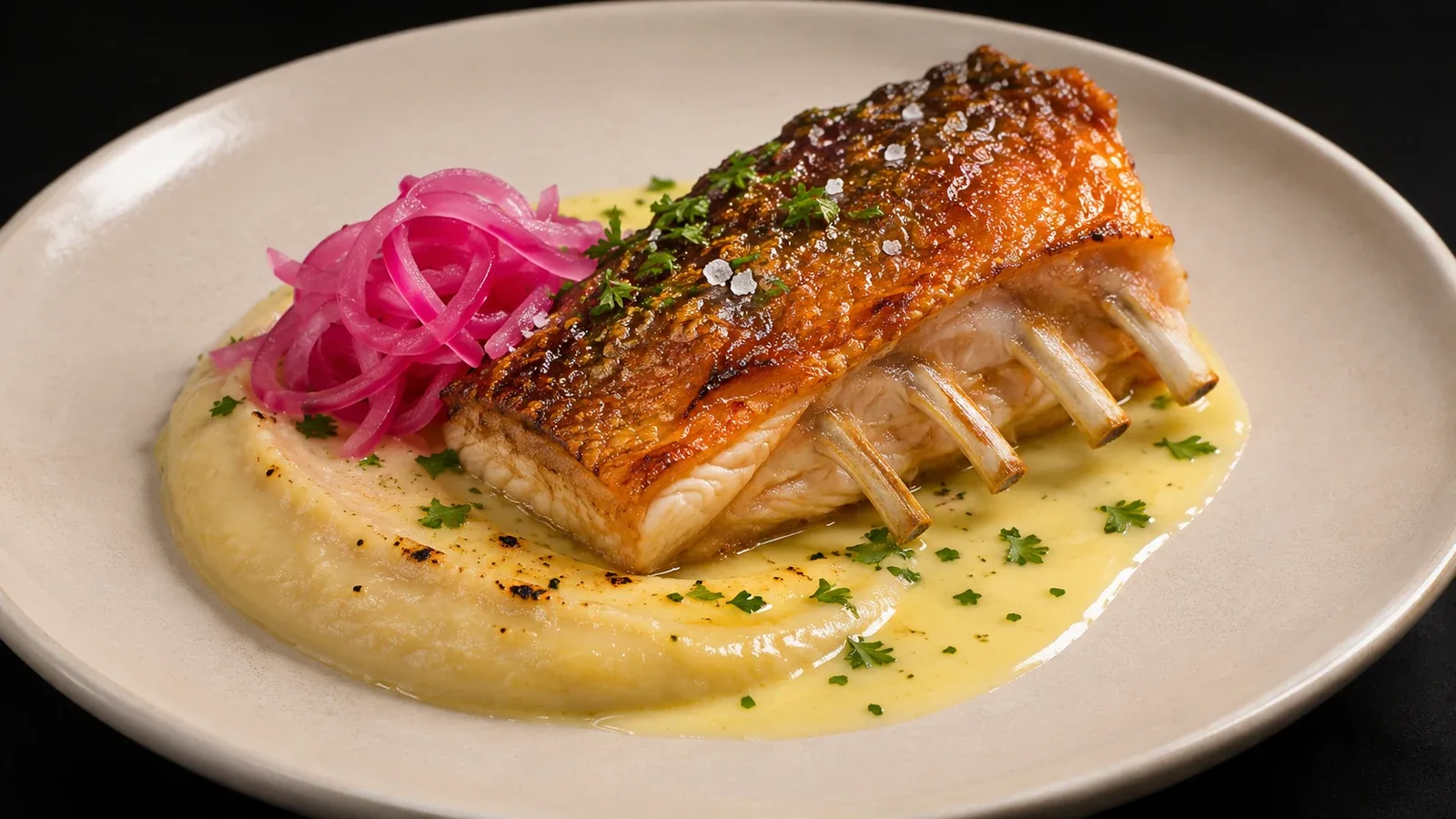
Illustrative image generated with AI, not a photo of the cooked dish.
Pacú rib rack from the Litoral, with crisp skin and fatty, juicy, lightly smoky flesh, over a silky cassava purée with an ember backdrop. A roasted lemon butter gives the fish acidity and smoke, and pickled red onion cuts the richness with a sharp, crunchy edge in each bite.
The cure of salt, lemon zest and a pinch of sugar carries flavor into the flesh and dries the surface, so the skin browns and crackles against the grill. The boiled cassava is toasted over the embers before it is puréed, and that smoke becomes the base of the purée. The lemons are roasted before squeezing: they give a deeper, less sharp butter that accompanies the pacú without wetting its skin.
Special equipment: wood or charcoal grill; fine probe thermometer; potato ricer or food mill
Ingredients
Embers-grilled cured pacú
- 1.6 kg pacú rib rack with skin, in 2 pieces of about 800 g, cleaned and scaled.
- 16 g fine salt.
- 8 g sugar.
- Finely grated zest of 2 lemons, without the white pith.
- 1 g ground black pepper.
- 20 g sunflower oil.
- 5 g parsley leaves, chopped, to finish.
- 0.5 g flaky salt, to finish.
Smoked cassava purée
- 650 g peeled cassava (yuca), in pieces of about 6 cm.
- 1.5 l water and 15 g coarse salt, for boiling.
- 20 g sunflower oil, for brushing.
- 120 g whole milk, warm.
- 60 g butter, cubed, at room temperature.
- 4 g fine salt.
Roasted lemon butter
- 2 lemons, halved.
- 40 g dry white wine.
- 25 g shallot, minced.
- 110 g cold butter, cubed.
- 1 g fine salt.
Pickled red onion
- 150 g red onion, thinly sliced.
- 60 g red wine vinegar.
- 60 g water.
- 12 g sugar.
- 4 g fine salt.
- 1 bay leaf.
Method
Embers-grilled cured pacú
- Cure. Pat the rib rack dry with paper towels. Mix the salt, sugar, lemon zest and pepper and rub them over the flesh and between the ribs, without touching the skin. Set it flesh side up on a rack over a tray and leave it 40 minutes in the refrigerator at 5 °C (41 °F) or less, uncovered. The salt draws out moisture: before grilling, pat the flesh dry without rinsing it.
- Build the fire. Light the embers about 40 minutes before grilling. They are ready when the charcoal or wood is covered in gray ash and your hand, held at grill height, can stay 6 or 7 seconds, about 180–200 °C (355–390 °F). Spread them in a low, even layer on one side, leaving a third of the grill without embers, to move the fish aside if the fat flares up. Raise the grill to about 15 cm above the embers, then clean and oil it.
- Grill skin side down. Brush the skin with the oil and set each rib rack skin side down over the low embers. Grill it 25–30 minutes without moving it: the fat drips and melts, and the skin releases from the grill on its own when it is golden and crisp. If a flame flares up, move the piece to the ember-free area until it dies down. Turn with two wide spatulas, carefully, because the flesh is fragile, and grill 8–10 minutes on the flesh side, until it browns. With the probe in the thickest part, not touching bone, it should read 70 °C (158 °F). The total time, 35–45 minutes, is approximate for pieces 3–4 cm thick: the probe decides.
- Rest. Move it to a board, uncovered, for 5–8 minutes. The fat settles and the skin stays dry. Cut each piece into two sections of 3 or 4 ribs with a sharp knife, from the flesh toward the skin.
Smoked cassava purée
- Boil. Put the cassava in the water with the coarse salt, bring to a boil and cook over medium heat for 25 minutes, until a knife goes through without resistance; start when the pacú goes on the grill. Drain and discard the water. Open each piece and remove the fibrous core. Let it air-dry for 3 minutes.
- Toast over the embers. Brush the pieces with the oil and grill them over low embers, 3–4 minutes per side, until they have dark marks and toasted edges. This happens in the last minutes of the pacú, in the middle area of the grill.
- Purée. Pass the hot cassava through the ricer or food mill into a saucepan; no blender, which makes it gluey. Add the warm milk and the salt and stir with a spatula. Add the cubed butter a little at a time until the purée is smooth, glossy and thick, like a cream that falls slowly from the spoon. Makes about 740 g. Keep it covered at 60 °C (140 °F) or more, in a bain-marie, until serving, no more than 1 hour.
Roasted lemon butter
- Roast the lemons. With the pacú already on the grill, set the lemons cut side down in the middle area of the grill for 4–5 minutes, until dark golden and juicy. Squeeze and strain: you need about 50 g.
- Reduce and mount. In a small saucepan over medium heat, cook the shallot, wine and the 50 g of juice; reduce 8–10 minutes, to about 35 g, with the look of a loose syrup. Lower to the minimum and add the cold butter cube by cube, whisking constantly, until each one dissolves and the sauce is creamy and opaque. It must not boil: the emulsion breaks above about 80 °C (176 °F). Season with salt. Hold it in a small jug in hot water at 55–60 °C (131–140 °F), no more than 30 minutes, and do not reheat it. Makes about 150 g. If it breaks, whisk 1 tablespoon of hot water and add it drop by drop.
Pickled red onion
- Pickle. Put the onion in a jar. Bring the vinegar, water, sugar, salt and bay leaf to a boil, pour it hot over the onion and let it cool. Refrigerate at least 30 minutes; it keeps up to 7 days. It should be pink and still firm.
The dish
Use wide, flat, warm plates. Spoon 180 g of cassava purée on one side of each plate, slightly off-center, and smooth it with the back of the spoon into a half circle. Lean a section of rib rack on the purée, skin side up with the ribs showing, so the golden skin does not touch the sauce. Surround the purée and the edge of the flesh with about 35 g of roasted lemon butter, forming a pale, glossy pool. Place 15 g of well-drained pickled red onion in a loose nest beside the fish. Finish with chopped parsley over the sauce and a few flakes of salt on the skin. Serve right away: copper-colored, crisp skin, pale beige purée with dark ember marks, pale glossy butter and the vivid pink of the onion.
Key points
- Dry the flesh and skin well before grilling: moisture keeps the skin from browning and crisping.
- Grill over low embers with an ember-free area: pacú fat causes flare-ups that blacken the skin.
- Go by the probe, 70 °C (158 °F) in the thickest part, not by the clock.
- Process the cassava with a ricer or food mill and without the central core: a blender makes it gluey.
- Mount the butter off the boil: above about 80 °C (176 °F) it breaks.
Pairing
Young Patagonian Chardonnay, unoaked, chilled: its tense acidity answers the lemon butter. Without alcohol, tonic water with a slice of grapefruit and plenty of ice.
Notes
- Fish: choose firm-fleshed rib rack with a clean smell, from a trusted fishmonger. Farmed pacú can have muddy notes; the lemon cure and the smoke soften them. If rib rack is not available, skin-on fillet 3 cm thick works, with 20–25 minutes of total cooking.
- Cassava: always cook it fully and discard the cooking water; it is not eaten raw. Remove the fibrous core.
- Gas grill: medium heat, lid closed, about 180–200 °C (355–390 °F). The smoke in the purée is milder; grill the cassava and lemons with the lid closed.
- Storage: the pacú is served freshly grilled. Leftover fish, cooled quickly, keeps in the refrigerator at 5 °C (41 °F) or less up to 2 days and is reheated to 74 °C (165 °F) in the center. The purée and the lemon butter are not stored.
- Scaling: by pieces of rib rack; do not crowd the grill so that pieces touch. Grilling time depends on thickness, not weight.