Signature · about 3 hours of work spread over 2 days, plus 4–8 hours of brining · Serves 4
Crispy roasted lemon, honey and thyme wings
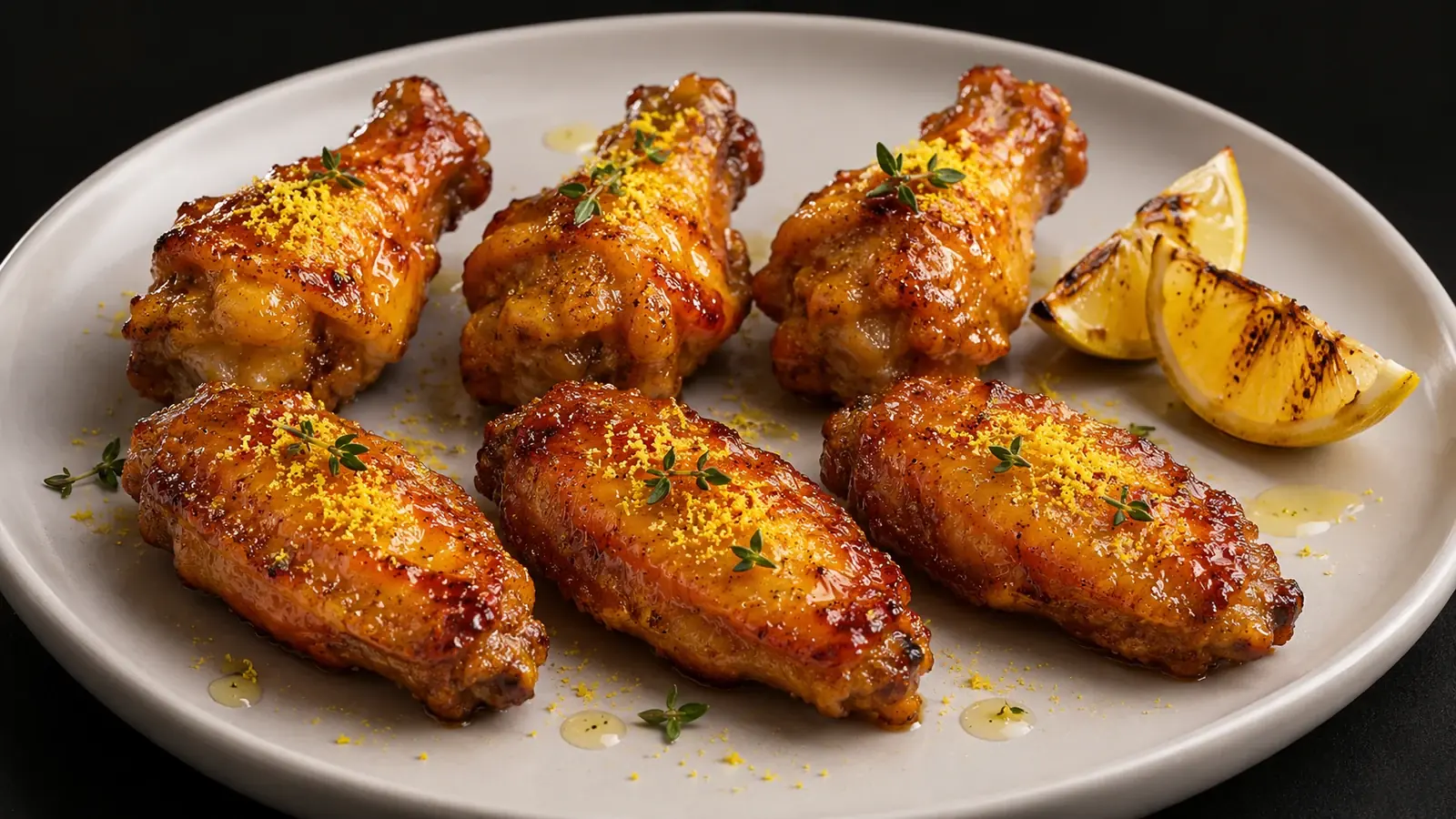
Illustrative image generated with AI, not a photo of the cooked dish.
Kitchen test pending
Chicken wings glazed with lemon and honey, made with the method of the wing collection: aromatic brine, slow confit in oil and a final crisping, for very tender meat and crisp skin before the sauce goes on. It is the freshest, most acidic finish of the series.
The twist is to use the lemon in two ways: one part is roasted cut side down until caramelized and the other is squeezed fresh. This brings toasty, acidic and aromatic notes without making the sauce aggressive. The honey, butter and olive oil round out an emulsion that clings to the wing, the thyme adds perfume and a powder of dried lemon zest gives a last citrus touch.
Special equipment: thermometer for the confit oil; convection oven
Ingredients
Wings and brine
- 1500 g whole chicken wings (about 12 wings, 24 separated pieces)
- 1.2 liters cold water
- 84 g fine salt
- 40 g sugar
- 4 garlic cloves, lightly crushed
- 8 g black peppercorns
- 2 bay leaves
- Peel of 1 lemon, without the white pith
Confit
- Neutral oil, as much as needed to cover the wings; 15–20% can be replaced with duck fat
- 4 garlic cloves
- 4 thyme sprigs
- Peel of 1 lemon
Crisping
- Neutral oil for frying, only if frying is chosen
Roasted lemon and honey sauce
- 5 lemons: 2 to roast and 3 to squeeze fresh
- 120 g honey
- 80 g cold butter
- 60 ml mild olive oil
- 4 g fresh thyme leaves, picked
- White pepper and salt
- 20–30 g preserved lemon, very finely chopped, optional
Lemon powder
- The yellow zest of 2 of the fresh lemons, grated before squeezing them
Finishing
- 1 lemon, in grilled wedges
- Fresh thyme leaves
Method
Wings and brine
- Breaking down. Separate each wing at its joints into drumette and flat, and set the tips aside for a poultry stock. Remove any feathers or visible bits.
- Brine. Fully dissolve the salt and sugar in the cold water and add the garlic, pepper, bay leaves and lemon peel. Submerge the wings and refrigerate for 4 to 8 hours, never longer. Remove them, rinse very briefly to take off the excess salt and pat carefully dry with paper towels: the drying is what later allows a crisp surface.
Confit
- Slow cooking. Arrange the wings in a saucepan or deep dish, cover them completely with the oil and add the garlic, thyme and lemon peel. Keep the oil between 95 and 105 °C (203–221 °F) for 75–90 minutes: there should be no intense frying, only small bubbles. This cooks the connective tissue slowly and leaves the meat very tender without falling apart.
- Cooling. Remove from the heat and let them cool first in the fat; then refrigerate for at least 2 hours, ideally from the day before.
Crisping
- Drying. Lift the wings out of the oil and dry them carefully.
- Browning. Choose a method: convection oven at 225–230 °C (435–445 °F) for 12–15 minutes, turning halfway; deep-frying in oil at 180–185 °C (355–365 °F) for 2–3 minutes, or a very hot cast-iron pan, 2–3 minutes per side. They must be crisp before they touch the sauce. Since these are cooked and chilled wings, the center must reach 74 °C (165 °F): with frying or the griddle, it is best to take them out of the refrigerator 20–30 minutes ahead and, if they do not reach it, finish them for a few minutes in the oven.
Roasted lemon and honey sauce
- Roasted lemon. Cut 2 lemons in half and place them cut side down on a very hot griddle until deeply caramelized. Squeeze them, together with the 3 fresh ones: you want about 200–240 ml of juice in total.
- Emulsion. Gently reduce the juices with the honey in a pan. Gradually whisk in the cold butter and then the oil. Add the thyme, white pepper, salt and, if using, the preserved lemon. It should be thick enough to cling to the wing.
Lemon powder
- Drying. Grate only the yellow part of the zest, dry it in the oven at 90 °C (195 °F) for about 20 minutes, let it cool and crush it. Only a pinch per wing is used.
Finishing
- Wedges. Cut the lemon into wedges and mark them on the hot griddle until they take on color.
- Lacquering. Coat the crisp wings with the emulsion and put them in the oven at 220–230 °C (430–445 °F) for 1–2 minutes. Remove them and add fresh lemon zest.
The dish
Use a matte white or light gray plate. Arrange the 6 lacquered pieces with some volume and add one or two grilled lemon wedges on the side. Finish with fresh thyme leaves, a pinch of lemon powder over each wing and a few drops of the emulsion on the plate, and serve at once. Final look: golden, glossy wings, the intense yellow of the lemon powder, the wedge with toasted marks and the green of the thyme.
Key points
- Dry the wings very well after the brine and after the confit: moisture prevents the crisp crust.
- Confit between 95 and 105 °C (203–221 °F), without intense frying: only small bubbles.
- Bring the crisped wings to 74 °C (165 °F) at the center before lacquering, because they start cooked and chilled.
- Roast the lemons to a deep caramelization, without burning them: it is what separates this sauce from a simple lemon and honey.
- Lacquer with two thin, glossy films, never a thick coat: crisp wing, first film, strong heat, second film, finish and serve immediately.
Pairing
A Sauvignon Blanc or a Brut Nature sparkling wine.
Notes
- Scale: the original cooks 1.5 kg of wings to share among several finishes, with sauce for 8–12 pieces of each. This recipe uses double the sauce to lacquer all 24 pieces with a single flavor, about 6 per person as a starter.
- Five-flavor tasting: you can serve one wing of each finish, in this order of increasing intensity: roasted lemon and honey, amber orange, Parmesan and black garlic, Malbec and cocoa BBQ, and spicy gochujang. The other four recipes of the collection share the same base.