Signature · about 3 hours of work spread over 2 days, plus 8–12 hours of pressing · Serves 4
Crisp potato and smoked bacon millefeuille with leek cream and 64 °C egg
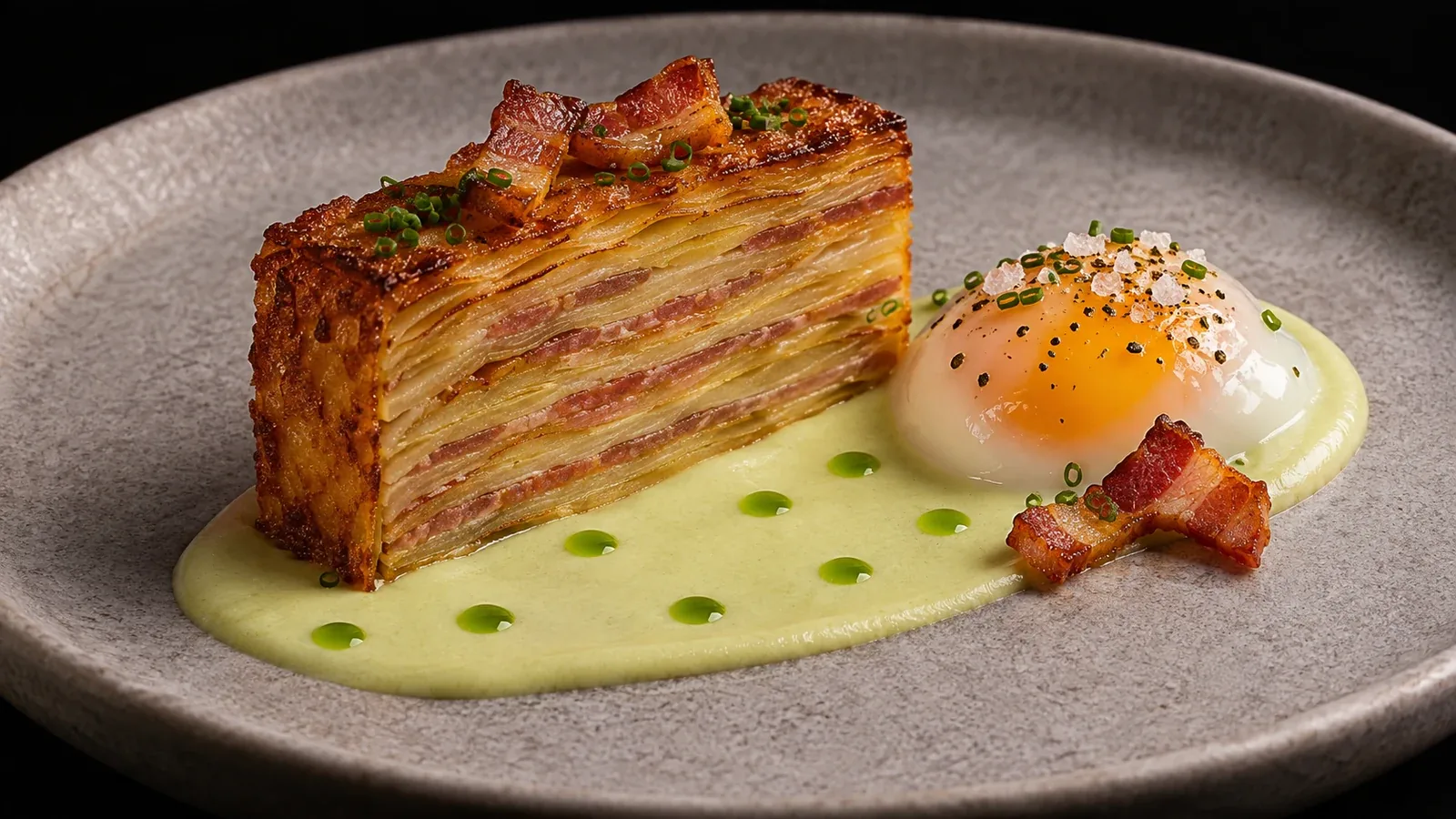
The root is the potato gratin and the potato and bacon millefeuille of the family: thin potato slices interleaved with smoked bacon, bound with cream and baked until they melt into a tender block. This version takes that side-dish preparation to the center of a starter, like a potato pavé: the block is pressed overnight, cut into neat rectangles and browned in the pan on all its faces.
The twist is to transform the texture. Pressed cold, the millefeuille compacts into dozens of layers visible in the cut; browned, the faces turn crisp and the center stays creamy. On top, an egg cooked at 64 °C (147 °F), with a yolk as thick as syrup, acts as a sauce when broken; a light leek cream adds vegetal sweetness, and the bacon returns as a toasted crisp that repeats the smokiness. A few drops of chive oil and some flakes of salt close the dish.
Special equipment: mandoline; 20 × 10 cm rectangular mold and a 1 kg weight; sous vide circulator or precise thermometer; hand blender; nonstick pan
Ingredients
Pressed millefeuille
- 1 kg medium potatoes with firm flesh, of even size
- 120 g very thinly sliced smoked bacon, 1–2 mm, without rind
- 200 ml heavy cream
- 1 garlic clove, lightly crushed
- 2 thyme sprigs
- 3 g fine salt
- 2 g freshly ground black pepper
- 1 pinch of nutmeg
- 20 g butter, for the mold
Leek cream
- 250 g leek, white and light green part only, in rounds
- 20 g butter
- 250 ml vegetable or chicken stock
- 60 ml heavy cream
- Fine salt and white pepper
- A few drops of lemon juice
64 °C eggs
- 4 very fresh eggs, with clean shells
Crisp bacon
- 60 g thinly sliced smoked bacon
Chive oil
- 20 g chives
- 60 ml neutral oil
Browning and finishing
- 15 ml neutral oil
- 10 g butter
- Flaky salt
- Freshly ground black pepper
- Very finely cut chives
Method
Pressed millefeuille
- Infusion. Heat the cream with the garlic, thyme, salt, pepper and nutmeg until it steams, turn off the heat and infuse 15 minutes. Strain.
- Assembly. Heat the oven to 160 °C (320 °F). Butter the mold and line it with parchment paper, letting it overhang on the long sides. Peel the potatoes and slice them on the mandoline at 1.5 mm, without rinsing them: the starch is what sticks the layers. Toss them with the infused cream to coat each slice. Arrange the overlapping slices in even layers, alternating every three layers of potato with one of bacon, up to 4–5 cm tall. Pour over any cream left and press.
- Baking. Cover with parchment paper and foil and bake 1 h 30 min – 1 h 45 min, until a knife goes through the block without resistance. Uncover and bake 15 minutes more to barely brown the surface.
- Pressing. Let cool 30 minutes, cover with parchment paper, set an identical mold or a board with the weight on top and refrigerate 8–12 hours, within the first hour, once it stops steaming. The next day the block is firm, compact and easy to cut.
Leek cream
- Cooking. Sweat the leek in the butter over low heat, covered, 12–15 minutes, stirring, until very tender and without color. Add the stock and simmer 5 minutes.
- Blending. Blend with the cream until completely smooth and strain through a fine sieve. Salt, add the white pepper and a few drops of lemon. It should be coating, with the thickness of a light cream: if thick, add stock.
64 °C eggs
- Cooking. Heat the bath to 64 °C (147 °F) and submerge the eggs in their shells 45–60 minutes. The white is very tender and almost liquid on the outside, and the yolk thick and creamy, like a dense syrup.
- Opening. At serving, crack each egg over a small sieve, so the more liquid white drains, and carefully move it to a spoon.
Crisp bacon
- Baking. Lay the bacon slices between two sheets of parchment paper and two trays and bake at 180 °C (355 °F) for 15–20 minutes, until dry, golden and brittle. Let cool on paper towels and break into small pieces.
Chive oil
- Blending. Blend the chives with the oil at maximum speed 2 minutes and strain through cheesecloth without pressing. Keep in a squeeze bottle in the refrigerator.
Browning and finishing
- Cutting. Unmold the cold block, trim the edges and cut it into 4 rectangles of about 9 × 4 cm with a hot knife, cleaning it between cuts.
- Browning. Heat the oil in the pan over medium-high heat and brown the rectangles 3–4 minutes per side, without moving them, including the sides, until golden and crisp. Add the butter in the last minute and baste them. Finish them in the oven at 180 °C (355 °F) for 6–8 minutes, until well heated at the center, to 74 °C (165 °F).
The dish
Use flat plates in light ceramic or gray stone, warmed. Put about 3 tablespoons of hot leek cream to one side and drag them with the back of the spoon into a wide teardrop. Stand the millefeuille rectangle on the cream, with one of the cut faces toward the diner, so the layers show. Set the 64 °C egg beside it, resting in the cream, and season the yolk with flakes of salt and pepper. Scatter the crisp bacon over the millefeuille and next to the egg, and let fall 6–8 drops of chive oil on the cream. Finish with very finely cut chives. Final look: a golden, crisp block with the thin layers of potato and bacon in view, the pale green cream, the white, trembling egg with the golden yolk and the intense green dots of the oil.
Key points
- Slice at 1.5 mm and do not rinse the potatoes: the starch sticks the layers.
- Bake until the knife goes through without resistance before pressing.
- Press cold at least 8 hours to cut clean rectangles.
- Brown without moving and finish in the oven to 74 °C (165 °F) at the center.
- Control the egg bath precisely: two degrees change the texture of the yolk.
Pairing
A barrel-aged Chardonnay or a delicate Pinot Noir. Without alcohol, very cold non-alcoholic cider.
Notes
- 64 °C egg: the yolk and part of the white are only lightly cooked. For pregnant women, small children, the elderly or the immunocompromised, use pasteurized eggs.
- No circulator: keep a pot of water at 64 °C (147 °F) with a thermometer, adjusting the heat to the minimum.
- Storage: the pressed block keeps up to 3 days at 5 °C (41 °F) or below, well wrapped.