Signature · 2 days; 5–6½ hours of preparation on the first, plus cooling and 8–12 hours of chilled resting; 50–75 minutes on the second · Serves 4
Criollo mille-feuille with braised beef and golden potatoes
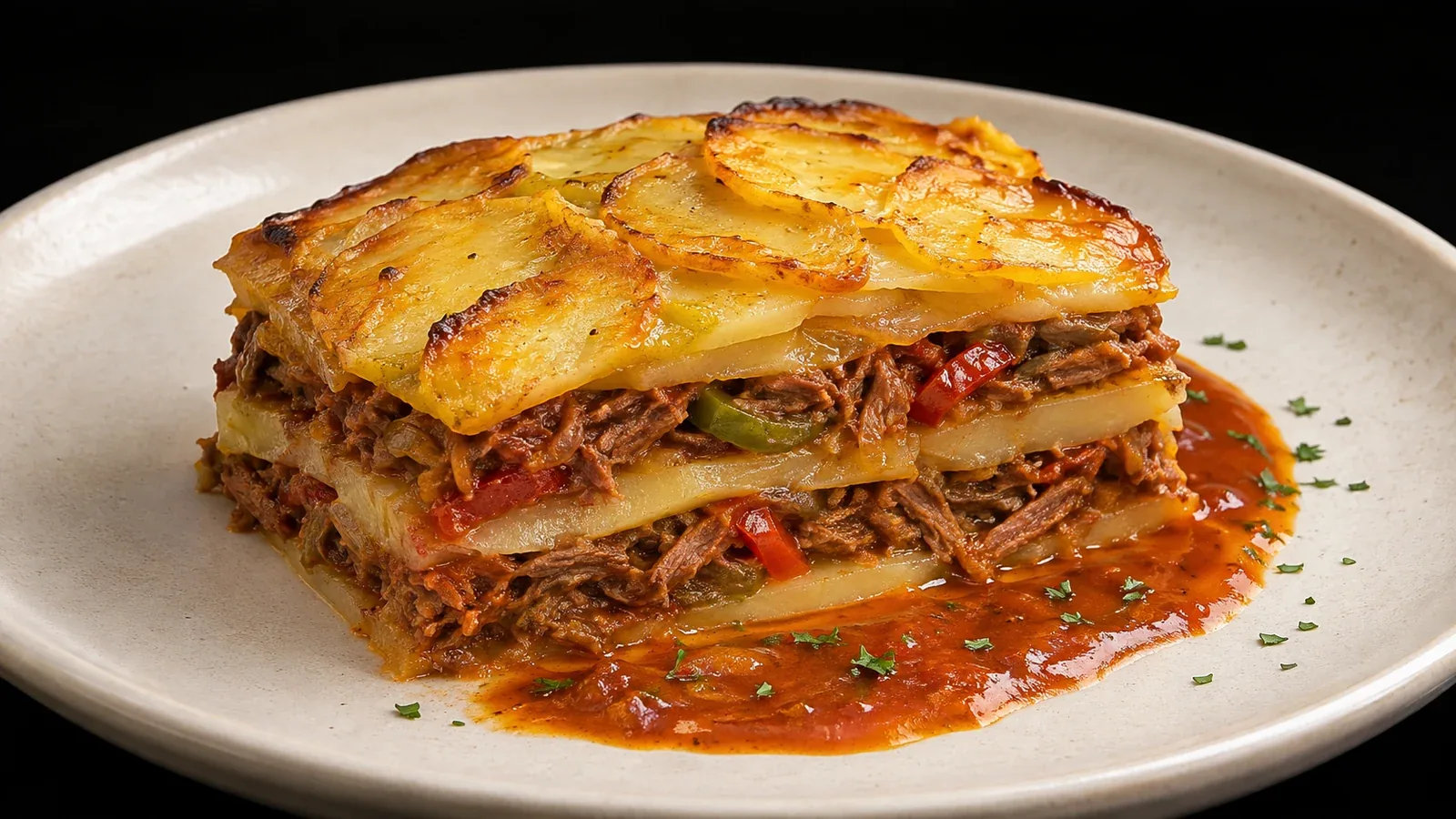
Illustrative image generated with AI, not a photo of the cooked dish.
Concept: slow-cooked bifes a la criolla remain recognizable in fork-tender beef, potatoes soaked in cooking juices, and the sweetness of onion and bell pepper sharpened by tomato. Four portions with visible layers bring those flavors together, with a moist, tender center and a golden potato top.
Twist: the braised beef is shredded and layered with thin potato slices; baking them together infuses the layers, and gentle pressing during chilling allows clean portions to be cut. Separating the cooking juices controls moisture in the filling, and those juices return as a sauce. Final browning concentrates the textural contrast on the surface, while a little vinegar and parsley balance the richness and sweetness of the long cooking.
Special equipment: 4 l ovenproof casserole with a lid; metal mold measuring 24 × 20 cm and at least 5 cm deep; mandoline with a guard; probe thermometer; container for an ice bath and a plate for pressing
Ingredients
Beef and criollo vegetables
- 800 g boneless beef chuck, trimmed of tough tendons and excess exterior fat, cut into 5–6 cm pieces.
- 200 g peeled onion, thinly sliced lengthwise.
- 150 g trimmed red bell pepper, cut into 5 mm strips.
- 100 g trimmed green bell pepper, cut into 5 mm strips.
- 400 g ripe plum tomatoes, stems removed, chopped with their juices.
- 8 g peeled garlic, chopped.
- 30 ml olive oil, divided into 20 ml for the beef and 10 ml for the vegetables.
- 120 ml dry white wine.
- 400 ml unsalted beef stock, plus hot water to adjust the level if needed.
- 3 g sweet paprika.
- 1 g dried oregano.
- 1 bay leaf.
- 10 ml red wine vinegar.
- Fine salt and black pepper, to taste.
Potato layers and assembly
- 800 g peeled potatoes suitable for baking, weighed after peeling.
- 45 g butter, divided into 10 g for the mold, 25 g for the layers and 10 g for the final browning.
- Fine salt, to taste.
Finishing
- 8 g fresh parsley leaves, washed and thoroughly dried.
Method
Beef and criollo vegetables
- Brown in batches. Heat a conventional oven to 160 °C (320 °F). Pat the beef dry, season moderately with salt and brown in the 20 ml oil in a hot casserole, in 2 batches, about 8–10 minutes per batch. Allow a crust to form on each side before moving it; the fond should be brown, with no black patches. Remove the beef.
- Criollo base. Reduce to medium heat, add the remaining 10 ml oil and cook the onion and both bell peppers for 12–15 minutes, until softened and beginning to brown at the edges. Add the garlic and cook for 1 minute. Add the paprika and oregano, stir for a few seconds and immediately add the wine so the paprika does not burn. Scrape up the fond and reduce the wine by approximately half, 3–5 minutes.
- Braise. Add the tomatoes, stock and bay leaf; return the beef with its juices. The liquid should come approximately halfway to two-thirds up the pieces: adjust with hot water if the shape of the casserole requires it. Bring to a gentle simmer, cover and place in the oven for 2½–3½ hours, checking from 2½ hours and turning the pieces halfway through cooking. Maintain very gentle bubbling; lower the oven temperature if it boils hard. Add water only to prevent the bottom from drying out. The beef is ready when two forks separate the fibers effortlessly; if it resists, continue in 20-minute intervals.
- Separate the juices. Remove the beef, discard the bay leaf and pour the vegetables and liquid through a strainer over a container, without crushing or pressing. Keep both the drained vegetables and the juices. Spoon off any free fat floating on top. Shred the beef while still hot into short, thick strands; remove any cartilage or tendons that have not softened. Keep the beef and vegetables covered and hot while finishing the sauce.
- Sauce and filling moisture. Reduce the juices at a moderate boil to 320 ml, with a lightly coating consistency; depending on evaporation during braising, this may take 10–20 minutes. If there is already less liquid or the flavor is too intense, top up with hot water to that volume. Measure 180 ml, mix with the beef and vegetables and cook together for 3–5 minutes, until the juices cling to the strands and no puddle remains when the casserole is tilted. The filling should stay glossy and moist rather than dry. Reserve the remaining 140 ml as sauce, add the vinegar to it and adjust the salt and pepper. If the filling has to wait, keep it above 60 °C (140 °F) and assemble promptly.
Potato layers and assembly
- Mold and slicing. Increase the oven to 170 °C (340 °F). Line the base and two sides of the 24 × 20 cm metal mold with a wide strip of baking parchment that will allow the cold block to be lifted out. Grease the parchment and inner surfaces with the 10 g butter. Slice the potatoes 1.5–2 mm thick with a mandoline and guard; do not rinse after slicing, as their starch helps bind the slices. Slice them once the filling is ready to avoid oxidation and waiting.
- Three potato strata. Melt the 25 g butter intended for the layers. Divide the potatoes into 3 parts and the hot filling into 2 parts. Cover the base with one-third of the potatoes, overlapping the slices without gaps; distribute one-third of the melted butter and a little salt between them. Spread half the filling in an even layer. Repeat with potatoes, butter and salt, then the remaining filling, and finish with the last potatoes, butter and salt. Press gently with a spatula to remove air pockets. Total height must be no more than 4 cm; if the actual mold is smaller, divide everything between two shallow metal molds and keep that thickness.
- Bake together. Cover with baking parchment touching the surface and seal with foil. Bake at 170 °C (340 °F) for 75–95 minutes, on a baking sheet. Check from 75 minutes with a thin skewer in the center: it should pass through every layer without resistance or a crisp sensation. If the potatoes are still firm, cover again and continue in 10-minute intervals. Do not seek browning yet; the top should be cooked, flexible and moist.
- Gentle pressing. Remove the foil and keep a clean sheet of parchment touching the surface. Place a flat metal plate smaller than the mold on top, with a clean 400–500 g weight spread across the surface. It should only settle the layers; if filling is squeezed out at the sides, reduce the weight. Begin cooling immediately, without a prolonged hot rest.
- Controlled cooling. Place the mold in a bath of water and plenty of ice, keeping the water below the rim so it cannot enter the food. Replenish the ice and move the water around the mold; check the center with a clean probe. Cool from cooking temperature to 60 °C (140 °F) in less than 30 minutes, from 60 to 21 °C within 2 hours, and from 21 to 5 °C within another 2 hours, taking no more than 4 hours for these last two stages. Move it to the refrigerator during this process only if probe readings confirm that it maintains this cooling curve. Cool the sauce separately in a shallow container over ice, following the same criteria. These are the guidelines in ANMAT's 2024 manual, pp. 49–50. If they are not met, do not keep the batch for the following day.
- Rest and cut. Once the center is at 5 °C or below, cover and keep under the gentle weight for 8–12 hours in the refrigerator. Remove the weight and top parchment. Lift the block by the bottom parchment, transfer to a board and cut into 4 rectangles approximately 12 × 10 cm, wiping the knife between cuts. If two molds were used, divide their contents into four equivalent portions. Keep the portions chilled until they go into the oven.
- Reheat and brown. Space the four portions on a parchment-lined baking sheet, keeping the original top facing up, and cover loosely with foil. Heat at 170 °C (340 °F) for about 35–50 minutes, checking from 30 minutes, until they reach at least 74 °C (165 °F) in the center, following the ANMAT reheating guidance cited above. Remove the foil, brush the top with the remaining 10 g butter, melted, and brown under a hot grill or broiler for 3–5 minutes, watching closely: look for toasted edges and defined slices without burning the butter. Timing is approximate; check the hot center before broiling. Rest for 2 minutes before lifting each portion with a wide spatula.
Finishing
- Sauce and herb. Heat the 140 ml sauce in a small saucepan to at least 74 °C (165 °F), stirring to make it uniform. If it thickened in the refrigerator, loosen with a little hot water, keeping approximately the intended volume. Finely chop the parsley just before serving. Taste a drop of sauce with a strand of filling: the vinegar should brighten the tomato without dominating.
The dish
Use four wide, shallow, light-colored ceramic plates, warmed beforehand. Lift each rectangle with a wide spatula and place it slightly off-center, with a cut face toward the diner to show the three potato strata and two layers of beef with onion and bell pepper. Divide about 35 ml hot sauce per plate in a crescent beside the base, leaving one side uncovered so the layers remain visible. Avoid pouring sauce onto the golden top. Scatter the chopped parsley over the sauce and a small part along the edge of the mille-feuille without concealing it. Serve immediately: the finished plate combines golden potatoes, reddish-brown filling with bell pepper and onion strips, glossy sauce and a green accent; it should yield to a fork and allow potatoes, beef and juices to come together in each bite.
Key points
- Choose beef suitable for braising and cook until yielding: a lean quick-cooking cut will not produce the same texture.
- Drain the vegetables and measure the juices added to the filling; free liquid makes the layers slide.
- Slice the potatoes uniformly, retain their starch and check that every layer is tender before cooling.
- Keep the block shallow, monitor cooling with a probe and press gently; chilling sets the shape and does not replace cooking.
- Reheat the center before browning the top and serve the sauce alongside to preserve the contrast.
Pairing
A young Cabernet Franc with fresh acidity and restrained oak complements the bell pepper and beef without overwhelming the tomato. Without alcohol, light cold black tea with a slice of lemon, unsweetened.
Notes
- Storage: the best window is to finish the mille-feuille the day after making it. If cooling was verified and it is kept at 5 °C or below, use the block and sauce within 48 hours of cooking; this is a prudent quality window, not a guarantee independent of handling. Reheat only the portions that will be served, and only once. Freezing the block is not proposed, as the potatoes may lose texture.
- Alternative cut: boneless beef shoulder can be used in the same weight and piece size; check that it shreds easily rather than assuming a fixed time.
- First cooking trial pending: record the actual filling yield, firmness after reheating, cooling curve and time needed to heat the center. Published times are design ranges rather than measurements from a physical cooking trial.