Signature · 4–5 h including chilling and rests · Serves 4
Cotoletta alla Milanese 2.0
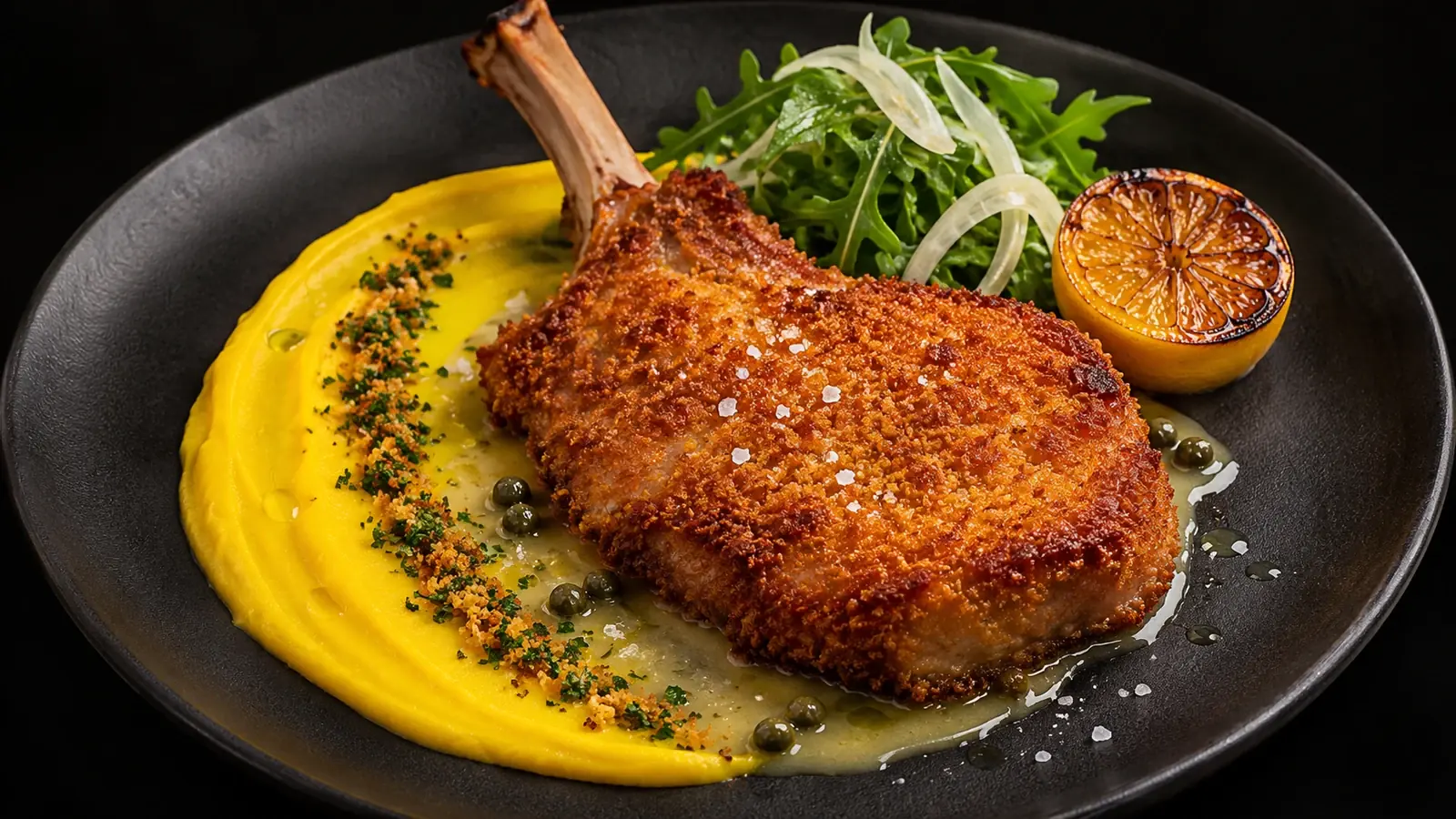
Illustrative image generated with AI, not a photo of the cooked dish.
Kitchen test pending
It keeps the elements that define the cotoletta alla milanese: a thick bone-in veal chop, a crunchy breading, the final cooking in clarified butter and lemon as the acidic counterpoint. The aim is a very crisp, light crust, with a deep flavor of butter and Parmigiano, over pink, juicy veal from edge to edge.
The twist is a sous vide precook at 55 °C (131 °F), followed by an ice chill: the thick chop is cooked uniformly and the frying only has to brown the breading and reheat the center, with no risk of overcooking and with a good part of the mise en place solved ahead. Around it, a silky potato and saffron cream evokes the Milanese risotto, a light lemon and caper sauce brings acidity without wetting the crust, the crisp gremolata adds texture and the arugula, fennel and burnt lemon give freshness and bitterness.
Special equipment: sous vide circulator and vacuum sealer; mandoline; kitchen thermometer
Ingredients
Veal cotoletta
- 4 bone-in veal chops, 3.5–4 cm thick and 400–450 g each
- Fine salt: 0.8–0.9% of the weight of the meat (14–16 g in total; 3.5–4 g for a 425 g chop)
- 2 g black pepper
- 10 ml mild olive oil
- 4 sprigs fresh thyme
Potato and saffron cream
- 600 g peeled starchy potato
- 500 ml clear chicken stock
- 250 ml whole milk
- 0.30–0.40 g saffron threads
- 80 g mascarpone
- 60 g grated Parmigiano Reggiano
- 40 g unsalted butter
- Fine salt and white pepper, as needed
Crisp gremolata
- 60 g panko
- 20 g fresh parsley, chopped
- Zest of 2 lemons
- 1 small garlic clove, very finely chopped
- 20 ml extra virgin olive oil
- Fine salt, as needed
Lemon and caper sauce
- 250 ml clear veal or chicken stock
- 80 ml dry white wine
- 50 ml fresh lemon juice
- 40 g small capers
- 80 g cold unsalted butter, in cubes
- Finely grated zest of ½ lemon
- Black pepper and salt, only if needed
Arugula and fennel salad
- 100 g baby arugula
- 1 large fennel bulb
- 20 g small capers
- 30 ml lemon juice
- 60 ml extra virgin olive oil
- 5 g Dijon mustard
- 3 g honey or sugar
- Fine salt and black pepper, as needed
Breading
- 120 g all-purpose flour
- 5 eggs
- 30 ml water
- 180 g panko
- 120 g dried grated brioche
- 80 g Parmigiano Reggiano or Grana Padano, finely grated
- Finely grated zest of 2 lemons
- 4 g fresh thyme, finely chopped
Frying
- 600–700 g clarified butter, store-bought or made from about 900 g of butter
- 50 ml neutral oil, optional
- Flaky salt
Finishing
- 2 lemons
- Extra virgin olive oil and flaky salt, as needed
- Small parsley leaves, optional
Method
Veal cotoletta
- Trimming. Clean the bone if you want a French-rack look, remove the overly thick outer membranes and keep the thin peripheral fat. Check that the pieces are of similar thickness. Do not pound or flatten the meat: the idea is a thick, juicy cotoletta.
- Pre-salting. 45 to 60 minutes before the sous vide, salt the chops with 0.8–0.9% of their weight, spreading the salt evenly, and add a minimal amount of pepper.
- Sous vide. Preheat the bath to 55 °C (131 °F). Vacuum-seal each chop in an individual bag with a sprig of thyme and a few drops of olive oil; the oil only helps contact with the bag and can be omitted, and no butter is needed. If the tip of the bone could puncture the bag, protect it with a folded piece of parchment paper. Cook 1 h 45 min – 2 h: the center stays pink, tender and juicy, with room for the frying to raise the temperature a little. For a more cooked doneness, use 57–58 °C (135–136 °F) for 1 h 30 min – 1 h 45 min.
- Chilling. Immediately move the bags to a large container with water and plenty of ice and chill them 15–20 minutes, until the surface of the meat feels clearly cold. This step allows the breading to be fried intensely without overcooking the inside. If the meat is used later, refrigerate it right away.
- Drying. Open the bags and remove the thyme, the juices and the coagulated bits from the surface. Dry the meat extremely well with paper towels: a wet surface keeps the breading from adhering, makes it come off in patches, generates steam and loses crispness. Arrange the chops on a rack and refrigerate them uncovered 15–30 minutes.
Potato and saffron cream
- Infusion. Heat 80 ml of the stock to 70–80 °C (158–176 °F), without boiling. Add the saffron, cover and infuse 15–20 minutes.
- Cooking. Cut the potatoes into regular cubes and cook them with the rest of the stock and the milk, over moderate heat, 18–22 minutes, until completely tender.
- Blending and refining. Drain the potatoes, keeping the liquid. Blend them with the saffron infusion, mascarpone, Parmigiano and butter, adding cooking liquid little by little until a thick cream: it should form a stable teardrop on the plate without looking like a stiff purée. Pass through a fine sieve and adjust the salt and white pepper. Keep it between 60 and 65 °C (140–149 °F), without letting it boil again once the dairy and cheese are in.
Crisp gremolata
- Toasting. Heat the olive oil over medium-low heat, add the garlic and cook it 20–30 seconds, without browning. Add the panko and sauté, stirring constantly, until it takes on a light golden color. Remove from the heat at once.
- Finishing. When it is lukewarm, add the lemon zest, parsley and a pinch of salt. If the parsley goes into a very hot pan, it loses color and aroma. Store dry, at room temperature.
Lemon and caper sauce
- Reduction. Reduce the wine with the stock over medium heat to 140–150 ml. Add the capers, cook 1 minute, add the lemon juice and remove from the heat. This base can be made several hours ahead.
- Mounting. At the moment, with the base hot but not boiling, whisk in the 80 g of cold butter in cubes, moving the pan or whisking constantly. Add the zest and pepper, and taste before salting. It should be glossy, light, slightly acidic and fluid, never a heavy butter sauce. Keep it warm.
Arugula and fennel salad
- Vinaigrette. Mix the lemon juice with the mustard, honey, a pinch of salt and pepper. Add the 60 ml of oil little by little, whisking, to a light emulsion.
- Fennel. Remove any damaged outer leaves, cut the bulb lengthwise and slice it on a mandoline at 1 mm. Leave it 10 minutes in very cold water for crispness, drain and dry it completely.
- Assembly. Right before serving, mix the arugula, fennel and capers, and dress with little vinaigrette: it should be only glossy, never soaked. Adjust the salt.
Breading
- Brioche crumbs. 12 to 24 hours ahead, cut the brioche into slices and let it dry completely, or dry it in the oven at 90–100 °C (195–212 °F) for 45–60 minutes. Cool it, process it to a fine but not powdered crumb and store it in an airtight container.
- Mix and station. Mix the panko, grated brioche, Parmigiano, lemon zest and chopped thyme, making sure the zest is well distributed. Set up three containers: the flour; the eggs beaten with the water, without incorporating too much air; and the crumb mix.
- Breading. Work one chop at a time: pass it through a very thin layer of flour and shake off all the excess; dip it in the egg and let it drain; pass it through the crumb mix and press gently with your hands. For a thicker crust, repeat the egg and crumbs once.
- Resting. Arrange the chops on a rack and refrigerate them uncovered 20–30 minutes. The rest stabilizes the breading, slightly hydrates the flour, improves adhesion and reduces shedding in the frying. The breaded cotoletta is preferably fried the same day.
Frying
- Clarified butter. If not store-bought, melt about 900 g of butter over very low heat, without stirring, and skim off the foam. When the milk solids settle at the bottom, carefully pour the clear fat into another container and discard the sediment. It yields 700–750 g; keep it in the refrigerator.
- Temperature and amount. In a wide, heavy 28–32 cm pan, heat the butter, with the oil if used, to 175–180 °C (347–356 °F). It should cover about half the thickness of the chop so it browns evenly. Since the meat is already cooked, the frying only browns the breading, reheats the center and develops the aroma of butter and nuts.
- Cooking. Fry one chop at a time, 60–90 seconds per side, moving the pan gently, basting the surface constantly with the hot butter, browning the edges and watching the area next to the bone. The color wanted is a deep, even, glossy gold, with the center at 56–58 °C (133–136 °F) depending on the doneness desired.
- Draining and resting. Remove right away to a rack, without leaving it long on paper towels. Salt with flakes and rest 3–4 minutes, uncovered.
Finishing
- Burnt lemon. Cut the 2 lemons in half and dry the cut surface. In a very hot pan, set them cut side down and cook without moving 2–3 minutes, to an intense caramelization.
The dish
Use wide dark ceramic plates —matte black, graphite gray or stone—, only slightly warm and not too hot. With the back of a spoon, spread 60–70 g of saffron cream in a teardrop or wide arc along one side. Set the cotoletta partly over the cream, with the bone on the diagonal toward the top of the plate and the meat clearly visible. Spoon 20–25 ml of lemon and caper sauce around the meat, with a little under one end if you like, but never coating the breading: the priority is crispness. Draw a thin line of gremolata next to the cream, 8–10 g per plate, with a pinch on one end of the meat right before serving. Place 25–30 g of salad near the base of the bone, with volume and without compressing, and half a burnt lemon on the side. Finish with a few drops of olive oil, flaky salt and, if using, small parsley leaves, and serve immediately. Final look: golden, glossy crust over the yellow arc of saffron, capers and clear sauce around, the green of the arugula and the white of the fennel next to the bone, and the caramelized lemon as a dark note.
Key points
- Dry the meat thoroughly after the sous vide: moisture is what lifts and softens the breading.
- Chill the chop before breading. If breaded fresh out of the bath, the frying takes the interior to an excessive temperature.
- Control the butter between 175 and 180 °C (347–356 °F): below 170 °C (338 °F) it absorbs fat and loses crispness; above 185 °C (365 °F) the breading burns before the center heats.
- Fry one chop at a time: two large pieces lower the fat temperature too much.
- Do not cover the crust with sauce and dress the salad at the last moment: arugula and fennel lose their texture quickly.
Pairing
A Franciacorta Satèn Brut: its acidity and fine bubbles balance the butter, breading and Parmigiano, and go with the lemon, saffron and veal. As alternatives, a Lugana DOC, a Soave Classico, a lightly oaked Italian Chardonnay or a Pinot Bianco from Alto Adige.
Notes
- Version without sous vide: use chops 3–3.5 cm thick, bread them raw and fry them in clarified butter at 165–170 °C (329–338 °F) for 4–6 minutes per side, depending on thickness, basting constantly. Remove them with the center at 54–56 °C (129–133 °F) and rest them before serving. The result is somewhat more traditional, with a more direct relationship between the frying and the meat.
- Storage: sous vide chops not used right away are chilled in an ice bath and refrigerated at once at 5 °C (41 °F) or below; do not leave them at room temperature. The saffron cream can be made ahead and gently reheated; the gremolata is stored dry, and the salad is assembled only at serving.
- Intended result: meat pink from edge to edge, with no marked gray band; very crisp breading, dry, adhered and with the aroma of butter and Parmigiano; smooth, silky, barely fluid cream, with the saffron present but not dominant; acidic, salty, glossy sauce, and a fresh, crunchy, slightly bitter salad.
- Equipment: besides the circulator and vacuum sealer, a heavy 28–32 cm pan, thermometer, rack, hand blender or blender, fine sieve, mandoline, microplane and a precision scale for the saffron are useful.
- Some commercial capers contain sulfites.