Signature · 2 hours 15 minutes on the day of service, plus 1 hour 30 minutes the day before · Serves 4
Costoletta alla milanese, riso al salto and burnt lemon
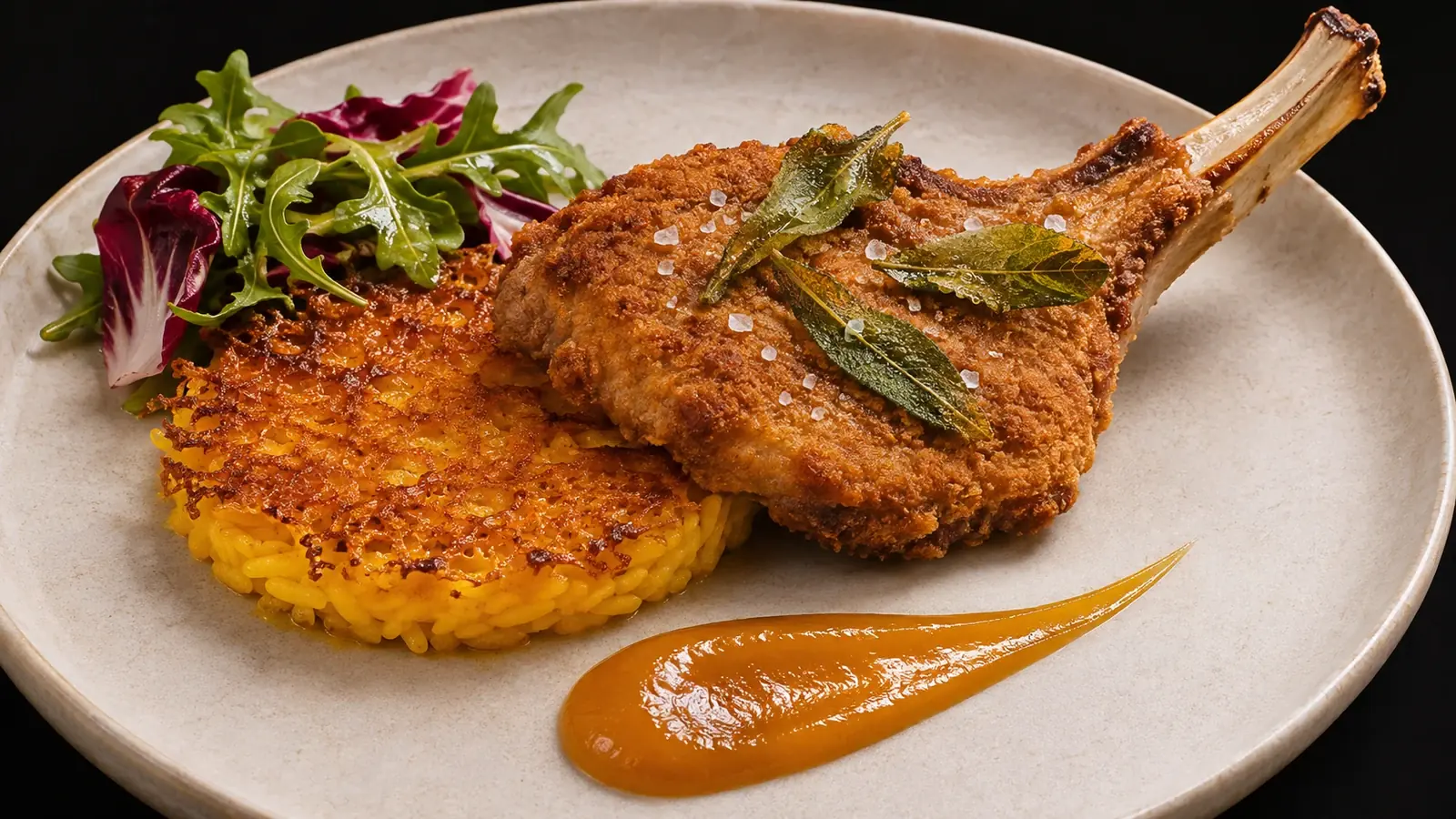
The root is the classic costoletta milanese: bone-in cutlet of young veal, breaded in egg and breadcrumbs and fried in clarified butter, with lemon on the side. The cut, the thickness, the simple breading and the doneness control of the Essential version stay intact. The dish aims for everything that accompanies the meat to come from the same city and for every bite to balance crunch, noble fat, acidity and bitterness.
The twist is in what surrounds the meat. The potatoes are replaced by riso al salto, the Milanese way of using up yesterday's yellow risotto: a disc of saffron risotto fried in butter until it forms an openwork, crisp crust, with the center still creamy. The lemon wedge becomes a burnt lemon purée: the peel, blanched three times and confited, brings a tamed bitterness, and the juice of charred lemons adds a toasted note that talks to the fried breading. At the end of the frying, the meat is basted with foaming butter and sage, which give a hazelnut aroma without softening the crust. The bitter leaves, dressed with that same burnt juice, cut the fat.
Special equipment: thin-probe thermometer and frying thermometer; two 30–32 cm pans with a useful base of at least 26 cm; 26–28 cm nonstick pan; 10 cm rings; blender or hand blender; fine sieve
Ingredients
Riso al salto (risotto the day before)
- 750 ml clear chicken or veal stock, low in salt, hot
- 0.15 g saffron threads, about 1 sachet
- 15 g unsalted butter, for the sofrito
- 50 g white onion, very finely chopped
- 180 g Carnaroli rice
- 50 ml dry white wine
- 25 g cold unsalted butter, in cubes, for finishing
- 30 g finely grated Parmigiano Reggiano
- Fine salt, to taste
- 5 ml neutral oil, for the rings and the paper
- 40 g clarified butter, for frying
Burnt lemon
- 3 thick-skinned, unblemished lemons, about 450 g in total
- 60 g sugar
- 100 ml water
- 30 ml extra virgin olive oil
- 1 g fine salt
Costoletta
- 4 bone-in rib chops from a young veal rack, 250–320 g each and 18–22 mm of meat thickness; about 1.2 kg in total
- 8 g fine salt; adjust to about 7 g per kg of bone-in cut
- 4 medium eggs, about 200 g without shell
- 220 g dry white breadcrumbs, finely ground, with no seasoning or added sugar, passed through a medium-mesh sieve
- 700 g clarified butter, to fill the two pans
- 60 g unsalted butter, in cubes, for the final basting
- 12 fresh sage leaves, dry and whole
- Flaky salt
Bitter leaves
- 40 g arugula
- 40 g radicchio, in small leaves or wide strips
- 15 ml extra virgin olive oil
- 10 ml burnt lemon juice, reserved from making the purée
- 1 g fine salt
Method
Riso al salto
- Yellow risotto. Dissolve the saffron in 50 ml of the hot stock and infuse for at least 15 minutes. Keep the rest of the stock just below a boil. In a wide saucepan, melt the 15 g of butter over medium-low heat and sweat the onion 4–5 minutes, until translucent and soft, without color. Raise to medium heat, add the rice and toast it for 2 minutes, stirring, until the grains are hot to the touch and with translucent edges. Deglaze with the wine and let it evaporate completely. Add the stock one ladle at a time, waiting for it to be absorbed before adding the next, and stir frequently. At 10 minutes, add the saffron with its liquid. Cook a total of 16–17 minutes, until the grain is firmly al dente, with a minimal white dot in the center: it finishes cooking when fried. Some stock may be left over.
- Finishing denser. Off the heat, add the cold butter and the Parmigiano, beating vigorously for 1 minute. Adjust the salt. Unlike a risotto to be served, this one should not be all'onda: it must be compact, with no liquid running on the plate, because that is what later allows the discs to be formed. It yields about 520 g.
- Forming and chilling. Grease four 10 cm rings and a tray lined with parchment paper with the neutral oil. Divide 130 g of risotto per ring, press with the back of a wet spoon to an even height of 1.3–1.5 cm and remove the rings. Leave the tray uncovered, without stacking, in a cool place until it stops steaming, no more than 30 minutes, and move it to the refrigerator. The cooked rice must go from 60 to 21 °C (140 to 70 °F) in 2 hours or less and to 5 °C (41 °F) in the following 2 hours; discs of this thickness do this in the refrigerator with no difficulty. Cover once cold. Keep at 5 °C (41 °F) or below and fry within 24 hours.
- Frying al salto. Fry in two batches of two discs. In the nonstick pan, heat 20 g of clarified butter over medium heat. Lay down the cold, firm discs without moving them, and cook 5–6 minutes, until the base forms a deep golden crust with openwork edges. Turn them with a wide spatula and cook 4–5 minutes more. Measure the center of each disc with the probe: it must reach 74 °C (165 °F) or more, because it is cooked, chilled and reheated rice. If the crust is ready and the center has not reached it, finish in the oven at 160 °C (320 °F) for 4–5 minutes and measure again. Repeat with the second batch and the remaining butter. Keep the discs on a rack in the oven at 100 °C (212 °F), uncovered, for up to 20 minutes.
Burnt lemon
- Blanching three times. Cut 2 lemons into quarters lengthwise and remove the seeds and the central white column, keeping the peel and pulp. Cover them with cold water, bring to a boil, boil 2 minutes and drain. Repeat twice more, always from cold water. This triple blanching is what removes the harsh bitterness of the white part and leaves a clean, pleasant one.
- Confit. Put the blanched quarters in a small saucepan with the sugar and the 100 ml of water. Cook covered over the lowest heat for 20–25 minutes, until the peel is translucent and breaks with a spoon, and the syrup has thickened and reduced to about 3 tablespoons. If it dries out sooner, add water 15 ml at a time.
- Burning the third lemon. Meanwhile, cut the remaining lemon in half. Heat the cast-iron pan over maximum heat, with no fat, and set the halves cut side down for 4–5 minutes, without moving them, until the surface is black and caramelized over almost its whole extent. Squeeze them and strain: about 25 ml of smoky, less acidic juice is obtained. Reserve 10 ml for the leaves.
- Processing. Blend the confited quarters with their syrup, 15 ml of the burnt juice and the salt until a smooth purée. With the motor running, add the olive oil in a thin stream until the purée is glossy and thick, with the texture of a mustard. Pass through a fine sieve. Taste: first the acidity should arrive, then the bitterness and at the end a sweetness that does not dominate. If it ended up too thick, loosen with water 5 ml at a time. It yields about 170 g and 15–20 g are used per plate. Keep covered in the refrigerator at 5 °C (41 °F) or below; for quality, it keeps well for 5 days.
Costoletta
- Conditioning and salting. Pat the chops dry and remove the thick outer membranes. If the peripheral membrane pulls the piece, make two or three small cuts in it without reaching the muscle. Even out any protrusion with a few gentle taps of the flat side of the mallet, between papers, keeping 18–22 mm. Spread the 8 g of salt on both sides and refrigerate 45–60 minutes on a rack, with a tray underneath and away from other foods. Keep a thin strip of clean fat and the bone attached.
- Breading. When the riso al salto is in the oven, dry any visible moisture from the meat, without washing it. Beat the eggs until combined, without making foam. Pass each chop through egg, let it drain well and cover with the sifted crumbs, pressing gently so it also adheres at the edges. Shake off the excess: with sifted crumbs the crust is thinner and even, and browns without burning at the thick spots. The bone can stay clean. Set the pieces on a tray without overlapping and fry within the next 20 minutes. Discard the egg and crumbs that touched raw meat.
- Frying. Divide the 700 g of clarified butter between the two pans and heat it to 165–170 °C (330–340 °F), with about 7–10 mm of depth before adding the meat. Add two chops per pan only if they fit with space between them and the fat quickly returns to 160 °C (320 °F); if not, one per pan, in two services. Keep the fat at 160–170 °C (320–340 °F), with active bubbling, adjusting the heat. Cook about 4–5 minutes on the first side and turn carefully. Start checking the center at 6 minutes total.
- Basting with butter and sage. When the second side has about 2 minutes and the center reads around 55 °C (131 °F), add to each pan 30 g of butter in cubes and 6 sage leaves. Tilt the pan and, with a large spoon, baste the meat continuously with the foaming butter for 45–90 seconds, focusing on the thick edges and next to the bone. The foam should go from white to light hazelnut and smell of nuts. If it darkens toward brown, lower the heat and stop basting. Remove the sage leaves when translucent and crisp and drain them on paper towels.
- Doneness and rest. Insert the probe from the side to the center of the thickest part, without touching the bone, and measure the muscle near the bone too. Take the lower reading. When the center reaches 63–65 °C (145–149 °F), move the meat to a clean rack and hold the center at 63 °C (145 °F) or more for 3 minutes, checking with the probe, uncovered. If it drops below 63 °C (145 °F) before completing that time, return to gentle heat and restart the count. If the crust browns before the center reaches the target, finish on a rack in the oven at 140 °C (285 °F), removing the riso al salto first, and measure every 2 minutes. The crust should be hazelnut-colored, dry and adhered. The interior color does not replace the thermometer.
Bitter leaves
- Preparing and dressing. Wash the leaves with potable water and dry them very well. Mix the 10 ml of burnt lemon juice with the salt and olive oil. While the meat rests, dress the leaves only until they shine and leave in the bowl any dressing that does not adhere.
The dish
Use large flat plates, 28–30 cm, warmed to about 50 °C (122 °F). Place the riso al salto disc slightly left of center, with its golden, openwork side up. Lay the whole costoletta to its right, with the inner edge resting 1–2 cm over the disc, so both crusts touch dry and the plate gains height, and with the bone up and to the right, accessible for cutting. With the back of a spoon, draw in the free space below a teardrop of 15–20 g of burnt lemon, without touching the crust or the rice. Build at top left a loose mound of bitter leaves, leaning against the edge of the disc but not on top, so the rice does not get damp. Finish with 3 crisp sage leaves on the costoletta and a few flakes of salt on the crust, and serve immediately. Final look: the thin, matte hazelnut crust of the meat beside the saffron yellow of the rice, with its toasted lace; the dark, glossy amber of the lemon as the only wet stroke; the green and purple of the leaves as a fresh counterpoint, and the sage as an aromatic note.
Key points
- The riso al salto only works with a compact, well-chilled risotto that goes into the pan cold. To serve it, the center must reach 74 °C (165 °F) or more.
- Respect 18–22 mm of meat and an even thickness, and control the fat (160–170 °C / 320–340 °F) and the center (63 °C / 145 °F or more for 3 minutes) separately. The color of the breading does not indicate doneness.
- Blanch the lemon three times, always from cold water. With fewer blanchings, the purée is bitter and harsh instead of bitter and clean.
- The butter basting is brief and stops when the foam is light hazelnut: burnt butter on the crust gives an acrid flavor and darkens it.
- Nothing wet touches the crusts: lemon, leaves and dressing go to the side, and the meat rests on a rack, uncovered.
Pairing
A traditional-method brut nature sparkling wine, such as a Franciacorta or a long-aged Patagonian sparkling: the bubbles and acidity cleanse the butter, and the yeast notes go with the fried breading and the saffron. Without alcohol: very cold sparkling water with a twist of lemon peel.
Notes
- Homemade clarified butter. Slowly melt 1.1 kg of unsalted butter, without boiling hard. Skim off the foam and decant the clear fat, leaving the milk solids. It yields roughly 800–880 g; 740 g are needed. Do not brown the solids: a clean flavor is wanted, because the toasted note comes from the final butter basting. If prepared in advance, refrigerate it in a clean container, without assigning it a long storage time.
- Storage and reheating. The ideal is to fry and eat. If meat or riso al salto is left over, cool in shallow containers, without stacking: reach 60 °C (140 °F) in under 30 minutes, from 60 to 21 °C (140 to 70 °F) in 2 hours and from 21 to 5 °C (70 to 41 °F) or below in the following 2 hours. Preferably consume within 24 hours and reheat only once on a rack at 180 °C (355 °F) to 74 °C (165 °F) at the center. Riso al salto that has been reheated is not stored again. Discard any dressed leaves that are left over.
- Doneness criterion. The one from the Essential version is kept: 63 °C (145 °F) for 3 minutes, published by ANMAT, with control of the coldest point in whole veal chops, fried and eaten immediately. It is not extrapolated to ground, stuffed or injected meat. As support, the US recommendation for veal chops is the same combination.
- Stock. If using store-bought stock, choose a low-sodium one and reduce the salt in the risotto: the Parmigiano and the frying already add salt.