Essential · 1 hour 45 minutes, with simultaneous tasks · Serves 4
Costoletta alla milanese with golden potatoes and bitter leaves
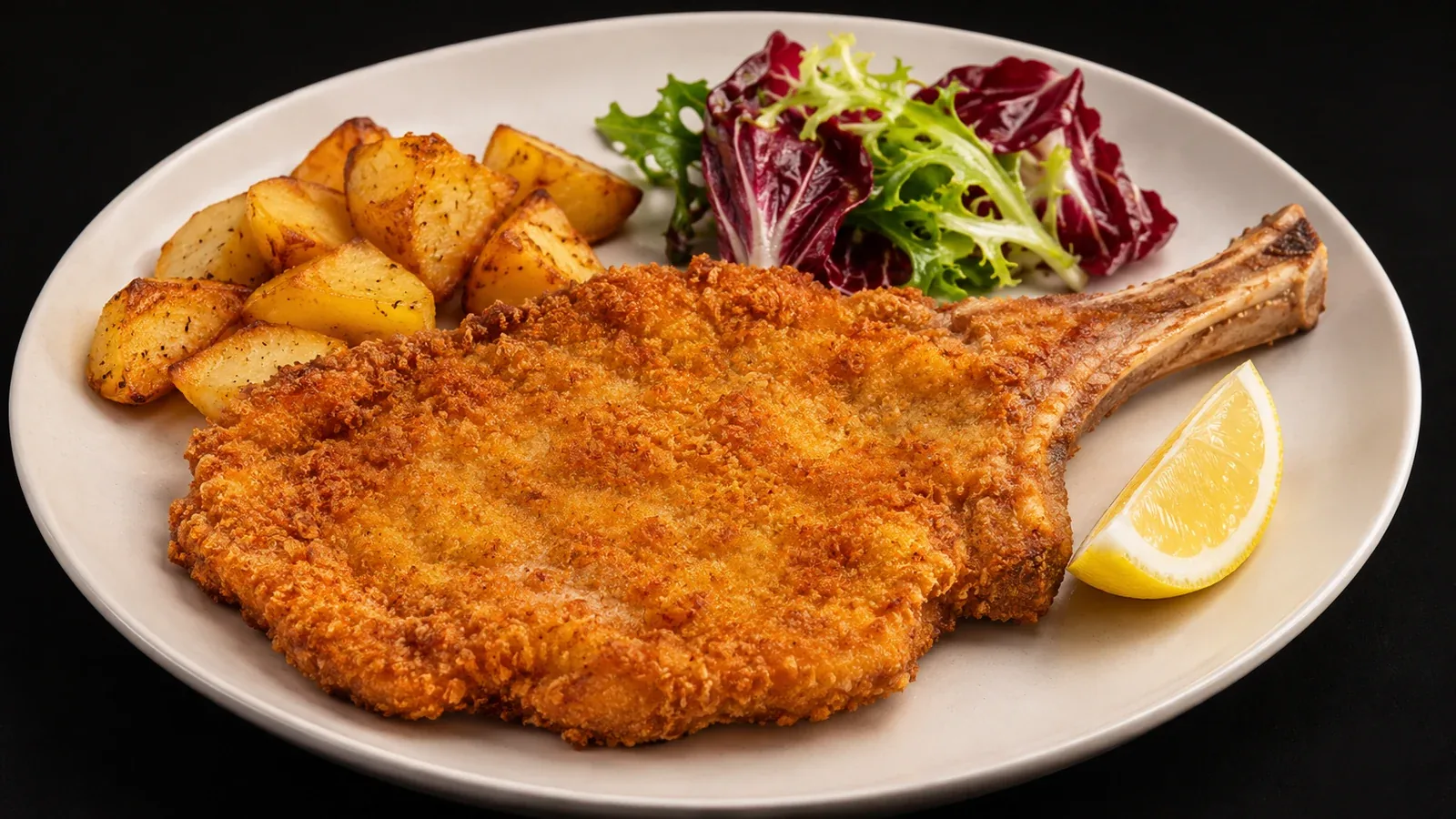
Bone-in veal rib chop, tender and juicy meat and a thin crust of egg and breadcrumbs, fried in clarified butter. Small potatoes, crushed and browned with rosemary, bring a creamy interior; the arugula and radicchio with lemon balance the fat with acidity and a gentle bitterness.
The fine-dining intent lies in the selection of the meat, the control of the cooking and the contrast of the side. The pre-salting and the double cooking of the potatoes improve seasoning and texture. This version develops the traditional alternative chosen by the user, independently of the earlier vacuum recipe; the following parameters are an in-house formulation pending a physical test.
Special equipment: thin-probe thermometer and frying thermometer; two 30–32 cm pans with a useful base of at least 26 cm; oven and rack
Ingredients
Crushed rosemary potatoes
- 800 g small potatoes, about 35–45 mm in diameter, with thin skin and similar size.
- 2 l water for boiling the potatoes, or enough to cover them.
- 20 g salt for 2 l of water; keep 10 g per l if the volume changes.
- 40 g clarified butter.
- 6 g fine salt for roasting.
- 2 small rosemary sprigs.
- 2 garlic cloves in their skins, lightly crushed.
Bitter leaves and lemon
- 60 g arugula.
- 60 g radicchio, in small leaves or wide strips.
- 25 ml extra virgin olive oil.
- 15 ml lemon juice, from 1 lemon; save the rest of that fruit for another use.
- 1 g fine salt.
- 1 additional lemon, cut into 4 wedges for serving.
Costoletta
- 4 bone-in rib chops from a young veal rack, 250–320 g each and 18–22 mm of meat thickness; about 1.2 kg in total.
- 8 g fine salt for about 1.2 kg of chops; adjust to about 7 g per kg of bone-in cut.
- 4 medium eggs, about 200 g without shell.
- 220 g dry white breadcrumbs, fine to medium, with no seasoning or added sugar.
- 700 g clarified butter to fill the two pans; adjust if the geometry requires more fat to reach the stated depth.
Method
Crushed rosemary potatoes
- Boiling. Wash the potatoes and put them whole in the cold water with its salt. Bring to a gentle boil and cook about 18–25 minutes from when it begins to boil, until a thin tip reaches the center without resistance, but the skin holds its shape. Drain and let steam off for 5 minutes. While they boil, preheat the oven to 220 °C (430 °F), top and bottom heat, or 200 °C (390 °F) with fan.
- Crushing and roasting. Spread on a wide metal tray and gently crush each potato to about 15–20 mm in height, trying to keep it together. Spread the 40 g of clarified butter on both sides, the 6 g of salt, the rosemary and the garlic. Roast 30–40 minutes, turning once with a spatula when the base is firm and golden. They should have crisp edges and a creamy center. Remove the rosemary or garlic earlier if they begin to burn and discard them at serving.
- Coordinating with the meat. Try to have the potatoes finish just before frying. They can wait spread out, uncovered, up to 15 minutes in the turned-off oven with the door ajar; it is a short quality hold, not prolonged storage. If serving two batches, leave half of the potatoes to finish browning during the second frying.
Bitter leaves and lemon
- Preparing. Wash the leaves with potable water, drain and dry well. Mix the 15 ml of lemon juice with 1 g of salt and the 25 ml of oil. Keep leaves and vinaigrette separate in the refrigerator at 5 °C (41 °F) or below. Cut the second lemon into four wedges.
- Dressing. During the last moments of the meat's rest, toss the leaves with the vinaigrette, only until lightly glossy. Leave in the bowl any liquid that does not adhere; avoid taking it to the plate.
Costoletta
- Choosing the meat. Look for pieces of the same thickness, from a supplier who can confirm it is young veal. A chop from an adult animal can be tasty, but the breading and frying do not correct its toughness. The aging is left to the supplier; it is not improvised by leaving meat several days in a home refrigerator.
- Conditioning and salting. Pat the chops dry and remove thick outer membranes. Make two or three small cuts only in the peripheral membrane if it pulls the piece, without cutting the muscle. If there is a protrusion, even it out with a few gentle taps with the flat side of a mallet, between papers; keep 18–22 mm. Spread the 8 g of salt on both sides and refrigerate 45–60 minutes on a rack with a tray underneath, protected from other foods. Keep a small strip of clean fat and the bone attached.
- Breading. When the potatoes are close to done, dry any visible moisture without washing the meat. Beat the eggs until combined, without making foam. Pass each chop through egg, let it drain and cover with the breadcrumbs; press gently to adhere, including the edges of meat. Shake off the excess. The bone can stay clean. Set on a tray without overlapping; if you have to wait, refrigerate and cook within the following 20 minutes. Discard egg and crumbs that touched raw meat.
- Heating the fat. Divide the 700 g of clarified butter between the two pans and heat to 165–170 °C (329–338 °F). Look for about 7–10 mm of fat depth before adding the meat; the exact amount depends on the useful base. Adjust the load if needed. Use pans with walls high enough to contain the rise in level and the splatter. Prepare a clean rack over a tray, clean tongs for the cooked meat and warmed plates.
- Frying. Add two chops per pan only if they fit with space between them and the fat quickly recovers at least 160 °C (320 °F). If not, cook one per pan and serve in two batches. Keep the fat around 160–170 °C (320–338 °F), adjusting the heat; there should be active bubbling and the breading should brown progressively. Cook about 4–5 minutes on the first side and 3–5 on the second, turning carefully and basting the thick edges with the fat. Start checking the center at 6 minutes total; the clock guides but does not decide doneness.
- Checking the center. Insert a thin probe from the side to the center of the thickest part, without touching the bone. Also check the muscle near the bone and take the lower reading as the reference. When the center reaches 63–65 °C (145–149 °F), move to the rack. Hold the center at 63 °C (145 °F) or more for 3 minutes, checking with the probe during the rest, uncovered. If it drops below 63 °C (145 °F) before completing that interval, return to gentle heat and restart the count when it recovers the temperature. The breading should be hazelnut gold, dry and adhered; the interior color of the meat does not replace the thermometer.
- Correcting early browning. If the crust is already golden and the center is still below the target, finish on a rack in the oven at 140 °C (285 °F), checking every 2 minutes until reaching 63–65 °C (145–149 °F), and then complete the 3-minute interval at 63 °C (145 °F) or more. If there were potatoes in the oven, remove them first. It is an execution correction; with the thickness indicated, it is best to solve the cooking in the pan.
- Serving. Plate once the rest is complete. Do not stack, cover with foil or leave on damp paper. In two-batch service, cook the other two chops after removing the first and serve each pair fresh, with its half of the side; allow about 10–15 minutes between services.
The dish
Use wide flat plates, warmed. Place a whole costoletta with the bone toward one side, accessible for cutting, and spread the potatoes alongside, not under the breading. Add the dressed leaves in a small separate cluster, with no loose liquid, and a lemon wedge next to the meat. Leave the crust visible and dry; the diner adds lemon over the bite to be eaten. Serve immediately.
Key points
- Tenderness depends first on young veal, cut and aging; the salting helps to season and keep juiciness, but does not replace that choice.
- Respect 18–22 mm of meat and an even thickness: a much taller piece requires recalculating the cooking and may burn the breading before reaching the center.
- Dry well, drain the egg and leave an even coating; an excessive layer separates and dominates the meat.
- Control fat and center separately: 160–170 °C (320–338 °F) during the frying and at least 63 °C (145 °F) for 3 minutes at the center, without relying on the color of the breading.
- The service governs the crispness: rack, uncovered rest and wet leaves and lemon kept apart from the crust.
Pairing
A brut sparkling wine with fresh acidity goes with the butter and breading without covering the veal. Without alcohol, very cold sparkling water and a strip of peel from the lemon used in the kitchen.
Notes
- Homemade clarified butter. Slowly melt 1 kg of unsalted butter in a pot, without boiling hard. Skim off the foam and decant the clear fat, leaving the milk sediment; it yields roughly 750–800 g, depending on losses. Weigh the 740 g needed and reserve any excess. Do not brown the solids: a clean-flavored clarified butter is wanted, not toasted butter. If made in advance, refrigerate in a clean container and follow the cooling criterion below; do not assign long storage to an unverified home clarification.
- Storage and reheating. The ideal is to fry and eat. If there is leftover meat or potatoes, separate into shallow containers and cool without stacking: reach 60 °C (140 °F) in under 30 minutes, from 60 to 21 °C (140 to 70 °F) within 2 hours and from 21 to 5 °C (70 to 41 °F) or below in the following 2 hours. Keep at 5 °C (41 °F) or below and preferably consume within 24 hours as a quality window, conditioned on that cooling. Reheat only once on a rack at 180 °C (355 °F) to 74 °C (165 °F) at the center, starting to measure at 10 minutes; juiciness is lost compared with the first cooking. Discard leftover dressed salad. Do not leave perishables out of refrigeration more than 2 hours, or 1 hour if the room exceeds 32 °C (90 °F).
- Doneness criterion. The combination of 63 °C (145 °F) for 3 minutes published by ANMAT is adopted, with control of the coldest point in these whole veal rib chops, fried and eaten immediately. A center at 54–58 °C (129–136 °F) is not proposed, nor is this procedure extrapolated to ground, stuffed or injected meat. The US recommendation for veal chops —63 °C (145 °F) and 3 minutes of rest— serves as specific support for this cut, without replacing the local criterion.