Signature · 1 hour 15 minutes · Serves 4
Contemporary tagliatelle parisienne
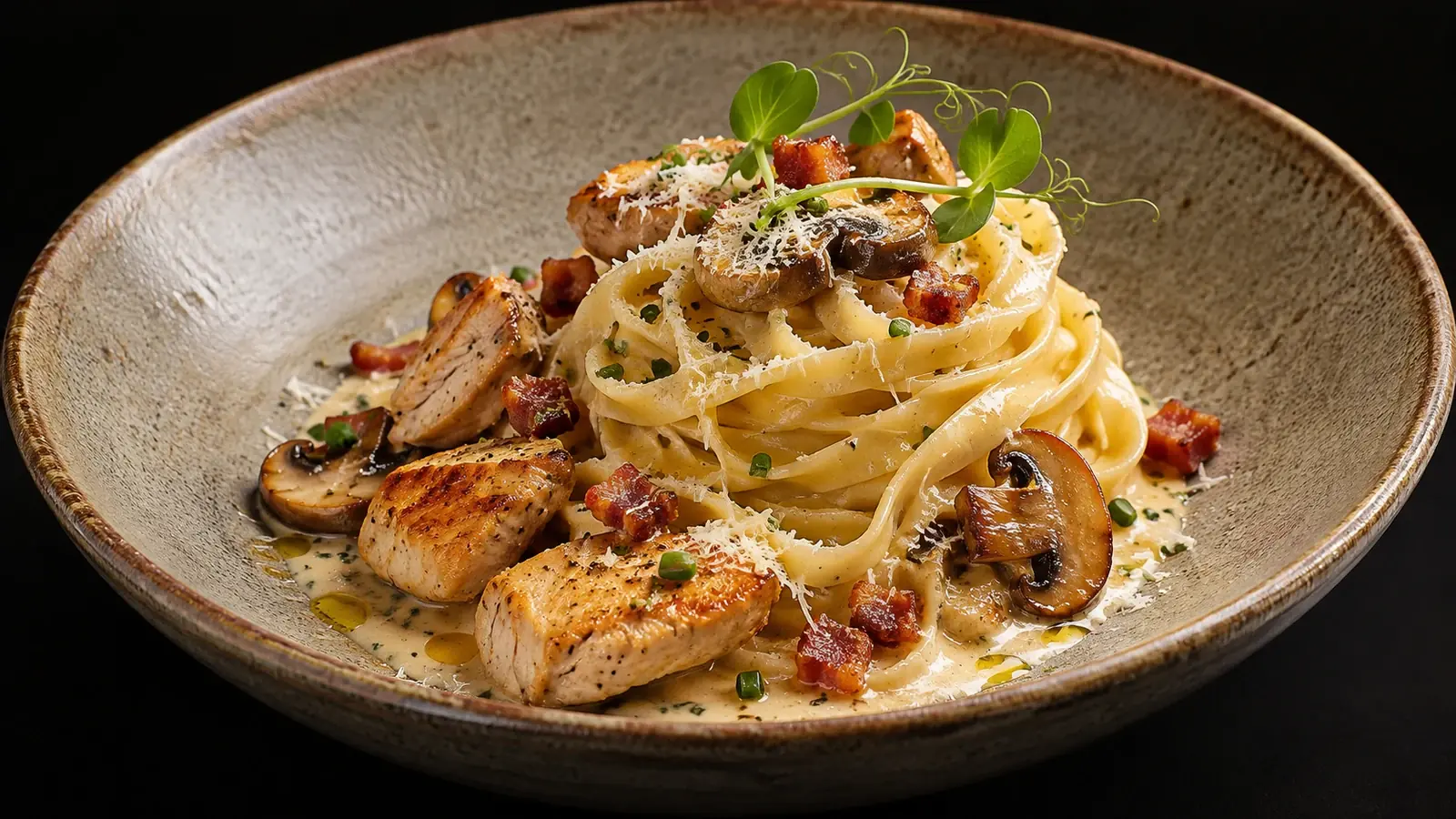
The noodles with parisienne sauce of the Buenos Aires cantinas: chicken, pancetta, cream and mushrooms over long pasta. The dish respects those flavors, but aims for a silky, glossy sauce instead of a heavy cream, with every ingredient recognizable.
The twist is to work each ingredient separately to boost caramelization, texture and depth. The chicken is seared, basted in thyme butter and finished in the oven; the pancetta is browned until crisp and its fat is used to toast the mushrooms. The sauce is built on those cooking bases, with white wine and chicken stock, and emulsified at the end with the starch of the pasta.
Special equipment: instant-read thermometer; heavy oven-safe pan
Ingredients
Chicken
- 2 chicken breast supremes, about 450–500 g in total
- Fine salt and freshly ground black pepper
- 1 tablespoon olive oil
- 15 g butter
- 2 sprigs fresh thyme
Pancetta
- 180 g smoked pancetta, in 1 cm cubes
Mushrooms
- 350 g fresh button mushrooms
- 100 g portobello mushrooms
- 20 g butter
- 1 garlic clove, lightly crushed
- 2 sprigs fresh thyme
- Fine salt and black pepper
Parisienne sauce
- 1 large shallot, in very fine brunoise
- 100 ml dry white wine
- 120 ml chicken stock
- 300 ml heavy cream
- 50 g finely grated Parmigiano Reggiano
- White pepper and freshly grated nutmeg
Pasta
- 400 g good-quality tagliatelle or fettuccine
- Plenty of water and salt
Finishing
- Parmigiano Reggiano
- Fresh chives, chopped
- Pea shoots or microgreens
- Freshly ground black pepper
- Extra virgin olive oil
Method
Chicken
- Searing. Dry the supremes very well with paper towels: a dry surface gives an intense Maillard reaction instead of steaming the chicken. Season both sides. Heat a heavy pan very hot over medium-high heat, add the oil and cook the supremes 3–4 minutes without moving them, to an intense golden crust.
- Basting and oven. Turn them, add the butter and thyme and, when the butter foams, tilt the pan and baste the chicken with it 1–2 minutes. Move it to the oven at 170 °C (340 °F) for about 5 minutes, depending on thickness. The center should reach 68–70 °C (154–158 °F) and stay above 68 °C (154 °F) for at least 1 minute during the rest; if you cannot monitor it, cook it to 74 °C (165 °F). Rest 8 minutes and cut into large cubes or thick slices.
Pancetta
- Browning. Put the pancetta in a cold pan and bring to medium-low heat. Cook 8–12 minutes, stirring occasionally, until deeply golden and crisp. Remove with a slotted spoon to paper towels and reserve 1–2 tablespoons of its fat for the mushrooms and sauce.
Mushrooms
- Toasting. Clean the mushrooms with barely damp paper towels or a brush, without submerging them. Cut large button mushrooms into halves or quarters and the portobellos into thick slices. Heat a wide pan very hot with a tablespoon of pancetta fat and spread the mushrooms with space between, in two batches if needed. Leave them 2 minutes without moving, until deeply browned, and sauté.
- Aromatics. Add the butter, garlic and thyme and cook 2–3 minutes more. Season only at the end, remove the garlic and thyme and set the mushrooms aside.
Parisienne sauce
- Reduction. In the same mushroom pan, over medium heat, cook the shallot 2 minutes, until translucent, without browning. Add the wine, raise the heat slightly and scrape the bottom to recover the caramelized bits. Reduce the wine by 70–80%, add the chicken stock and reduce again by half.
- Cream. Add the cream and cook over medium-low heat 5–7 minutes, without a hard boil. Add the Parmigiano, white pepper and very little nutmeg, and two thirds of the mushrooms; the rest is kept for plating. The sauce should be somewhat more fluid than desired, because it thickens as it emulsifies with the pasta.
Pasta
- Cooking. Cook the pasta in plenty of well-salted water until 2 minutes less than the package indicates. Before draining, reserve about 300 ml of cooking water.
- Emulsion. Move the pasta straight to the sauce pan with 80–100 ml of cooking water and cook over medium heat about 2 minutes, moving it constantly. If it thickens too much, add water little by little: it should be creamy, glossy and fluid, never pasta covered by a heavy cream.
- Chicken and pancetta. With the pasta al dente, lower the heat and add the chicken and two thirds of the pancetta. Mix gently 30–45 seconds, only to recover temperature: longer dries the chicken and softens the pancetta. Taste and correct the salt only now.
Finishing
- At serving. Grate the Parmigiano very fine and chop the chives at the moment; have the shoots, pepper and oil ready.
The dish
Use wide, somewhat deep plates of artisanal ceramic, stone or stoneware, only slightly warm. Take each portion with long tongs, twirl it inside a ladle to form a nest and set it slightly off center. Distribute around and over the pasta some pieces of chicken, the reserved mushrooms with their caramelized faces in view and cubes of crisp pancetta at different heights. Add a little sauce around, without flooding the plate. Finish with very finely grated Parmigiano, chives, a few pea shoots, pepper and a few drops of olive oil. Final look: a tall, glossy ivory nest, the gold of the chicken and mushrooms, the crisp pancetta and green dots, with free space on the plate.
Key points
- Dry the chicken very well and do not move it while searing: the golden crust is the base of the flavor.
- Do not soak the mushrooms or crowd them in the pan, so they brown and do not boil.
- Cook the shallot without color, only until translucent.
- Do not let the cream boil hard and finish the sauce with the pasta water, not with more cream.
- Add the chicken and pancetta at the end and for a short time, so they stay juicy and crisp.
Pairing
A Chardonnay with moderate barrel aging: its acidity cleanses the fat of the cream and pancetta, and its buttery and toasty notes go with the mushrooms, golden chicken and Parmigiano. As a red alternative, a light Pinot Noir, with good acidity and delicate tannins; avoid very structured reds, which dominate the sauce.