Signature · 1 h 30 min of active work, starting the day before · Serves 4
Contemporary gnocchi alla romana
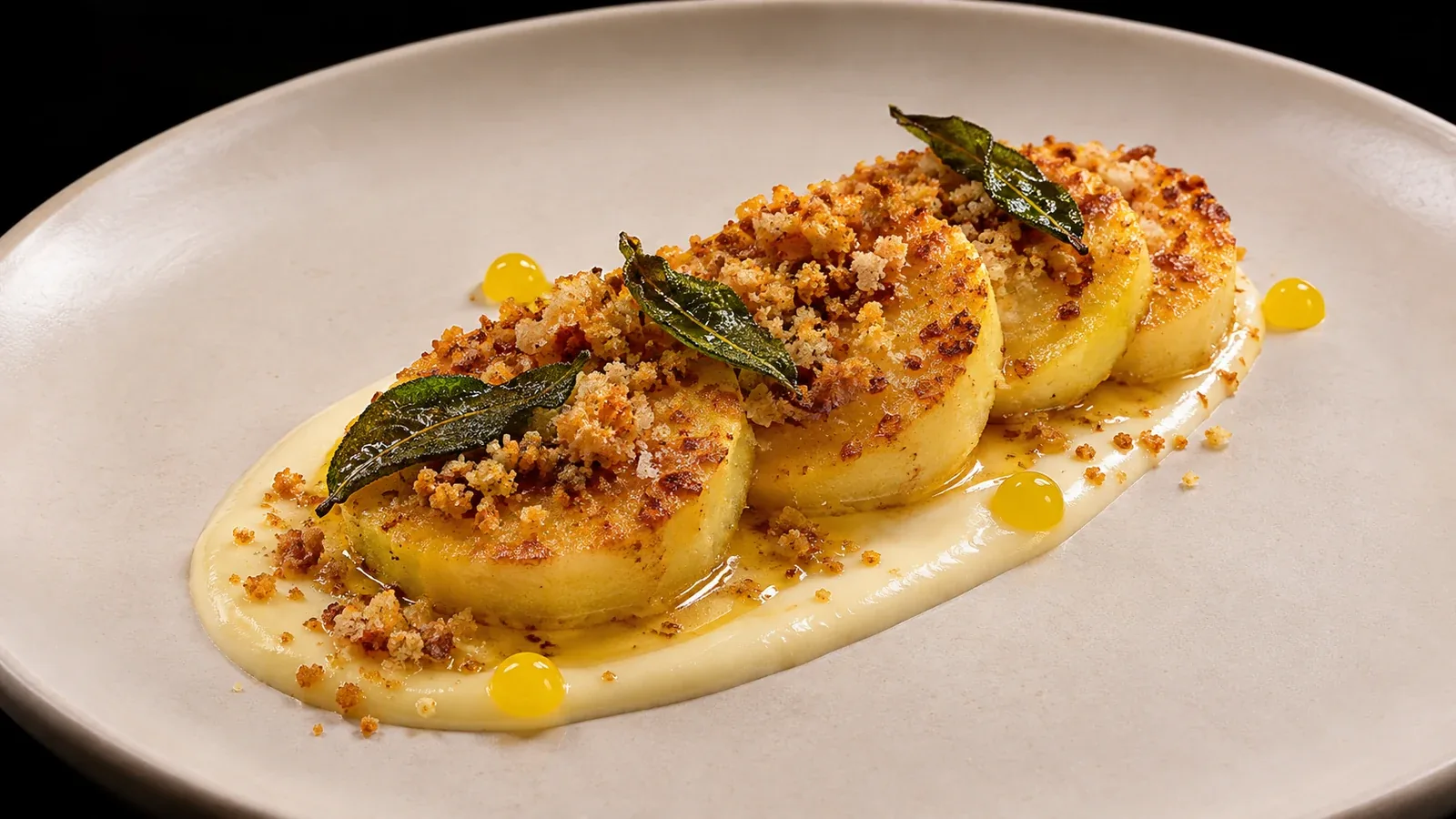
Illustrative image generated with AI, not a photo of the cooked dish.
Kitchen test pending
Gnocchi alla romana: discs of semolina cooked in milk with Parmesan, nutmeg and butter, gratinéed in the oven. The idea is that the diner immediately thinks of the classic dish —semolina, milk, Parmesan and gratinéed butter— and finds a more precise execution.
The twist is to add five contrasts without changing the base. The discs are browned in a pan and lightly gratinéed, for a golden exterior and a creamy interior. A light Parmigiano cream acts as the sauce, a sage brown butter gives aromatic depth, a Parmesan pangrattato brings crunch, a mushroom powder adds a very light note of umami and a lemon gel gives the acidity that cleanses the palate. The sophistication comes from the precision of doneness, not from luxury ingredients.
Special equipment: 5–6 cm round cutter; hand blender; fine sieve; spice grinder; squeeze bottle
Ingredients
Gnocchi alla romana
- 750 g whole milk
- 50 g butter
- 6 g fine salt, approximately
- 0.5 g freshly grated nutmeg
- A pinch of white pepper
- 150 g fine durum wheat semolina
- 90 g finely grated Parmigiano Reggiano
- 2 egg yolks
- Very finely grated zest of ¼ lemon
Light Parmigiano cream
- 180 g heavy cream
- 80 g whole milk
- 100 g grated Parmigiano Reggiano
- 15 g cold butter
- White pepper and salt, only if needed
Sage brown butter
- 120 g butter
- 15–18 fresh sage leaves
- 1 thin strip of lemon peel
Parmesan pangrattato
- 60 g panko or coarse breadcrumbs
- 20 g butter
- 20 g grated Parmesan
- Freshly ground black pepper
- A little lemon zest
Mushroom powder
- 15 g dried porcini or boletus
Lemon gel
- 60 g strained lemon juice
- 60 g water
- 12 g sugar
- 1.2 g agar-agar
- A pinch of salt
Finishing
- 40 g Parmigiano Reggiano, for gratinéing
- Clarified butter or neutral oil, for browning
- Parmigiano to grate at serving, optional
Method
Gnocchi alla romana
- Cooking. Heat the milk with 30 g of the butter, the salt, nutmeg and pepper. Almost at the boil, lower the heat and add the semolina as a rain, whisking constantly. Cook over low heat 5–7 minutes, stirring with a spatula, until it partly pulls away from the bottom and is thick, smooth and glossy.
- Enriching. Off the heat, add the remaining 20 g of butter and the Parmesan. Wait a minute so the temperature drops slightly and add the yolks, so they do not coagulate, and the lemon zest. Correct the salt.
- Molding. Spread right away between two sheets of silicone paper or on a buttered tray, to an even thickness of 18–20 mm. Cover touching the surface and chill. Once firm, cut 5–6 cm discs: it yields about 18. You can also cut rectangles or ovals, although the disc better keeps the classic reference. Keep in the refrigerator.
Light Parmigiano cream
- Emulsion. Heat the milk with the cream to 75–80 °C (167–176 °F), without boiling, and remove from the heat. Add the Parmesan little by little, mixing, and process with the hand blender. Add the cold butter, emulsify again and strain through a fine sieve. It should be a creamy sauce that coats, not a thick fondue. Do not boil it once the cheese is added, because it splits.
Sage brown butter
- Brown butter and sage. Slowly melt the butter and keep heating until the solids begin to toast and a hazelnut aroma appears. At a deep golden color, add the sage and fry it briefly, until crisp; move the leaves to paper towels. Add the lemon peel for 30 seconds and remove it. Strain only if a very clean presentation is wanted: the toasted solids add flavor. Keep warm.
Parmesan pangrattato
- Toasting. Melt the butter, add the bread and cook slowly until it browns. Remove from the heat and, once somewhat cooler, add the Parmesan, pepper and very little lemon zest. It should be loose and crisp, not greasy. Store dry.
Mushroom powder
- Grinding. Process the completely dry mushrooms to a fine powder and sift. Use it very sparingly: 0.5–1 g per plate. It is a seasoning, not a main ingredient.
Lemon gel
- Gelling. Mix everything cold and boil 30–45 seconds to activate the agar. Pour into a container and refrigerate until it sets. Once cold, blend it with the hand blender until completely smooth and move it to a squeeze bottle or small piping bag.
Finishing
- Browning. Take the gnocchi out of the refrigerator about 15 minutes ahead. Brush a nonstick pan with clarified butter and brown the discs over medium heat on one side, about 3 minutes, to an even crust; turn them and brown the other briefly.
- Gratinéing. Move them to a tray, cover with a thin layer of Parmesan and put them 1–2 minutes under the oven's hot broiler. They should be well browned outside, hot to the center and soft and creamy inside. Over-gratinéed, they dry out.
The dish
Use wide, warmed plates. Put 45–50 g of Parmesan cream in a teardrop, circle or small mirror, and set 4–5 gnocchi slightly overlapping on top. Coat with 12–15 g of brown butter, add a little irregular pangrattato and 3–4 crisp sage leaves. Add a few small dots of lemon gel and finish with a minimal amount of mushroom powder and, if you like, very finely grated Parmesan at the last moment. There is no need to add microgreens: the sage already fulfills the vegetal and aromatic function. Final look: golden discs with a gratinéed crust on an ivory cream, the amber shine of the brown butter, the dark green sage and yellow dots of lemon.
Key points
- Add the yolks off the heat and with the semolina slightly cooled, so they do not coagulate.
- Do not boil the Parmigiano cream after adding the cheese, because it splits.
- Keep the pangrattato loose and crisp, not greasy.
- Take care with the final cooking: that is where the contrast between crust and interior appears.
- Do not over-gratinate, because the gnocchi dry out.
Pairing
A white with body and good acidity, such as a lightly oaked Chardonnay or a Fiano, goes with the butter and Parmesan without covering the sage or lemon. Without alcohol, sparkling water with a strip of lemon peel.
Notes
- As a starter: the recipe yields 6 starters of 3 gnocchi, with 30–35 g of cream and 8–10 g of brown butter per plate.
- Tasting version: with the same base, cut discs of about 4 cm and serve two pieces; you can finish with grated cured yolk on one of them, although it adds another layer of fat and umami to an already rich dish.
- Intended result: first you taste the classic gnocchi alla romana —semolina, milk, Parmesan, nutmeg and butter—; then, the hazelnut of the brown butter, the sage, the crunch of the bread, a very light note of mushroom and, at the end, the acidity of the lemon cleansing the palate.