Signature · 2 h 30 min, plus 8–12 hours of soaking · Serves 4
Toasted cheese-crusted steak with chipotle black beans and roasted tomato red rice
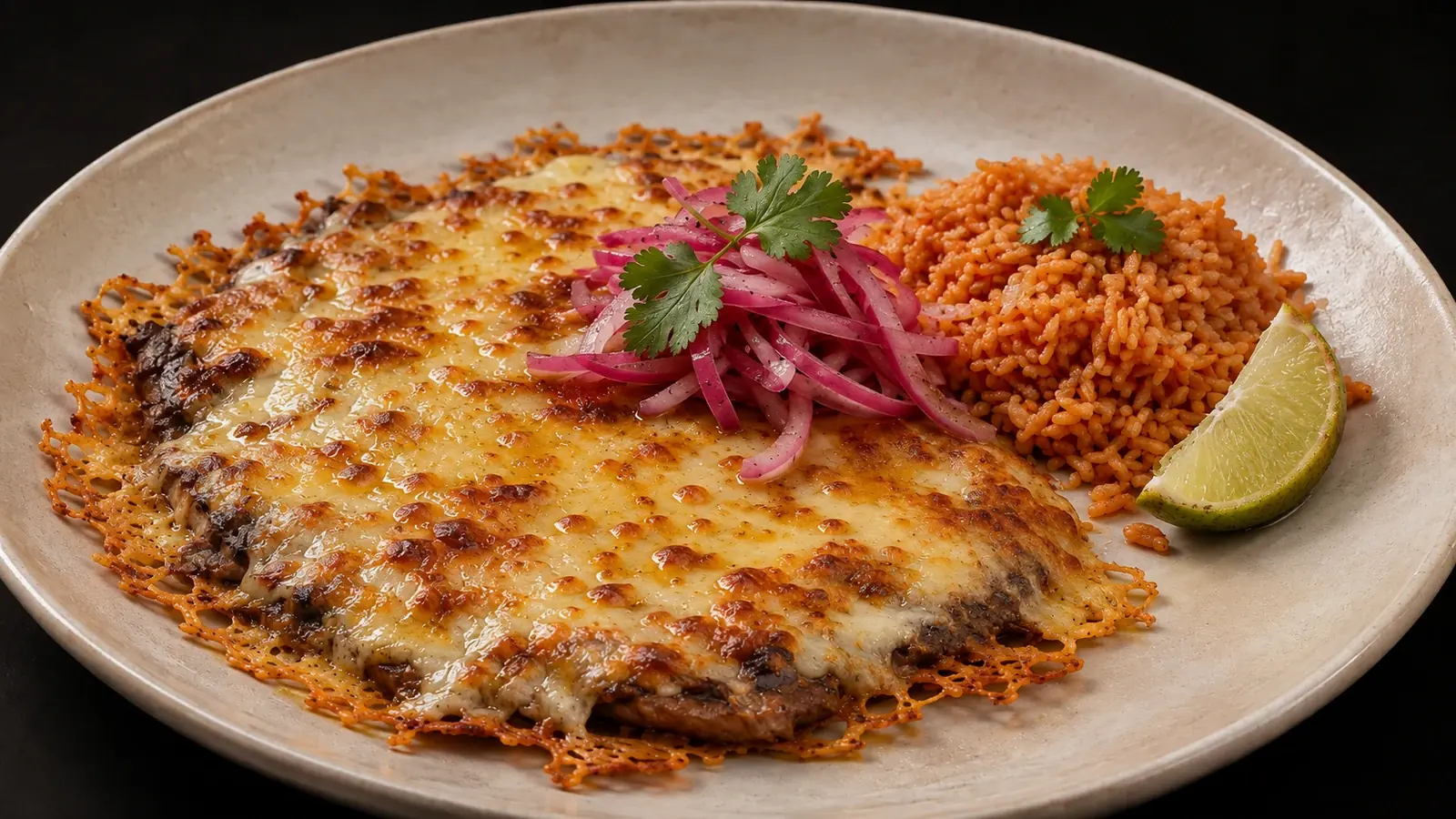
Illustrative image generated with AI, not a photo of the cooked dish.
Kitchen test pending
The root is Mexican fonda cooking: a thin griddled steak, refried beans, cheese melted in the oven and red rice, the kind that is fried dry and cooked with blended tomato. In Mexico there is no traditional dish with its own name that brings all this together. It appears on menus as a house specialty, with the milanesa toluqueña as the closest relative. The dish keeps that logic of a complete bite: meat, bean and cheese are cut together, with the lightly spicy rice on the side. The aim is a juicy steak even though it is very thin, a silky bean layer rather than a dry paste, and a cheese with two textures.
The twist is that every layer has a technical function. The steak is pounded to 4–5 mm and seared for less than a minute in a very hot iron pan. Then the layer of beans insulates it from the broiler: the heat melts and toasts the cheese without cooking the meat twice. The black beans are blended with their broth and chipotle to the texture of a thick cream, so the blanket holds without wetting the meat. For the cheese, three are used that can be found in Argentina. The block mozzarella stretches like Oaxaca, the semi-hard Gouda-style cheese brings the lactic flavor and browning of Chihuahua, and the Parmesan-style cheese, which spills over onto the tray, toasts and forms a crisp lace around the meat, like the cheese crust of the taquerías. The rice is cooked with tomatoes roasted in iron and chile de árbol, which give it smoke and a mild heat. A red onion cured in lime cuts through the richness of the whole.
Special equipment: 28 cm cast-iron pan; oven broiler; blender or hand blender; meat mallet or the bottom of a heavy saucepan; instant-read thermometer recommended
Ingredients
Cured onion
- 1 medium red onion (150 g), in 2 mm slices
- 60 ml lime juice (about 3 limes)
- 2 g fine salt
- ¼ teaspoon dried oregano
Chipotle black beans
- 200 g dry black beans
- Water for soaking, as needed
- 1.25 liters fresh water, plus hot water if needed
- ½ white onion (80 g), in one piece
- 2 garlic cloves, lightly crushed
- 1 bay leaf
- 5 g fine salt, plus more to adjust
- 40 g lard (or 40 ml neutral oil)
- 80 g white onion, finely chopped
- 2 garlic cloves, finely chopped
- 15 g chipotle chiles in adobo (1–2 chiles), chopped, plus 10 ml of their adobo
- ½ teaspoon dried oregano
- ¼ teaspoon ground cumin
- 200–300 ml of the reserved cooking broth
- 10 ml lime juice
Roasted tomato red rice
- 250 g fine long-grain rice (not parboiled)
- 350 g ripe plum tomatoes (4–5), whole
- 60 g white onion, in chunks
- 1 garlic clove
- 1 dried chile de árbol, stem and seeds removed (or ½ teaspoon crushed chili flakes)
- 30 ml neutral oil
- 300 ml hot low-sodium chicken stock, plus 50 ml to adjust
- 3 cilantro sprigs, tied
- 4 g fine salt, adjusting to the stock
Steak
- 4 rump steaks (top sirloin) of 130 g, cut across the grain 1.2 cm thick (or top round or knuckle)
- 5 g fine salt
- ¼ teaspoon ground cumin
- Freshly ground black pepper
- 20 ml neutral oil
Cheese crust
- 140 g block mozzarella (not fresh), coarsely grated
- 80 g semi-hard cheese (Gouda-style), coarsely grated
- 20 g Parmesan-style cheese (or pecorino sardo), finely grated
- 5 ml neutral oil for the tray
Finishing
- 8 g cilantro leaves
- 1 lime, in 4 wedges
Method
Cured onion
- Curing. Mix the onion with the salt and rub it for 30 seconds with your fingers, until it begins to soften and release juice. Add the lime juice and oregano, press so it is submerged and refrigerate at least 30 minutes. It is ready when it has gone from purple to fuchsia, bends without breaking and still keeps a slight crunch. Drain it right before using.
Chipotle black beans
- Soaking and cooking. Pick over and rinse the beans, cover them with three times their volume of water and let them soak for 8 to 12 hours. Drain them, discard the water and put them in a pot with 1.25 liters of fresh water, the piece of onion, the crushed garlic and the bay leaf. Bring to a boil, lower the heat and cook partially covered, at a barely perceptible simmer, for 1 hour to 1 hour 30 minutes. Add hot water if they stop being covered. When almost tender, add the 5 g of salt and continue for 15 minutes. They should be creamy in the center, with no floury grain, and the broth should be dark and somewhat thick. Remove the onion, garlic and bay leaf, and separate the beans from the broth: reserve at least 400 ml of broth.
- Sofrito. Heat the lard in a 26–28 cm pan over medium heat. Cook the chopped onion 5–6 minutes, until soft and with barely golden edges. Add the garlic, chipotle, oregano and cumin, and cook 30 seconds, until fragrant, without the garlic taking color.
- Refry. Add the drained beans and fry them 3 minutes, mashing them a little with the spoon so they absorb the fat. Add 200 ml of broth and the adobo, and cook 5 minutes. Blend everything until smooth and glossy, with no visible bits of skin. Return to the pan and reduce over medium-low heat, stirring from the bottom, 5–10 minutes. The target is a thick cream: when the spoon is dragged through the pan it leaves a trough that closes slowly, and a spoonful on a plate spreads only slightly, without releasing liquid around it. If it thickens too much and forms a paste that cracks, add broth 30 ml at a time. Off the heat, add the lime juice and adjust the salt. It yields about 520 g and 440 g are used. The rest gives margin for the reduction and the reheating.
- If prepared ahead. Transfer them immediately to a shallow container, chill them over ice water and keep them covered at 5 °C (41 °F) or below. To use them, reheat over low heat with 30–60 ml of broth until they reach 74 °C (165 °F) at the center and recover the same thick-cream texture. Cold, they harden a lot.
Roasted tomato red rice
- Washing. Rinse the rice in a bowl, rubbing it with your hand and changing the water 4 or 5 times, until it runs almost clear. Drain it in a fine sieve at least 15 minutes: it must be dry to the touch so it fries instead of boiling.
- Roasted tomatoes. Heat the cast-iron pan dry over high heat for 3 minutes. Roast the whole tomatoes 8–10 minutes, turning them, until the skin has black spots on a third of the surface and begins to split. In the last minute, toast the chile de árbol 15–20 seconds per side, only until it puffs and darkens a little. If it burns, it turns bitter. Blend the tomatoes with their skin, onion, garlic and chile to a smooth purée. Pass it through a sieve, pressing: about 330 g should remain.
- Frying the grain. In a heavy-bottomed 20–22 cm pot with a lid, heat the oil over medium heat and fry the rice 6–8 minutes, stirring often. First it turns opaque and chalk white, then takes an even pale golden tone, sounds like sand and smells toasty. This sealed layer is what keeps the grains separate.
- Cooking. Pour in the tomato purée all at once, because it splatters, and cook over medium heat 3–4 minutes, stirring, until it reduces and coats the grains with a brick-red paste, with no loose liquid. Add the 300 ml of hot stock, the salt and the tied cilantro. Stir only once, bring to a boil and lower to the minimum. Cover and cook 18 minutes without lifting the lid. Turn off the heat and let rest covered 10 minutes. Remove the cilantro and fluff the grains with a fork. The rice should be tender, orange-red, with separate grains and only slightly moist. If the center is still firm when tasted, sprinkle 30–50 ml of hot stock, cover and leave 5 minutes more over the lowest heat. A toasted film on the bottom is fine, but it should not smell burnt.
Steak
- Pounding. Remove the thick outer fat and the silver skin. Place each steak between two sheets of plastic film with a few drops of water and pound it with the flat side of the mallet or the bottom of a heavy saucepan. Work from the center outward, with dragging blows, to an even thickness of 4–5 mm, about 14 × 18 cm. Even thickness matters more than the exact measure: a thicker area stays raw and a thinner one dries out. Make 3 or 4 cuts of 5 mm on the edge so it does not curl when searing.
- Seasoning. Mix the salt with the cumin and spread it on both sides. Leave the steaks on a rack, uncovered, in the refrigerator for 30 minutes to 2 hours: the salt penetrates and the surface dries, which improves the browning. Before searing, pat dry and add the pepper.
- Searing. Heat the clean cast-iron pan over maximum heat for 4–5 minutes, until it barely smokes. Add a third of the oil and sear one steak at a time, or two if they fit without overlapping, 40–50 seconds on the first side. An even dark brown crust should form. Turn and sear 20–30 seconds on the second side. The center stays pink, because the broiling finishes the cooking. Move each steak to a rack and add oil between batches. Searing the four pieces takes about 4 minutes and is done right before broiling.
Cheese crust
- Mixing. Mix the three cheeses with your fingers, without packing, and divide into 4 mounds of 60 g.
- Broiling. Preheat the broiler to maximum for 10 minutes, with the rack at a height that leaves the surface of the tray 10–12 cm from the element or flame. Lightly oil a tray. Arrange 2 steaks with the browner side up, at least 6 cm apart. Spread over each 110 g of hot beans, in an even layer 6–8 mm thick reaching the edge of the meat: this protects it from the direct heat. Cover with 60 g of cheese, letting 1 cm spill onto the tray around the steak. Broil 2½–4 minutes, turning the tray halfway if the broiler does not heat evenly. It is ready when the cheese bubbles across the whole surface, has golden spots and some toasted points, and the edge on the tray has turned amber, dry and with holes like lace. Leave 30 seconds for the lace to set and lift each piece whole with a wide spatula, edge included. Repeat with the other two steaks. The meat finishes cooking with the heat of the tray and the beans. At this thickness it ends up cooked and juicy, with no raw center: when cutting the edge, it should not look red or release red juice.
Finishing
- At serving. Drain the cured onion. Separate the cilantro leaves and cut the lime into wedges.
The dish
Use large flat plates, about 28 cm, in light ceramic, warmed to about 60 °C (140 °F) in the turned-off oven, because thin meat loses heat quickly. Lightly oil a 200 ml cup, fill it with a quarter of the rice pressing gently with the back of a spoon and unmold it in the right third of the plate, as a low, compact dome. Set the steak with its crust at center-left, slightly tilted toward the rice, with the lace edge brushing the dome, and arrange the whole lace, unbroken, so it shows around the meat. On the crust, off-center toward the rice side, build a loose mound of well-drained cured onion, about 25 g, so its juice does not soften the cheese. Finish with 3 or 4 cilantro leaves on the onion and another 2 on the rice. Set the lime wedge next to the dome and serve at once, while the cheese still moves. Final look: golden cheese with toasted spots and an openwork amber edge, a glossy black band of bean visible in the cut, orange-red loose-grained rice, fuchsia onion and the green of the cilantro as the only fresh touches.
Key points
- Pound the meat to an even thickness and sear it for less than a minute in total. If seared longer, the broiler dries it and it turns to leather.
- The beans go on hot and with a thick-cream texture: cold, they do not protect the meat and lengthen the broiling. Too loose, they make the cheese slide and wet the steak.
- The lace only forms if the cheese spills onto an oiled, hot tray, with Parmesan-style cheese in the mix. Without the spill, the dish loses its most memorable texture.
- For loose rice, wash it, dry it and fry it to a pale gold before adding the tomato. After that, do not stir it or lift the lid.
- Roast the tomatoes to black spots, not charred, and toast the chile for seconds: over-doing either turns the whole rice bitter.
Pairing
A Vienna lager or an Argentine amber lager, with soft caramel that goes with the toasted cheese and chipotle, and enough carbonation to clean the fat. Without alcohol: lightly sweetened hibiscus water with lime, whose acidity and tannin do the same job as the cured onion.
Notes
- Chipotle: it is found canned in Mexican grocery stores. As an alternative, rehydrate 1 ancho or guajillo chile in hot water for 15 minutes and add ½ teaspoon of smoked paprika: it gives a similar smokiness, with less heat.
- Heat: the rice is only mildly spicy with 1 chile de árbol. For more, use 2. The beans are mild with 15 g of chipotle and can take up to 25 g.
- Cheeses: the proportion aims for 60% stretching cheese, 30% flavor and browning cheese and 10% hard cheese for the lace. The semi-hard cheese can be replaced with another Gouda-style or tybo-style cheese, and the Parmesan-style cheese with pecorino sardo or finely grated hard provolone. Fresh mozzarella does not work because it releases water.
- No broiler: use the oven at 250 °C (480 °F) with the tray on the highest position, 5–6 minutes. The lace forms just the same, but the meat cooks a little more.
- Rice ahead of time: if it is not served within the hour, spread it on a tray to cool quickly and refrigerate at 5 °C (41 °F) or below for up to 1 day for quality. Reheat it covered with 30 ml of stock to 74 °C (165 °F) at the center.
- Yields to confirm: the weight of the finished refry, of the strained tomato purée and the exact broiling time depend on the bean, the tomato and the broiler. Record them at the first test.