Signature · about 5 hours spread over 2 days, plus 8–12 hours of soaking · Serves 4
Charro beans in charred tomato broth with chile de árbol lacquered pork belly and crisp chorizo
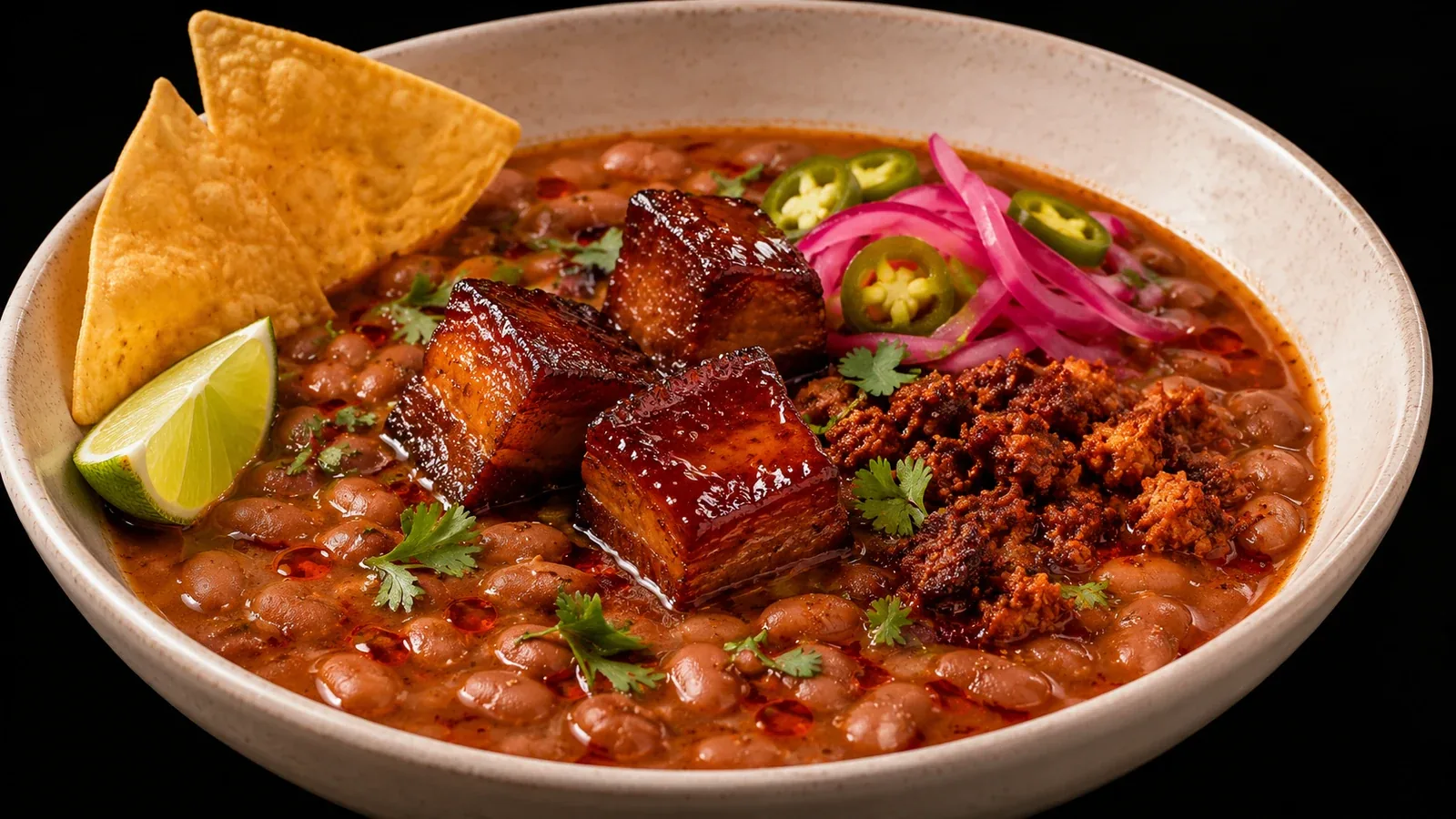
Illustrative image generated with AI, not a photo of the cooked dish.
Kitchen test pending
The root is the charro beans casserole of northern Mexico: whole pinto beans in their broth, with bacon, chorizo, tomato, chile and cilantro, a substantial, brothy spoon dish. This version keeps the broth, the whole beans and all the flavors, but changes the place of the pork: instead of dissolving in the pot, the bacon becomes a bite of its own.
The twist is to separate the three pork elements to give each a different texture. A block of pork belly is cooked slowly and covered until tender, pressed, cut into cubes and lacquered with piloncillo, orange and chile de árbol to a glossy crust. The chorizo is toasted crumbled until crisp, and its fat fries the sauce. The broth is made with tomato, onion, garlic and chile dry-charred, which bring smoke without a smoker, and fried Mexican style before joining the beans. A pickled onion and jalapeño, a chile de árbol oil and freshly baked totopos finish the dish.
Special equipment: heavy-bottomed pot; baking dish with lid; cast-iron pan; blender; fine sieve
Ingredients
Pot beans
- 250 g dry pinto beans
- Water for soaking, as needed
- 1.5 liters fresh water, plus hot water if needed
- ½ white onion, in one piece
- 2 garlic cloves, whole
- 1 bay leaf
- 7 g fine salt, plus more to adjust
Lacquered pork belly
- 450 g fresh pork belly in a block, skinless
- 6 g fine salt
- 200 ml water
- 40 g piloncillo or muscovado sugar
- 60 ml orange juice
- 15 ml apple cider vinegar
- 1–2 dried chiles de árbol, ground or very finely chopped
Charred tomato broth
- 350 g ripe plum tomatoes
- ½ white onion, in two pieces
- 3 garlic cloves, in their skins
- 1 serrano chile or ½ jalapeño
- 400–500 ml of the bean cooking broth
- 15 ml chorizo fat or neutral oil
- 15 g cilantro stems, tied
Crisp chorizo
- 150 g fresh Mexican pork chorizo, casing removed
Pickled onion and jalapeño
- ½ red onion, in thin slices
- 1 jalapeño, in thin rounds
- 80 ml apple cider vinegar
- 40 ml water
- 10 g sugar
- 3 g salt
Chile de árbol oil
- 60 ml neutral oil
- 3 dried chiles de árbol, seeds removed
- 1 garlic clove, sliced
Totopos
- 4 corn tortillas
- 15 ml neutral oil
- Fine salt
Finishing
- Cilantro leaves
- 2 limes, in wedges
Method
Pot beans
- Soaking. Wash the beans and soak them 8–12 hours in three times their volume of cold water, in the refrigerator. Drain them.
- Cooking. Put them in the pot with the fresh water, onion, garlic and bay leaf, bring to a boil and skim. Cook at a very gentle simmer, partly covered, 1 h 30 min – 2 hours, adding hot water if the beans become uncovered. Salt only when they are tender and leave 10 minutes more. They should be whole, with intact skin, and creamy inside when one is pressed against the tongue. Remove the onion, garlic and bay leaf and keep the beans in their broth.
Lacquered pork belly
- Slow cooking. Salt the block of pork belly all over, set it in a small dish fat side up, add the water, cover tightly and bake at 150 °C (300 °F) for 2 h 30 min, until a toothpick goes in without resistance.
- Pressing. Move the pork belly to a tray with parchment paper, cover it with another paper and a board with a 1 kg weight, and refrigerate it once it stops steaming, at least 4 hours: it ends up firm, flat and easy to cut into neat cubes. Skim the fat and reserve the liquid from the dish.
- Lacquer. In a small saucepan, boil the piloncillo, orange juice, vinegar, chile and 3 tablespoons of the dish liquid for 4–5 minutes, to a syrup that coats a spoon.
- Browning and lacquering. Cut the cold pork belly into 12 cubes of 3 cm. Brown them in the cast-iron pan over medium heat, without oil, 2–3 minutes per side, until the fat toasts and the edges crisp. Pour off almost all the fat, lower the heat, pour in the lacquer and move the cubes 1–2 minutes, until covered by a dark, glossy film, without burning the sugar. They should be hot at the center, at 74 °C (165 °F).
Charred tomato broth
- Charring. Heat the cast-iron pan over medium-high heat, without oil, and roast the tomatoes, onion, garlic in their skins and chile 10–15 minutes, turning them, until they have black spots all over and the tomatoes are soft. Peel the garlic and remove the chile stem.
- Blending and frying. Blend the vegetables with 200 ml of the bean broth until smooth and strain. Heat the chorizo fat in the pot over medium-high heat and pour in the sauce all at once, carefully because it splatters; fry it 5 minutes, stirring, until it darkens a shade and thickens: that way it loses its raw taste.
- Combining. Add the drained beans, the cilantro stems and 200–300 ml more of the bean broth, to a substantial broth that just covers the beans. Cook gently 15 minutes so they come together, remove the cilantro and adjust the salt. It should remain brothy, reddish and only slightly bound by starch, never a thick stew.
Crisp chorizo
- Toasting. Cook the chorizo in a pan over medium heat, breaking it up with a wooden spoon, 10–12 minutes, until it releases its fat and ends up in toasted, crisp crumbles. Drain on paper towels and reserve the fat for the broth.
Pickled onion and jalapeño
- Pickling. Boil the vinegar with the water, sugar and salt and pour over the onion and jalapeño. Let cool and refrigerate at least 1 hour.
Chile de árbol oil
- Infusion. Heat the oil with the chiles and garlic over low heat until the garlic begins to brown, 4–5 minutes, without burning the chiles. Let cool, blend briefly and strain: it should be red, spicy and toasty.
Totopos
- Baking. Cut the tortillas into triangles, brush them with the oil and salt them. Bake them on a tray at 180 °C (355 °F) for 10–12 minutes, turning them halfway, until golden and crisp.
Finishing
- At serving. Have the cilantro picked and the lime wedges ready.
The dish
Use wide deep plates or low casseroles, hot. Serve the beans with their broth, about 250 ml per person, and set in the center three cubes of lacquered pork belly in a triangle, with the glossiest side up. Scatter the crisp chorizo on one side, over the broth, and add a small mound of well-drained pickled onion and jalapeño next to the pork belly. Finish with a few cilantro leaves and a few drops of chile de árbol oil on the broth, and set two or three totopos at the rim of the plate, with a lime wedge. Final look: a reddish broth with whole, glossy beans, dark, lacquered cubes of pork belly, the toasted chorizo, the fuchsia of the onion, the green of the cilantro and the golden totopos.
Key points
- Salt the beans only when tender, so the skin does not harden.
- Press the pork belly cold to cut neat cubes.
- Lacquer over low heat and remove before the sugar burns.
- Char the vegetables to black spots and fry the sauce before adding broth.
- Keep the broth light: it is a spoon dish, not a stew.
Pairing
An amber beer or a medium-bodied stout, which goes with the smoke and the piloncillo. Without alcohol, hibiscus water with lime.
Notes
- Storage: the beans in their broth and the pressed pork belly keep up to 3 days at 5 °C (41 °F) or below, chilled quickly. Reheat the beans to 74 °C (165 °F).
- Chorizo: if Mexican chorizo is not available, use fresh paprika chorizo crumbled with a pinch of cumin and paprika.