Signature · 3 hours, with ricotta draining included; about 95 active minutes · Serves 4
Bergese raviolone in toasted onion and sage broth
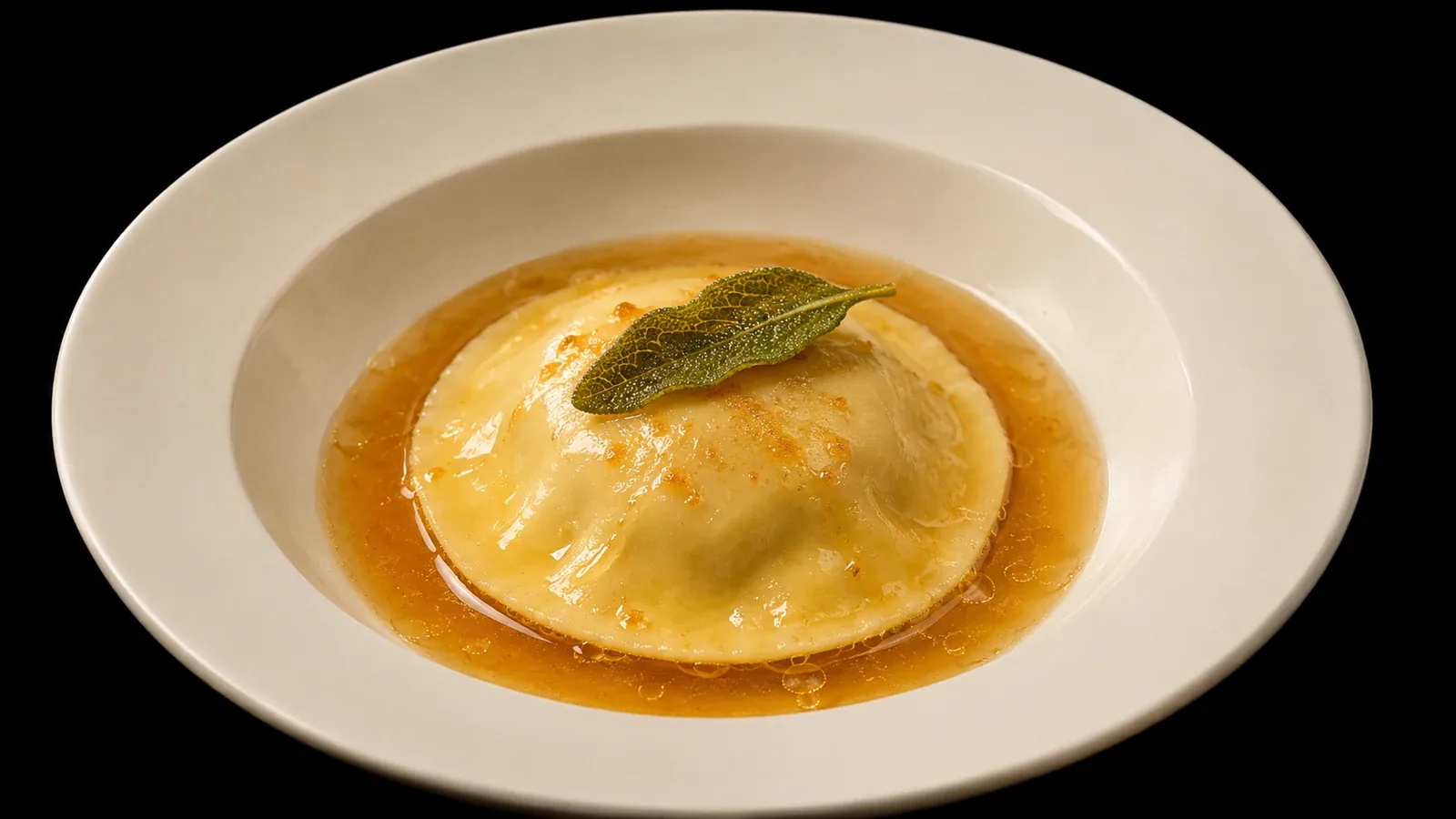
One large raviolone per person keeps the heart of the Bergese: thin fresh pasta, a crown of ricotta and spinach, Parmigiano and a center of fluid yolk. The pasta is served whole; when opened, the yolk meets a hot broth and finishes the sauce on the plate. It is a generous starter or a first course within a menu, for 4 people.
The Signature twist turns the accompaniment into an amber broth of intensely toasted onion, with a discreet acidity of sherry vinegar. The gentle extraction and the filtering keep a light texture; a few drops of brown butter link the toastiness with the egg, and a crisp sage leaf brings aroma and snap. The memorable contrast happens when cutting: the clear broth turns golden and unctuous around the green filling.
Special equipment: pasta machine, 1 g precision scale, thermometer and two wide pots to cook 2 pieces in each
Ingredients
Toasted onion broth
- 600 g yellow onion, peeled weight
- 10 g olive oil
- 900 ml water, plus more as needed to adjust the yield
- 1 small bay leaf
- 8 ml sherry vinegar, divided into 5 ml and 3 ml
- 2 g fine salt, plus more to correct at the end
Fresh dough
- 120 g 00 flour
- 30 g fine durum wheat semolina
- 75 g beaten whole egg, weighed without shell
- 5 g olive oil
- 5–15 ml water, depending on absorption
- 1 g fine salt
- 15 g additional fine semolina for the tray and rolling, using only what is needed
Ricotta and spinach filling
- 150 g pasteurized-milk ricotta, weight after draining; buy about 200–250 g depending on moisture
- 40 g blanched spinach, cold and very well squeezed; start from about 180–220 g fresh leaves and weigh after draining
- 25 g finely grated Parmigiano Reggiano
- 1 small pinch of nutmeg
- Fine salt and black pepper, as needed
- Water and ice to blanch and cool the spinach
Brown butter and sage
- 40 g unsalted butter
- 4 medium sage leaves, washed and completely dry
Yolk center and cooking
- 72 g commercial pasteurized liquid yolk, unsalted and unsweetened, suitable per the manufacturer for consumption without full cooking; 18 g per raviolone
- 6 l water for the pasta, divided between two pots
- 36 g coarse salt for that water, 18 g per pot
- Water to moisten the edges, minimal amount
Method
Toasted onion broth
- Roasting. Heat the oven to 220 °C (430 °F), conventional heat. Cut the onions across the equator to expose a wide face, toss with the 10 g of oil and set them cut side down on a metal tray. Roast 35–45 minutes, until the contact face is dark brown and the interior begins to soften. Lift one half to check: look for deep toasting, without extensive black areas or an acrid smell. Remove any charred edge.
- Extraction. Move the onions to a saucepan and deglaze the tray with part of the 900 ml of hot water. Recover only the brown juices, avoiding black residue. Add the rest of the water, bay leaf and 2 g of salt. Bring to a boil and lower the heat; keep a very gentle simmer 30–35 minutes, partly covered. The onion should yield easily and the liquid should taste toasty with moderate sweetness, without burnt bitterness.
- Filtering and yield. Strain first through a sieve and then through a clean, dampened food-grade cloth, letting it drip without pressing the solids. Measure the liquid: gently reduce if it exceeds 400 ml or top up with hot water if short. The target is 400 ml of broth before the vinegar, light and amber; not a syrupy reduction. The spent onion stays out of the dish.
- Acidity. Add 5 ml of the vinegar, taste and add the other 3 ml: the full recipe takes 8 ml. Correct the salt. It should keep onion flavor and end fresh; when later mixed with yolk and butter, the acidity will soften. If served in the same session, keep covered at 60 °C (140 °F) or more for no longer than 30 minutes for quality. If made the day before, reheat to 74 °C (165 °F) or more and then hold in that window.
Fresh dough
- Kneading. Mix flour, 30 g of semolina and 1 g of salt. Add the egg, oil and the first 5 ml of water; gather and knead 8–10 minutes to a firm, smooth, barely satiny dough. If cracks remain that do not close when folded, add water 5 ml at a time, without exceeding the planned 15 ml without reassessing the absorption. Do not correct a firm dough by adding water before giving it time to hydrate.
- Resting. Wrap and rest about 60 minutes in the refrigerator at 5 °C (41 °F) or below; take out only the portion to be rolled. The rest reduces shrinking and limits the exposure of the egg dough outside the cold. The dough should fold without breaking and pass through the rollers without sticking; if very stiff when taken out, flatten gradually with a rolling pin before passing it through the widest setting, without letting it warm up during a long wait.
- Rolling. Divide in two, keep the unused part covered and pass progressively through the machine. Finish at 0.6–0.8 mm, checking the actual thickness: the machine numbers are not universal. The sheet should show the shadow of your fingers and hold without holes. This version uses less thickness than the Bergese 2.0 so the double edge cooks before the yolk thickens.
- Discs and checking. Cut 4 bases of 13 cm and 4 tops of 14 cm; cover them without stacking or moistening and refrigerate at 5 °C (41 °F) or below while finishing the broth and butter. Take them out when starting assembly, one piece at a time. Also set aside a folded, sealed trimming of the same thickness to later check the edge. The discs will be closed and trimmed to about 12–13 cm. The dough yields approximately 230–240 g: there will be trimmings and leftover, which should not become additional pieces without recalculating filling and yolk. See use in the Notes.
Ricotta and spinach filling
- Draining. Leave the ricotta in a fine sieve, covered and over a container with no contact with the whey, in the refrigerator at 5 °C (41 °F) or below. Weigh 150 g after draining. It should hold a mound on a spoon; if it releases liquid, extend the draining before continuing.
- Spinach. Blanch the leaves 30–45 seconds in boiling water. Immediately move to the ice bath, remove as soon as they are cold and squeeze in a clean cloth until they do not drip when pressed. Weigh 40 g and chop very fine by knife. The weight after drying governs the recipe; adjust the starting amount of leaves if they yielded less.
- Mixing. Combine the 150 g of ricotta with spinach, Parmigiano, nutmeg and pepper; taste before salting. Do not add raw egg or white. About 215 g of filling are obtained, around 53 g per piece, with a small piping tolerance. Transfer to a piping bag with a tip of about 12 mm and refrigerate. A test crown should hold its walls without spreading; if it gives way, check the draining, do not hide the moisture with more cheese.
Brown butter and sage
- Toasting. Melt the butter in a small, light-colored saucepan over medium heat. Cook about 3–5 minutes, moving, until the foam subsides and the solids are hazelnut-gold with a nutty aroma. Remove from the heat before they darken more: the container holds heat.
- Sage. Add the 4 completely dry leaves; let them fry in the residual heat about 10–20 seconds, until stiff and the bubbling nearly stops. If they don't reach that point, return a few seconds to low heat. Remove onto paper towels and set aside uncovered. Move the butter to another container to stop the toasting, keeping the golden solids. Do not add water to the hot fat. It yields approximately 30–33 g: divide it among the 4 plates.
Yolk center and cooking
- Product and cold. Use exclusively commercial pasteurized yolk whose manufacturer allows this lightly cooked use, within its date and period after opening. Keep at 5 °C (41 °F) or below and portion at assembly. The liquid yolk needs no membrane: the crown contains the 18 g until the pasta is closed. An ordinary fresh egg and a brief salt and sugar cure do not substitute for pasteurization. If the indicated product is not available, do not make this fluid-center version.
- Crown. Lay the 4 bases on a lightly floured surface with the working semolina. Form on each a continuous crown of about 8 cm outer diameter, with a central hollow of about 4 cm and walls of approximately 1.5 cm. Divide the filling by weight; the hollow must hold the 18 g of yolk without exceeding the wall. Leave no gaps through which it could escape.
- Closing. Work one piece at a time: weigh 18 g of yolk into the crown, minimally moisten an edge of about 1.5 cm, set the larger top by letting it fall over the volume and push out the air from the contour of the filling outward. Do not press the center. Seal well and trim to 12–13 cm, keeping at least 1 cm of closed edge. If the yolk soils the edge, do not rely on a wet seal: discard that piece for this service and redo it with reserve ingredients if available.
- Brief wait. Move to a tray with a little semolina, cover without crushing and refrigerate at 5 °C (41 °F) or below. Cook within about 20 minutes for the quality of the sheet. Do not freeze the pieces or prepare them the day before for this version: the center and edge require a specific test before extending that window.
- Water and control. Heat 3 l of water and 18 g of salt in each pot. Before putting in the pieces, cook the reserved double trimming for about 2 minutes and taste it: it should lose its floury core and keep a delicate resistance. If still raw, check the thickness before committing the pieces; the trimming guides on the pasta, it does not validate the temperature of the filling.
- Cooking. Keep a gentle, steady boil and put in 2 raviolone per pot with a wide slotted spoon, without overlapping. Initial guide: 2 minutes 30 seconds to 3 minutes 30 seconds from immersion, with pasta of 0.6–0.8 mm and pieces fresh out of the refrigerator. Maintain the boil without turbulence and release gently if they stick to the bottom. The edge should feel flexible, without an opaque white band; floating on their own does not prove doneness. The center is wanted warm and fluid, not at a critical pasteurization temperature.
- Out. Before putting in the pasta, adjust the broth to 70–75 °C (158–167 °F) to pour into the plates and warm the butter over minimal heat or in a warm water bath until it flows, without toasting it again; have the dishes warm. Lift each piece with its whole base supported, let drain 3–5 seconds and move to the plate. Do not sauté or glaze in a pan. Serve within about 1 minute of leaving the water. The exact time and fluidity of the center must be recorded in the first physical test; an interior temperature is not promised from the clock.
The dish
Warm four deep wide-rimmed plates, of ivory porcelain or light ceramic, and dry them so as not to dilute the broth. Set a whole raviolone in the center of each bottom, dome up and edge free, without folding it. Pour around 90 ml of broth at about 70–75 °C (158–167 °F), taking care that it reaches only the lower part of the pasta and leaves its surface visible; set aside the small excess to correct the level between plates. Divide the brown butter among the four servings, leaving part on the dome to give it shine and the rest in small islands on the amber. Rest a crisp sage leaf on the high, dry part of each raviolone, without submerging it. Keep the rim clean and serve at once so the sage arrives crisp and the yolk stays fluid. The final look is a dome of pale, glossy pasta, surrounded by a transparent broth with golden drops and a single green accent; the diner opens the pasta at the table and mixes the yolk with the broth in each bite.
Key points
- The pasteurized yolk suitable for this use is an execution condition; brief cooking does not pasteurize an ordinary egg.
- Toast the onion to dark brown and remove anything black: burnt bitterness concentrates in the broth.
- Weigh ricotta and spinach after draining; a wet crown does not hold the liquid yolk well.
- Respect the 0.6–0.8 mm thickness and the sealed edge; a thick edge forces extending the cooking of the center.
- Cook all four pieces at once in two pots, with broth and dishes ready; the wait thickens the yolk and softens the sage.
Pairing
A traditional-method brut sparkling wine, with good acidity and toasted bread notes, goes with the onion and butter and refreshes the richness of the yolk. As a non-alcoholic alternative, very cold sparkling water served separately brings freshness without adding sweetness to the broth.
Notes
- Status: Signature development with documentary QA; no culinary test recorded. en-revision marks the stage of pending gastronomic trial. The sibling recipe Bergese 2.0 keeps its content and its truffle, gel and foam alternatives.
- Center safety: ANMAT/Senasa recommend full cooking for ordinary egg. Here a commercial pasteurized egg product suitable for lightly cooked use is required, following the manufacturer's indication and with prevention of recontamination; the US FDA guide is used only as specific support for that substitution, not as Argentine regulation. For vulnerable diners, choose a completely cooked egg preparation.
- Cold and anticipation: ricotta, filling and yolk at 5 °C (41 °F) or below. Prepare the filling the same day and preferably use it within 2 hours of making; no universal microbiological shelf life is assigned. Keep out-of-refrigerator work brief and cumulatively under 1 hour, applying the specific Argentine guideline for preparations with egg. Use sooner if the yolk manufacturer requires a shorter period.
- Broth from the day before: chill in a shallow container over an ice bath, stirring with a clean utensil. According to the ANMAT manual: reach 60 °C (140 °F) in under 30 minutes, drop from 60 to 21 °C (140 to 70 °F) in no more than 2 hours and from 21 to 5 °C (70 to 41 °F) in another 2 hours at most. Cover once cold, keep at 5 °C (41 °F) or below and use the next day, a window chosen for quality. Reheat to 74 °C (165 °F) or more before service.
- Leftovers: do not plan on reheating raviolone to keep the liquid center. If cooked pieces are stored, apply the chilling indicated and reheat to 74 °C (165 °F) or more, accepting the set yolk; use the next day for quality. Discard pieces with uncontrolled exposure or chilling. Do not store leftovers of served plates.
- Leftover dough: gather clean trimmings before they touch filling or yolk, wrap and refrigerate immediately; roll and cook as another pasta within 24 hours for quality. They are a separate use and do not increase the 4 raviolone servings. Discard trimmings contaminated with filling.
- Scaling: the initial factor is N/4 for ingredients. Do not increase diameter, thickness or time per piece. Above 4 servings, pots, burner power and plating help must be recalculated; two successive batches do not keep the same doneness if the first ones wait.