Essential · 1 hour · Serves 4
Baked sole with Roquefort, whisky and potatoes
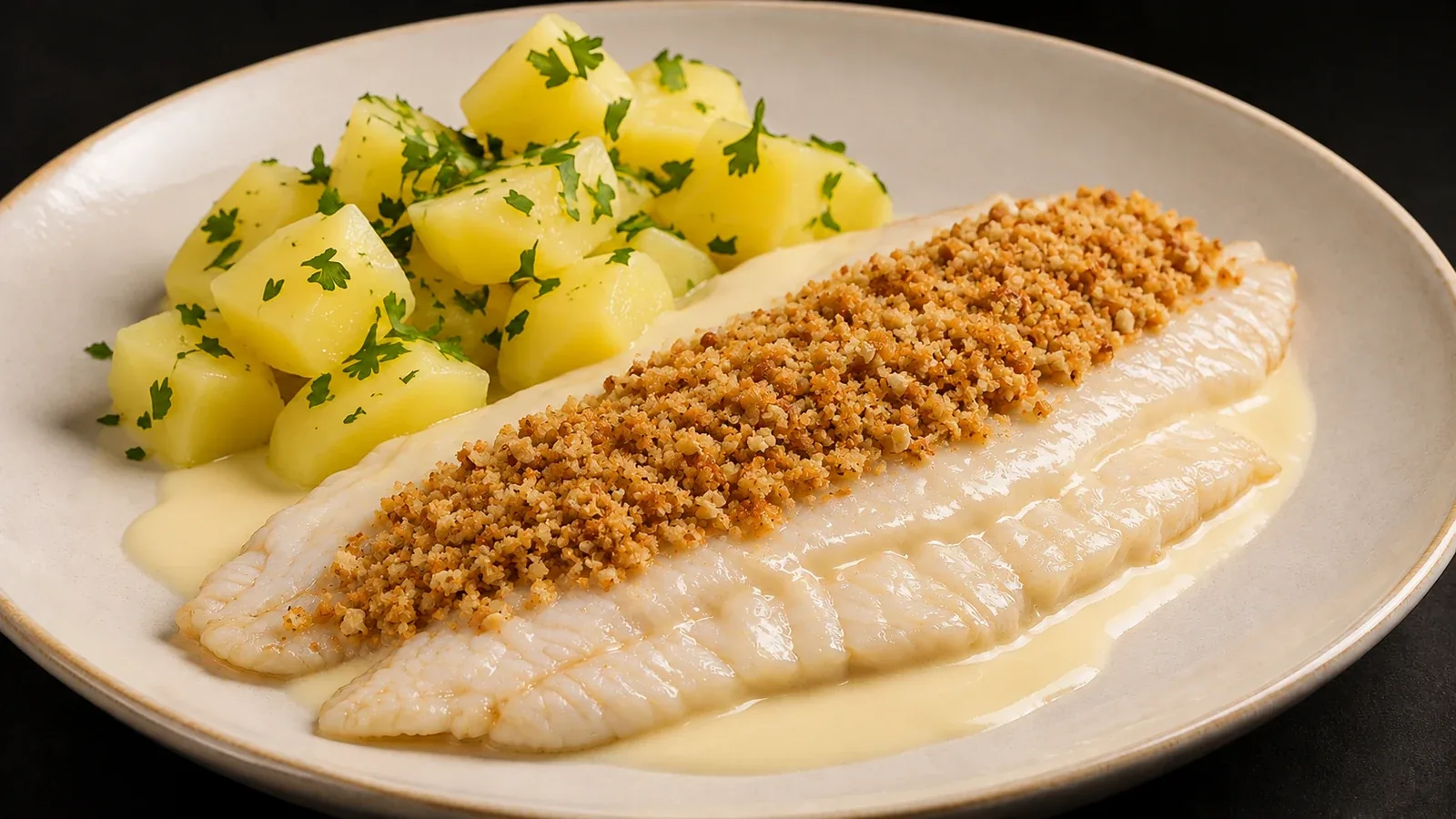
Illustrative image generated with AI, not a photo of the cooked dish.
Kitchen test pending
The baked sole keeps the cream, Roquefort and splash of whisky of the original dish, with potatoes that pick up the sauce. The cooking is organized so the fish goes in when the side and the sauce are already done.
The browning comes from a coating of breadcrumbs and walnuts toasted in a pan, added as the fish comes out of the oven. This gives a crunchy contrast and toasted flavor without waiting for a dish of cream to brown while the fillet keeps cooking.
Special equipment: oven and thin-probe thermometer
Ingredients
Parsley and lemon potatoes
- 700 g potatoes, peeled and cut into 2 cm cubes.
- Enough water to boil the potatoes.
- 15 g butter.
- 8 g parsley, chopped.
- 10 ml lemon juice.
- Salt, to taste.
Toasted bread and walnut topping
- 35 g coarse breadcrumbs or panko.
- 20 g walnuts, finely chopped.
- 10 g butter.
Roquefort and whisky sauce
- 20 ml whisky, preferably without strong smokiness.
- 200 ml heavy cream, of about 35% fat.
- 70 g Roquefort cheese, crumbled.
- 20–40 ml hot water, only if adjustment is needed.
- Black pepper, to taste.
Baked sole
- 720 g skinless, boneless sole fillets, in 4 portions of 180 g.
- 5 g butter, for the dish.
- 3 g fine salt, or less if the cheese is very salty.
Method
Parsley and lemon potatoes
- Boiling. Cover the cubes with cold water, salt and bring to a boil. Cook at a gentle boil about 12–18 minutes from when it boils, until a knife goes through the center without resistance and the edges keep their shape.
- Finishing. Drain well, return to the hot pot off the heat and let steam off for 1 minute. Mix with butter, parsley and lemon juice without breaking the cubes. Taste for salt. Keep covered and hot during the fish cooking; if they cool, reheat before assembling.
Toasted bread and walnut topping
- Toasting. Melt the butter in a pan over medium-low heat. Add the bread and stir 3–5 minutes until it begins to brown; add the walnuts and continue 1–2 minutes, stirring. It should be evenly golden, dry when moved and with a toasty aroma, never dark or bitter.
- Setting aside. Immediately move to a dry plate to stop the cooking. Let cool and keep protected from moisture and steam until service the same day. Do not leave it in the hot pan or sprinkle it over the sauce before baking.
Roquefort and whisky sauce
- Reducing. Put the whisky in a small saucepan off the flame, return to the heat and cook 30–60 seconds until reduced by about half. There is no need to flambé, and this step does not necessarily remove all the alcohol.
- Melting. Add the cream, heat until steam rises and lower the heat. Add the crumbled Roquefort and stir 2–4 minutes to a smooth cream that coats the spoon, without a hard boil. Add pepper and taste before considering extra salt; normally the cheese is enough.
- Adjusting. If too thick, add hot water 10 ml at a time, up to 40 ml. It should spread easily in the dish, without being runny like milk. Keep warm during the brief assembly: the sauce should go into the oven hot so as not to unnecessarily extend the cooking of the fish.
Baked sole
- Arranging. Preheat the oven to 160 °C (320 °F). Pat the thawed, refrigerated fish dry; remove bones. Choose fillets of similar thickness, 10–20 mm, and salt lightly right before baking. Do not roll or overlap them: a portion can have two small fillets placed side by side.
- Saucing. Butter the shallow dish, spread about a third of the hot sauce on the bottom and arrange the fish in a single layer. Spread the rest over it in a thin film; do not add water or raw whisky to the dish. Cover with aluminum foil without resting it on the fish.
- Baking to doneness. Cook at 160 °C (320 °F). For this thickness, plan about 8–15 minutes and begin checking at 6–8 minutes; very thin pieces may be done sooner. Insert the probe from the side to the center of the thickest part of each portion: it should reach 63 °C (145 °F) and stay there at least 15 seconds. If not there yet, continue and check at short intervals. Remove the pieces that have reached doneness; do not wait for the sauce to boil or brown. The flesh should be opaque and flake with gentle pressure, keeping moisture.
- Finishing. Remove the foil, serve right away with the potatoes and distribute the bread and walnut at the last moment. Do not return to the broiler: the toasting is already prepared and the residual heat of the dish will keep acting on the fillet.
The dish
Warm four plates and put on each a portion of potatoes to one side, without making a mountain that covers the fish. Lift the sole from the dish with a wide spatula, keep its shape and set it next to the potatoes; collect the sauce from the dish and spoon it over and around the fillets, leaving part of the surface visible. Sprinkle a strip of toasted bread and walnut along the back right as it comes out, without sinking it in the sauce. Serve immediately with the rest of the topping available for whoever wants more: the whole should show white fish, ivory cream, potatoes with parsley and a dry, golden finish that contrasts with the sauce.
Key points
- Preparing the sauce and side before cooking the sole avoids using the fish as waiting time.
- Bake the fillets in one layer and check each portion according to its thickness.
- Use hot sauce and measure the center; the time is a guide.
- The browning of the bread replaces the wait for the gratin, but does not reproduce a gratinéed cream crust.
- Add the topping at serving to keep it crunchy.
Pairing
A young Chardonnay without marked oak, fresh. Without alcohol, sparkling water and lemon peel.
Notes
- The main change from the original preparation is to cook the sauce beforehand and stop the fish by its doneness, without waiting for the color of the surface. The oven at 160 °C (320 °F) offers a greater margin of control than a very hot one, but does not prevent dryness if the cooking is extended. The times should be checked at the first test with the real oven and thickness.
- Storage. The fish is cooked to be eaten immediately; bagged cooking for storing or reheating is not proposed. Thaw in the refrigerator at 5 °C (41 °F) or below and dry well. The sauce and side can be prepared up to the day before if chilled quickly: from 60 to 21 °C (140 to 70 °F) in up to 2 hours and from 21 to 5 °C (70 to 41 °F) in another 2 hours, pre-chilling to 60 °C (140 °F) in under 30 minutes. Use shallow containers and an ice bath; keep covered at 5 °C (41 °F) or below and reheat to 74 °C (165 °F) at the center. It is a quality and organization window, not a universal shelf life. For leftover fish, apply the same chilling and eat the next day, reheating to 74 °C (165 °F); it will lose delicacy. Do not store closed bags with cooked fish.